Today was a documentation session. No code shipped. Six commits, all architectural records. And a single decision on runtime registry semantics rotated three times before it locked.
Each rotation was caught by the same two-word challenge from my building partner: “Check the repo.”
This is what disciplined AI-assisted building looks like. Not “I knew the answer.” Rather: “I rotated three times, got caught each time, and landed on the right answer only after going to the reliable source.”
The rotation arc
The question was architectural: how should the runtime registry behave when a module registers itself — as a self-improving feedback loop, or as a stable read substrate for other modules?
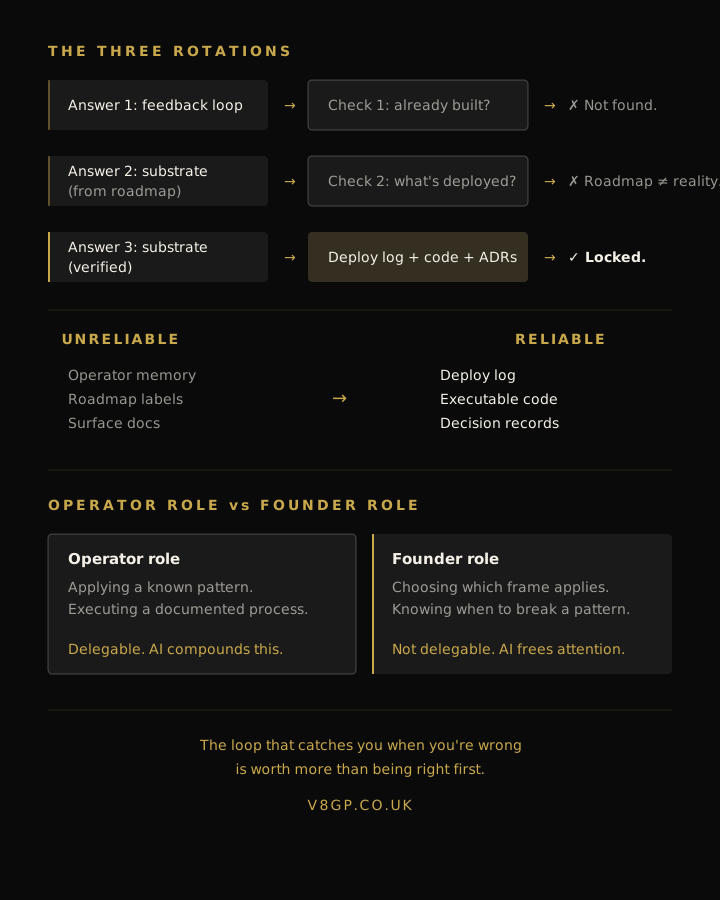
First answer: feedback loop. Confident. Wrong. The corrective: “Check 1 — is a self-improving feedback loop already implemented anywhere in the build?”
Deep repo check. It wasn’t. First rotation.
Second answer: stable read substrate, consistent with the roadmap label. Also wrong — the roadmap label described intent, not current state. The corrective: “Check 2 — better not rely on my memory, check what’s actually deployed.”
Deploy log check. Actual code check. Architectural decision records cross-referenced. Not just summary documents — the executable layer.
Third answer: stable read substrate, but the reasoning was now grounded in what exists, not what was planned. That answer locked.
Why the methodology rotated anyway
Prior-art-first is the correct methodology. Check what exists before proposing what should exist. We apply it consistently.
But the methodology rotated because the inputs were stale, not because the methodology was wrong.
Three sources that failed here, in order:
Operator memory. First rotation trusted my recollection of what had been built. Memory is not a reliable source for load-bearing architectural questions. It degrades, it conflates roadmap with reality, and it has no version control.
Roadmap labels. Second rotation trusted a label that described intent. Roadmaps describe direction, not current state. A module marked “planned” or “in progress” is not the same as a module that is deployed and executable.
Surface documentation. Partial repo check — summaries and design documents — still produced a wrong answer. Summary documents describe what was intended to be built. Deploy logs and executable code describe what was actually built.
The reliable source: deploy log + executable code + architectural decision records, cross-referenced. Not any one of these alone.
When the question is load-bearing, start there. Not with memory, not with the roadmap, not with the README.
The separation that matters
Mid-session, the observation came up: “You can literally replace me with patterns and AI at this point.”
The pushback was firm, and it matters enough to state clearly.
Patterns and AI absorb operator-role execution. They do not replace founder-role judgement.
The test for which role you’re operating in:
Operator role: Applying a known pattern within a settled frame. Executing a documented process. This is delegable. This is where AI compounds throughput.
Founder role: Choosing which frame applies. Knowing when to break a pattern. The load-bearing strategic calls — partnership terms, IP protection decisions, when Scaffold separability should bend, whether a registry substrate is a Phase 6 concern or a now concern. Not delegable.
Today’s three rotations were eventually resolved as a pattern question — once the repo was checked properly, the answer was clear and mechanical. But knowing it was a pattern question, rather than a strategy question, required judgement. That judgement is the founder role. It cannot be documented in advance because you don’t know which frame you’re in until you’ve looked.
The replacement framing leads to under-attending founder-role moments because the operator assumes patterns covered them. The separation-of-concerns framing keeps attention on which layer is operating at any moment.
AI frees founder attention from the mechanical layer. The leverage is in what that attention can now reach — not in eliminating the need for it.
What a documentation session actually costs
Three hours on one architectural decision. No code shipped.
The cost shape looks wrong to anyone who measures progress by features deployed. It isn’t.
AD-042 locking unblocks closure verification on a related decision that had been accumulating ambiguity for weeks. It gives future modules a clean readable substrate when they land, saving a refactor cycle. It closes a semantics question that was paying a small cognitive tax on every session that touched the registry.
The work that compounds is rarely the most visible work. Code ships, gets demoed, looks like progress. Architectural decisions documented properly are invisible — until you don’t have them, at which point every future decision pays the cost of that absence.
Documentation isn’t what slow companies do. It’s what companies do when they intend to build fast without rewriting.
The short version
Methodology works when applied to fresh inputs. When it rotates, check the inputs before blaming the methodology.
The reliable source for “what’s built vs what’s planned” is not memory, not the roadmap, not the README. It’s the deploy log, the executable code, and the architectural decision records — cross-referenced.
And the loop that catches you when you’re wrong is worth more than being right first.
Ready to take the next step?
V8 builds AI operating systems for sales and marketing — and runs them. Scaffold is how that gets built around your operations.
See how Scaffold works