The conversation about AI is exhausting.
Every week a new label, every month a new category. Generative AI, then agentic AI, then AI-native, then autonomous agents. The same underlying capability gets renamed, repackaged, and re-pitched. Somewhere in the middle of it, the SME owner who actually has to make a decision is left trying to work out whether anything has actually changed.
Most of the time, very little has.
The same machine, freshly painted
Take “agentic AI”, the term moving through pitch decks for the last twelve months. Three years ago the same architectural pattern was called “AI agents”. Five years ago a less capable version was called “RPA with cognitive features”. Ten years before that, a more primitive form was called “workflow automation with smart triggers”.
The capability has improved across each generation. That improvement is real. But the gap between agentic AI in 2026 and AI agents in 2023 is much narrower than the marketing makes it sound. What changed materially was the underlying model quality, and the model is rarely the thing the vendor is selling.
The thing the vendor is selling is a positioning layer that sits on top of someone else’s model, with a fresh label that makes the previous label look obsolete. The label is the product. The product is the label.
Who profits from the rebrand cycle
Vendors profit. That answer is obvious, and it’s true. The more interesting question is why the rebrand cycle keeps producing returns.
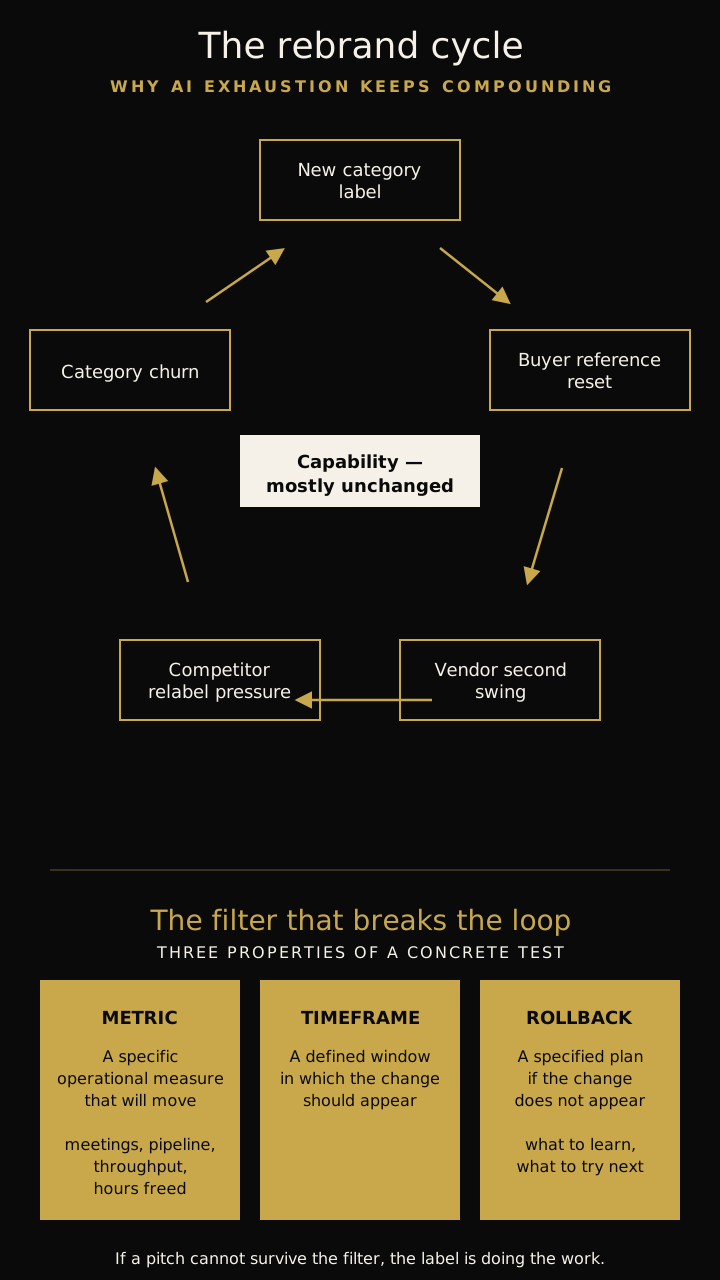
It works because the new label resets the buyer’s reference point. A buyer who said no to AI agents eighteen months ago has not said no to agentic AI yet. The vendor gets a second swing without having to address why the first pitch didn’t land.
It also works because the rebrand keeps competitors looking outdated by default. Anyone still using last year’s term sounds slow. Anyone using this year’s term sounds current. The pressure to relabel cascades through the market regardless of whether the underlying capability changed.
The buyer absorbs the cost of all this. The vendor gets a new pitch. The competitor gets dragged into the same vocabulary. The category churns faster than the technology underneath it.
What this means if you are the buyer
The exhaustion is structural. It is not a sign you are behind. It is a sign the market is doing what markets do when the substance is harder to differentiate than the language.
So the practitioner’s filter has to operate one level down, beneath the label, on the substance.
When the next pitch lands, the question is not what the category does. The question is: what specific commercial outcome will this produce in my business, and what is the concrete test I would apply to know whether it worked?
A concrete test has three properties. It names a measurable change in a specific operational metric, like meetings booked, pipeline value, response rates, throughput on a defined workflow, or hours of operator time freed. It defines the timeframe in which the change should appear. And it specifies what gets done if the change does not appear, meaning what the rollback looks like, what was learned, and what gets tried next.
If a pitch cannot survive that filter, the category label is doing more work than the underlying capability. Whatever it is being called this quarter, it is probably the same thing being called something else next quarter.
The cost of not filtering
The cost is not financial in the obvious sense. The financial cost of a wrong AI purchase is real, but it is rarely the worst cost.
The worst cost is operator attention. Each rebrand cycle absorbs another round of the SME owner’s bandwidth. Evaluating, comparing, attending the webinar, taking the call. The hours spent on the rebrand cycle are hours not spent on the actual commercial work the business needs.
The filter is not just about better purchasing decisions. It is about reclaiming the bandwidth the rebrand cycle takes from you by default.
Where this leaves us
V8 builds AI systems for sales and marketing operations. Custom Scaffold builds, designed around a specific business workflow, then run through Axia with human approval at every commercial decision. We try to position what we do in operational terms, not the category label of the quarter.
That is partly because we want buyers to filter before they buy. It is also because we want to be filterable ourselves. If a pitch from V8 cannot survive the concrete-test filter, the buyer should walk. That includes pitches from us.
The rebrand cycle will keep going. The filter is what makes it survivable.