Every AI sales tool on the market does roughly the same thing.
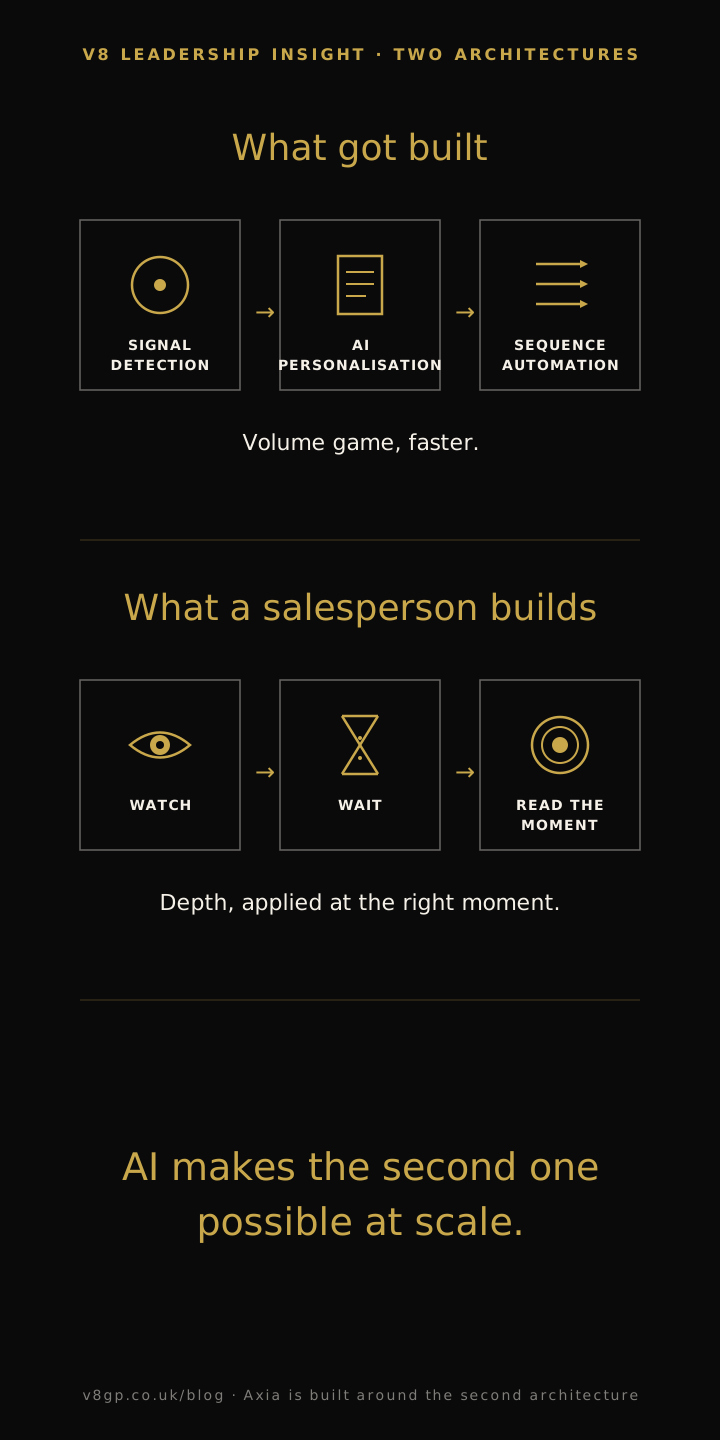
It detects a signal — a job change, a funding round, a hiring spike. It generates a personalised opener referencing that signal. It sequences the follow-up across email, LinkedIn, and sometimes phone. The pitch is identical across vendors: the volume game, but smarter.
It’s worth asking why every tool converged on the same answer.
Sales people rarely build software. Software people rarely sell.
The two professions almost never overlap. A career salesperson learns to read a room, hold context across months, and recognise the difference between a prospect who’s curious and a prospect who’s ready. A career programmer learns to model systems, automate sequences, and optimise throughput. Both are deep crafts. They just don’t tend to live in the same person.
So when AI arrived and someone had to decide what to build for sales teams, the people who built it were programmers. Not because anyone made a wrong call — because that’s who builds software. The salespeople who could have redirected the brief weren’t in the room. They were on calls.
The result is what programmers naturally build when they look at a sales workflow from the outside: a faster, more personalised version of the existing push. The legacy artefact — the cold sequence, the volume game, the assumption that more touches equals more meetings — got preserved. AI just made each touch cheaper to produce.
What a salesperson would have built
A good salesperson doesn’t optimise for reply rate. They optimise for the right conversation at the right moment. That sounds soft until you watch one work.
A good salesperson reads a prospect’s last six months of public output before making contact. They notice when someone is rebuilding their team, and when someone is consolidating after a rebuild. They know that the same person, six weeks apart, can go from completely uninterested to actively buying — and that the difference is rarely something the prospect announces.
Most importantly, a good salesperson knows when not to send anything. The discipline of restraint — waiting for the right moment instead of forcing one — is what separates a trusted advisor from a noise generator. It’s also exactly what no AI SDR tool currently does, because restraint doesn’t show up on the dashboard.
If a salesperson had been in the room when these tools were briefed, the first thing they would have asked is: how does this know when to stay quiet?
Why the answer is changing now
For most of commercial history, the volume game existed because the alternative didn’t scale.
Consultative selling was always more effective. It was also expensive. One good salesperson could only hold deep context across so many accounts. The maths forced a choice: go deep with a few, or go wide with many. Most companies, most of the time, chose wide. Not because they thought it worked better, but because depth didn’t scale.
AI changes that constraint. Not by making the push faster, which is what the current generation of tools does. By making depth itself cheap. An AI system can read a prospect’s public output, hold context across quarters, recognise the inflection points that signal genuine readiness, and decide — actively, on purpose — not to act yet. The thing a good salesperson does instinctively becomes something a system can do at scale.
That’s a different category of product than what’s currently being shipped. It’s not better outreach. It’s the end of outreach as a category, replaced by something closer to a patient, well-briefed advisor watching for the right moment to introduce a useful conversation.
What it actually looks like
Picture an AI that has been watching a prospect’s LinkedIn output, company updates, and public commentary for four months. It has produced exactly zero outreach messages in that time. Then, on a Tuesday morning, it surfaces a single recommendation to its operator: this person just announced they’re rebuilding their commercial stack. Last quarter they wrote three posts about pipeline visibility. We have something specific to say about that. The conversation is ready now.
That’s the alternative. Not a faster push. A patient one.
That’s the next thing to build. It’s also what we’re building.