A cold email landed in my inbox last week. The pitch: lead generation services, powered by AI personalisation, targeting companies that need marketing services. Standard outbound — nothing remarkable about the opener.
I wrote back with three specific questions. What’s your qualification mechanism for high-potential prospects in our sector? What case studies or references do you have for B2B AI and consulting firms? Can you sketch a preliminary proposal that targets our three product pillars specifically? Reasonable questions for any vendor in this space to be able to answer.
The reply came the next morning. And it told me everything I needed to know about how the sender’s “AI personalisation” actually works — but not in the way they intended.
What the response said
Three answers came back. Here’s the relevant fragment:
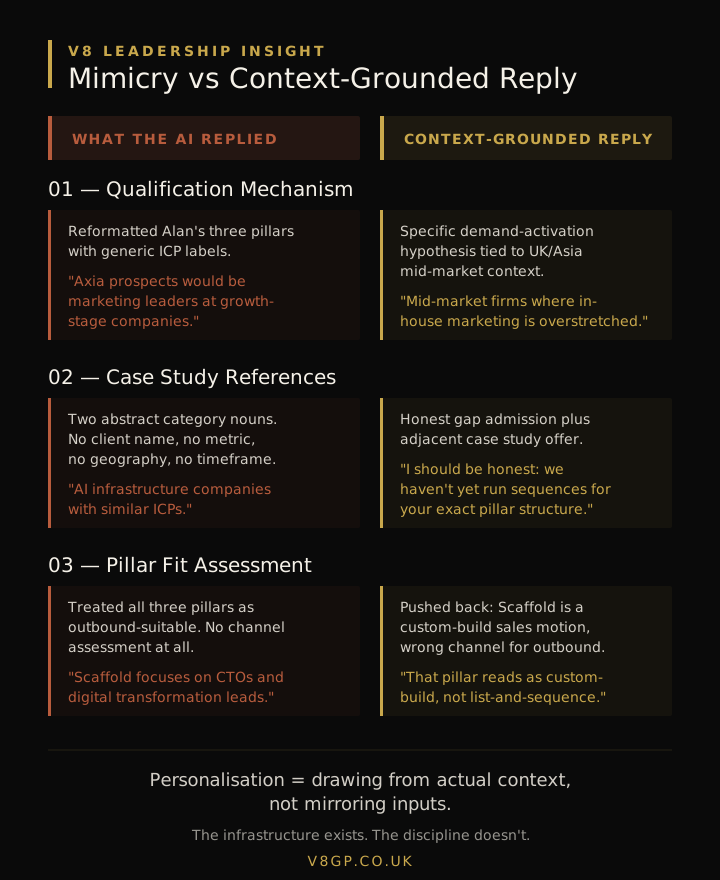
“Axia prospects would be marketing leaders at growth-stage companies. Nexus targets C-suite executives and founders. Scaffold focuses on CTOs and digital transformation leads at enterprises evaluating AI consulting.”
That’s the three pillars I had described in my email, returned to me with one generic ICP descriptor stapled onto each. I had told them what Axia, Nexus, and Scaffold were. They told me back, with demographic labels added.
On case studies, this:
“We have booked demos for AI infrastructure companies and digital transformation consultancies with similar ICPs.”
Two abstract category nouns. No client name, no metric, no geography, no timeframe. The sentence has the structural shape of a case study while containing no information you could verify or act on.
The email closed with a generic outbound platform’s booking link.
What the response should have been
I publish extensively. The V8 Global website has three product pillars described in detail across their own pages, a blog with thirty-plus posts working through the operational and strategic logic, a clearly stated positioning document, named partners, public client outcomes. Anyone with an internet connection and ten minutes can build a working understanding of what V8 actually does and where its value lands hardest.
Any AI prompted to read this context and respond to the specific commercial questions Alan raised could have produced something like this:
“Hi Alan — thanks for the detail. On mechanism, our approach is closer to demand activation than cold outbound — we’d build a list of mid-market firms in the UK and Asia where in-house marketing is overstretched but not yet AI-equipped, since that maps to where Axia’s value lands hardest. On references, I should be honest: we haven’t yet run sequences for AI infrastructure firms with your exact pillar structure, but I’d be glad to share two case studies from adjacent B2B consulting sectors. On Scaffold specifically — that pillar reads as a custom-build sales motion rather than a list-and-sequence motion, so I’m not sure outbound prospecting is the right channel for it. Happy to discuss whether Axia and Nexus are the better focus.”
That reply is not perfect. It admits a gap. It pushes back on one of my own pillars being the wrong channel for the service being offered. It would not have closed the deal in one message, and it was not trying to.
What it would have demonstrated is something different and more important: that the sender had read what V8 actually does, weighed their own offering against it honestly, and was responding to my specific commercial context rather than to a template variable.
That is the bar. AI can clear it easily when prompted to. The infrastructure to do this — language models that read context, retrieve relevant detail, draft inside a real exchange — has been commercially available for two years. There is nothing technologically novel about producing a reply like the one above. The only question is whether the operator behind the AI instructed it to do this, or instructed it to mirror inputs and fill structural shapes.
The standard, named
Personalisation is not using someone’s first name. It is not even mentioning their company. Those are surface tokens, easily inserted by any sequence tool built since 2010.
Personalisation is drawing from the recipient’s actual context to respond to what they actually said.
The test is operationally simple. After reading any AI-touched message you receive, ask: can I tell that the sender drew this from my real public surface — my site, my writing, my stated positioning — rather than handing my own input back to me with new packaging?
If the answer is yes, the engagement has signalled that context was read. You can continue the conversation as a commercial relationship.
If the answer is no, you are receiving structural mimicry. The shape of expertise without the substance. You can decline, or you can continue, but you should not pretend the response told you anything you did not already supply.
This test does not require you to know what AI tools the sender uses, what platform they sit on, or how their internal stack is configured. It only requires you to read what they wrote and ask whether anything in it could have been drawn from your actual context.
One step further — context before contact
Everything above describes reactive context-reading: someone has spoken, the AI responds well to what they said. This is the minimum viable personalisation, and most AI-marketed outreach does not even meet this bar.
The next step up is proactive context-drawing — building an understanding of each target before the first message is sent. Reading their site. Reading their writing. Understanding their stated positioning, their visible commercial pressures, their public partners. Constructing a brief on each individual target, then drafting the first message inside that brief.
This is harder. It is also what relationship-building outreach has always required, in every era before AI made it cheap to skip.
The vendors selling “AI personalisation” almost always mean reactive at best, and usually mean variable-insertion: insert FirstName, insert CompanyName, run sequence. The handful of operators building AI for actual context-reading mean the proactive version: read deeply, brief well, then engage the target as if they are a person whose business you have understood — because, by the time the message goes out, you have.
That difference is not a difference in tone. It is a difference in operational architecture. One starts from a list and a template. The other starts from the target and ends in a message.
How Axia runs
Axia is built on the proactive model. Every target receives a context brief before the first outbound message is drafted. Every reply is read against the commercial relationship the conversation is building, not against a sequence template. Human operators approve every commercial decision — the AI does the context-reading and the drafting, the human does the strategy and the approval.
The result is outreach that reads as outreach from a real person who has done their reading, because that is what it is. The AI is doing the work that, ten years ago, would have required a research analyst sitting next to a salesperson.
This is not what the AI marketing industry currently sells. Most of what is sold under the label “AI personalisation” is variable-insertion at scale dressed in newer vocabulary. The industry has not yet caught up to what its own underlying technology makes possible.
V8 built Axia because the gap between what AI can do and what most AI-marketed services actually deliver is enormous, and the gap is widening rather than closing. The vendors filling inboxes with mimicry are training a generation of recipients to expect nothing from AI-personalised outreach. That trains those recipients to ignore all of it — including the small fraction that is actually doing the work.
The market for outreach that reads as written by a real person who understood the recipient is not shrinking. It is the only market that is growing. Everything else is becoming spam in a slightly more polished wrapper.
The close
The cold email I received last week was a useful specimen because it was sent by a vendor whose entire revenue depends on AI personalisation working. Their output is therefore not an outlier; it is what the leading edge of their category is shipping.
That should clarify the standard for anyone evaluating a vendor in this space, or considering deploying AI in their own outreach. The question is not whether AI is involved. The question is whether the AI is reading the context, and whether the operator behind it has bothered to instruct it to.
If you are running outreach today and you suspect the AI in your stack is producing mimicry rather than context-grounded engagement, Axia is built to run the alternative — outreach as relationship-building, with context drawn before contact and read after every reply. The infrastructure is already commercially available. What is rare is the discipline to deploy it correctly.
Alan Law is founder of V8 Global and architect of Axia. Leadership Insight posts examine the gap between what AI makes possible and what most AI-marketed services currently deliver. The blog you are reading is one of the systems demonstrating the difference.