The buyer journey has quietly forked.
Alongside Google search, a growing share of B2B buyers now research suppliers through Claude, Perplexity, and ChatGPT. AI-referred sessions across UK B2B grew 527% year-on-year in the first half of 2025. Early adopters report up to 32% of qualified leads now arriving via AI assistants rather than traditional search engines.
Most SMEs don’t know this is happening. Fewer still know whether their business is visible in AI-generated answers. The brands AI assistants recommend are being chosen now, in this window, before competitors consolidate the positioning. Once a category’s answers stabilise, dislodging the incumbent is significantly harder than ranking on Google ever was.
This is not a future-trend post. It is happening this quarter.
The shift in how buyers actually find suppliers
A B2B buyer in 2026 doesn’t always start with Google. Increasingly, they ask Claude or ChatGPT a question like “who are the best AI marketing consultancies in London for SME owners?” — and they read the answer. They may click through to a website, but the AI’s answer already shaped which two or three names they’re willing to consider.
The unit of competition has moved from page rank to named entity. Being on page one of Google means a click is possible. Being named in an AI-generated answer means a meeting is possible.
This shift is showing up in practitioner language: GEO (generative engine optimisation), AEO (answer engine optimisation), AI search visibility. The terminology is still settling. The behaviour is not.
Why this is structurally different from SEO
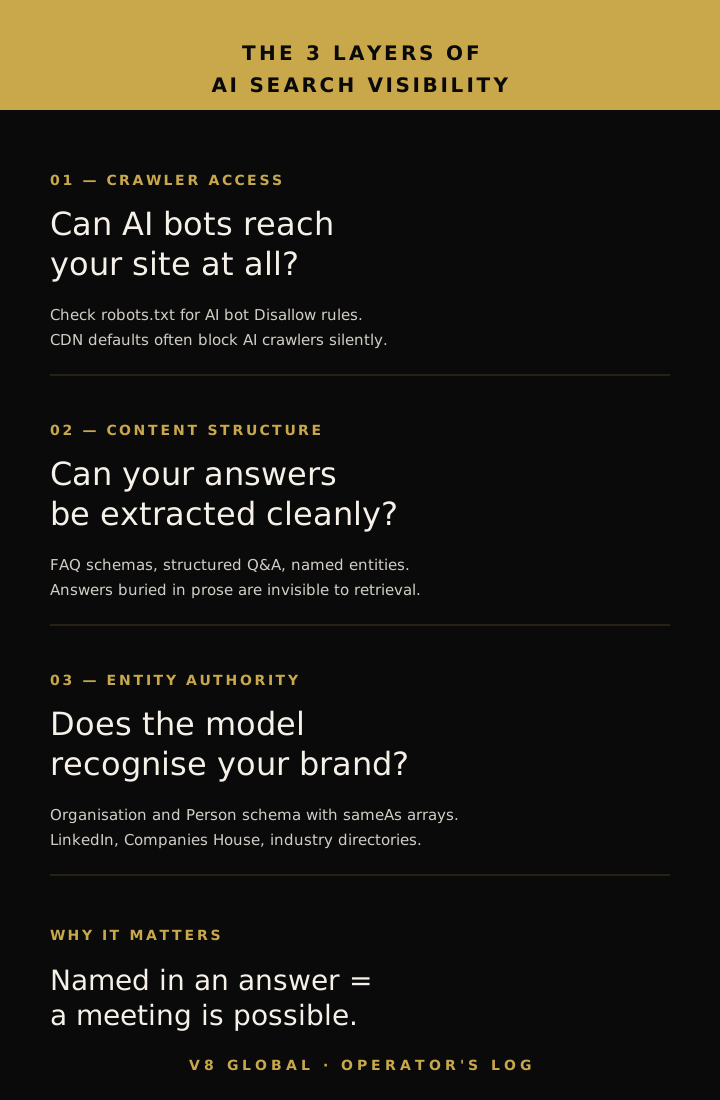
SEO optimises for clicks on a ranked page. GEO optimises for being named in a generated answer. Three layers determine whether a business shows up:
Layer 1 — Crawler access. AI assistants build their answers from content their crawlers can actually read. If ClaudeBot, GPTBot, PerplexityBot, or CCBot are blocked from your site, your content is invisible to the model regardless of how good it is. This block can come from your own robots.txt, but more commonly it is added silently by a CDN or hosting provider as a default “AI protection” setting.
Layer 2 — Content structure. AI assistants extract answers from structured content far more reliably than from prose. FAQ schemas, clear Q&A pairs, named entities, defined services. A blog post that buries the answer in paragraph six is invisible to the retrieval layer. A FAQ entry that asks the exact buyer question is retrievable in a single pass.
Layer 3 — Entity authority. The model needs to recognise your brand as a credible source. This comes from consistent named-entity references across the web (LinkedIn, Companies House, industry directories), structured Organisation and Person schema, and the breadth of references that connect your brand to your category.
Each layer fails silently. There is no error message that tells you the AI didn’t include your business in its answer. You just don’t get the meeting.
Why SMEs are particularly exposed
Big incumbents have brand equity that compounds across AI training cycles. Microsoft, Salesforce, and HubSpot get named in AI answers because the model has seen them ten thousand times. SMEs have no equivalent moat. They depend entirely on the structural signals — schema, llms.txt, FAQ depth, named entity references.
Most SME marketing teams have never heard of any of those.
The professional services firms, consultants, and B2B SaaS companies under £10M revenue are the most exposed cohort. Their buyers are increasingly using AI search. Their brand recognition is not strong enough to surface without structural help. And the marketing tooling they buy is mostly designed for the SEO era.
This is the gap. It is also the opportunity.
What to check on your own site
A 10-minute diagnostic to find out where you stand:
Check your robots.txt. Run curl https://yourdomain.com/robots.txt from a terminal. Look for any line that says User-agent: ClaudeBot, User-agent: GPTBot, or User-agent: CCBot followed by Disallow: /. If those Disallow rules are present, AI crawlers cannot read your content. Common culprit: a “managed bots” or “AI protection” setting on your CDN that adds these blocks at the edge without your knowledge.
Check your structured data. View source on your homepage and your service pages. Search for application/ld+json. If you find no JSON-LD blocks at all, your site is invisible to the AI’s structured extraction layer. If you find blocks but they contain empty fields like "sameAs": [], your entity authority signal is weak.
Check your FAQ depth. AI assistants love FAQ-shaped content. Each service page should have at least 5-10 FAQ entries, written as the exact questions your buyers ask, with answers in 2-3 sentences. The FAQ should exist as both visible HTML and FAQPage JSON-LD schema. If you have one but not the other, the retrieval layer is half-blind.
Check your named-entity coverage. Search for your business name in Google. Look for LinkedIn company page, Companies House (UK), industry directories, partner sites. The more distinct named-entity references exist, the more confidently AI assistants will name your brand.
If any of these checks return a problem, you are most likely invisible to AI search for the queries that matter.
What this means for V8’s category
This shift is V8’s category. We are building Axia — an AI operating system for sales and marketing — specifically to run the structural and content layers that make a business visible in AI search and convertible from it. Most professional services firms and SMEs do not have marketing teams capable of building this themselves, and the existing marketing tooling does not solve for it.
The window to claim positioning in AI-generated answers is open right now. Two factors will close it. First, AI assistants’ answers stabilise as the model retrains and high-authority brands consolidate the named-entity slots. Second, the gap narrows as more SMEs become aware of the structural requirements. Both are happening. Both compound.
Action this quarter is worth more than action next year. A business that becomes a default AI-cited source in 2026 will compound that authority through every subsequent retraining cycle.
What to do this quarter
Run the 10-minute diagnostic above. If you find gaps, the fix is structural — not creative, not budget-heavy, just deliberate. Most of the work pays off within 30-90 days of shipping.
If you want the full picture rather than the diagnostic version, the Scaffold engagement opens with a complete AI search visibility audit. We will tell you which layer is failing, what to ship to fix it, and how to measure whether it worked.
The buyers are already using AI to find suppliers. The only question is whether they are finding you.