On 6 May 2026, Anthropic expanded Claude Managed Agents at its Code with Claude conference. Three new capabilities — Dreaming, Outcomes, and Multiagent Orchestration — alongside memory and webhooks. The framing sounds transformative. The reality is more specific.
For anyone running a production AI system today, the question isn’t whether these capabilities are real. They are. The question is whether the trade-off favours migration, and the answer depends entirely on what you’ve already built.
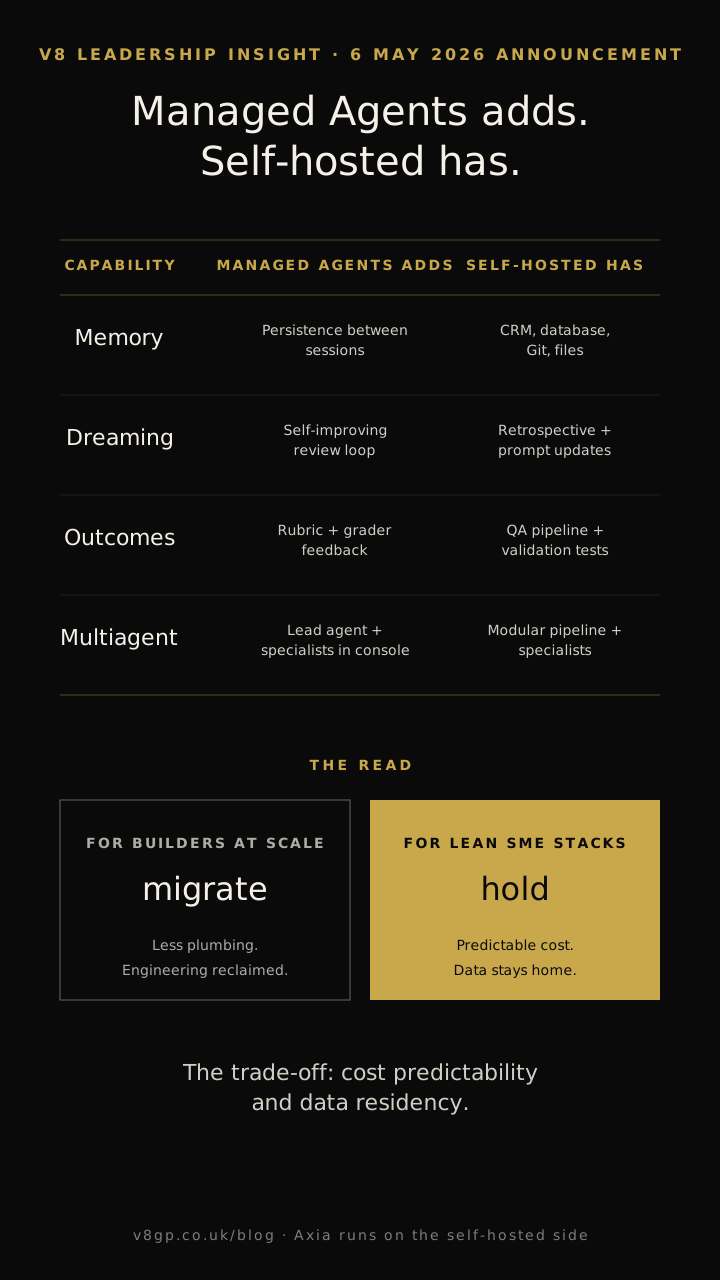
What it is
Managed Agents is SaaS infrastructure for developers building agent products at scale. Think Vercel or Supabase, but purpose-built for agent behaviour. It handles memory persistence, self-improving loops, quality grading, and parallel execution so you don’t have to engineer those yourself.
Translated into plain English:
- Memory — the agent stops forgetting between sessions
- Dreaming — the agent reviews its own past work and improves without explicit retraining
- Outcomes — you write a rubric for what good looks like, a separate grader evaluates the agent’s output, the agent takes another pass if it falls short
- Multiagent Orchestration — a lead agent breaks complex tasks into pieces and delegates to specialists running in parallel
- Webhooks — event-driven triggers, no constant polling
Outcomes and Multiagent Orchestration are now in public beta. Dreaming is in research preview. Anthropic reports a 10-percentage-point improvement on harder tasks when Outcomes is engaged in internal benchmarks. Netflix has deployed Multiagent Orchestration for its platform team. The infrastructure is real and the validation is enterprise-tier.
What it isn’t
It is not an App Store. Not a distribution platform. Not a tool you use directly inside Claude.ai. It is API-level infrastructure. You still have to build the product on top of it.
This matters because the announcement framing is broad enough to suggest a step-change for end users. It isn’t one. End users of agent products won’t notice anything different. Developers building agent products will notice quite a lot.
The irony for serious builders
If you’ve already built a production agent system, you have likely hand-built versions of all four of these capabilities. Not because you wanted to — because you had to.
- Memory maps to whatever persistence layer your system already uses. CRM, internal database, Git repository, file system. Not pretty, but functional.
- Outcomes maps to your QA pipeline, your validation tests, your “did this output meet spec” checks. Most production systems already have this in some form, even if it isn’t called Outcomes.
- Dreaming maps to your evolving precedent library, your retrospective discipline, the way you update prompts and architecture decisions when something didn’t work the first time. This is operator habit, codified.
- Multiagent Orchestration maps to your modular pipeline. Specialists already exist in production systems — they just aren’t called subagents and they don’t run inside a console.
So the question becomes: do you want Anthropic to handle these four concerns as managed infrastructure, or keep them under your own roof?
The real trade-off
Managed Agents removes operational overhead. That’s the genuine value. Less plumbing, less maintenance, less context-engineering you write yourself.
But it adds two things in return.
Cost unpredictability. Managed services are priced by usage. For SME-priced products running on fixed VPS costs, monthly economics are predictable today and become unpredictable on Managed Agents. That’s not necessarily a deal-breaker — but it changes the financial model materially.
Data residency. Client context lives on Anthropic’s infrastructure rather than yours. For some businesses this is fine. For regulated industries, professional services with confidentiality obligations, or any client who has asked specifically about where their data lives, it is a structural shift in the answer to that question.
The math does not obviously favour migration for lean operators. It favours migration for organisations with engineering resources who have not yet built this layer themselves.
The one genuine gap it addresses
There is one engineering problem Managed Agents handles well that most self-hosted systems handle awkwardly: the session open/close problem. Handshakes, context bridging, pulling necessary state from a repo or memory layer, persisting what just happened, closing cleanly so the next session starts where the last one left off.
This is real engineering work and it is genuinely tedious. Managed Agents handles it natively as part of memory and dreaming. If your current stack does this with hand-rolled session management code that breaks every time you change something upstream, that’s where Managed Agents earns its keep.
But the cost — again — is that the session state lives somewhere other than your own infrastructure.
The bottom line
If you are building for scale with engineering resources, Managed Agents is valuable infrastructure. The hand-built layer most production systems have evolved into is replaceable, and the trade-off in cost and residency may make sense for your stage and audience.
If you are a lean operator with a working self-hosted stack serving cost-sensitive or privacy-sensitive clients, the case for migration is not there yet. What you have already built is doing the same job, and the trade-off does not favour rebuilding it inside someone else’s runtime.
The signal worth watching is not the current feature set. It is the marketplace layer — when Anthropic adds distribution on top of Managed Agents, the conversation about who builds where and who consumes from where shifts materially. That is a different question from the one this announcement asks.
For now, the read is straightforward: useful infrastructure for a specific stage of builder, no urgent action for the rest. Build on what you have. Watch what comes next.
Axia is V8 Global’s managed AI operating system, built on a self-hosted stack designed for SME deployments where cost predictability and data residency both matter. See how Axia is built.