A founder I spoke with last quarter had spent six months building pipeline through his own outreach. Then he closed his biggest deal, took a fortnight to deliver against it, and came back to a pipeline that had quietly cooled. The contacts he had been nurturing went elsewhere. The follow-ups he had drafted in his head never went out. The relationships he had been compounding stopped compounding.
He told me, “I lost two months of work because I had two weeks of execution.”
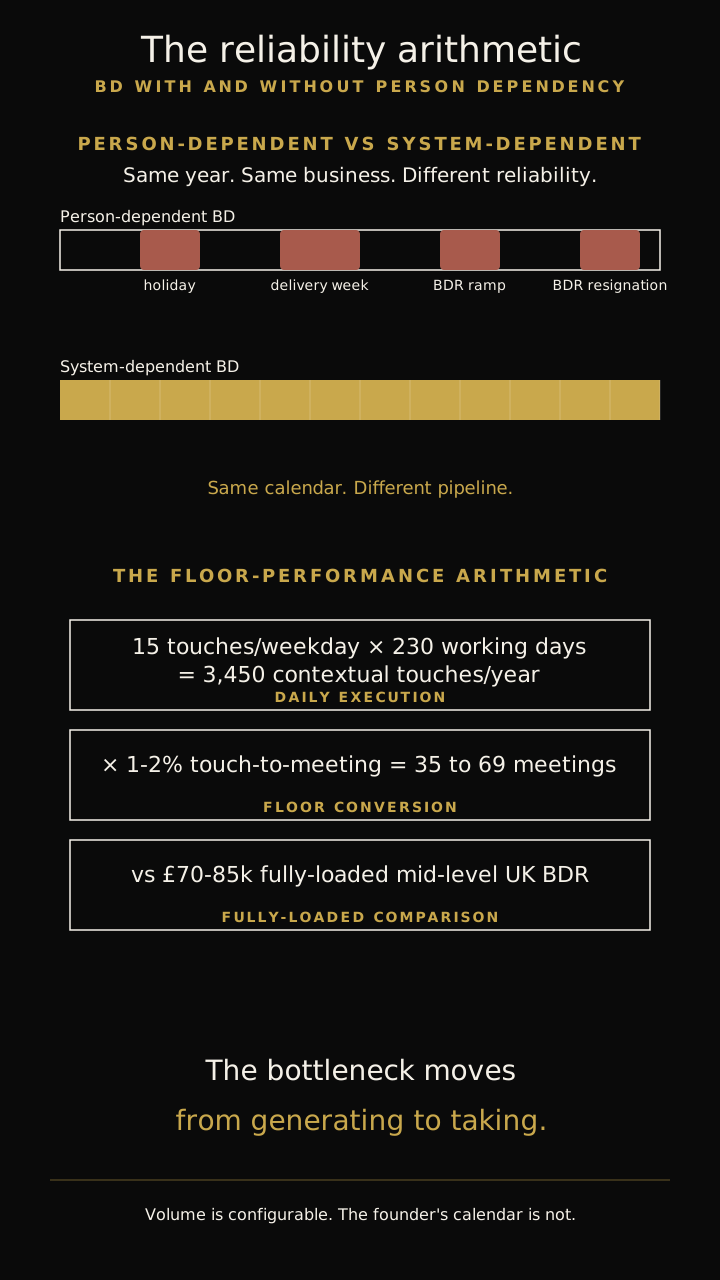
This is the BD problem for most SMEs. It is not that you cannot do business development. It is that business development is the thing that gets cut first when anything else goes wrong. The pipeline gap from a holiday, a busy delivery week, or a resignation is structurally identical: the person stopped, so the pipeline stopped.
Why volume outreach did not fix it
The first answer the market gave to this problem was volume. Mass connection requests, automated sequences, templated DMs scaled across hundreds of contacts a week. The promise was that if you generated enough touches, the inconsistency stopped mattering. Some percentage would always land.
What actually happened was that the channel degraded. Prospects learned to filter automated outreach because it felt automated. Replies dropped. Open rates declined. The companies that had once seen reasonable returns from sequence-based outbound now watch the same campaigns return single-digit reply rates and meeting rates well below one percent.
The problem moved from “not enough touches” to “touches that do not land.” Adding more volume to a channel that already does not land does not fix the underlying problem. It accelerates the degradation.
What reliability actually looks like
Reliable BD is not louder. It is consistent and contextual.
Consistent means it happens every weekday, regardless of what else is on. Ten to twenty meaningful touches a day, with the previous day’s follow-ups completed before the new day’s outreach begins. No skipped weeks. No backlog. No “I will catch up next month.”
Contextual means each touch is grounded in something specific to the prospect: what their company is doing right now, what they themselves have been writing or talking about, what is shifting in their market. The opening is not a pitch. It is a question, a comment, or an observation that demonstrates the writer has paid attention. The meeting happens because the prospect asked for it, not because they were chased.
These two properties are doing more work together than either does alone. Consistency without context is volume outreach with the same channel degradation. Context without consistency is the founder doing their best work in the weeks they have time, and losing the pipeline in the weeks they do not.
What consistent daily execution changes
Run the numbers at floor performance.
Industry-standard cold outreach converts touch to meeting at modest single-digit rates. Most credible benchmarks land between one and two percent, depending on channel mix and message quality. That is the floor, not the ceiling, but the floor is where the comparison becomes interesting.
At one percent touch-to-meeting, fifteen consistent touches per weekday across a year is roughly thirty-eight meetings booked. At two percent it is seventy-five. Neither figure assumes anything heroic about message quality. The arithmetic is in the consistency itself.
Now put that against the fully-loaded cost of a mid-level BDR hire in the UK: base salary around £35-40k, on-target earnings of £55-65k at full quota attainment, plus employer NI, benefits, tools, ramp time, attrition risk, and management overhead. The defensible fully-loaded annual figure lands between £70k and £85k, with Live Digital’s 2025-26 benchmark and PayScale UK data supporting that range. Add the structural reality that a sizeable share of BDRs do not hit full quota in their first year, and the comparison gets sharper.
A system that delivers fifteen consistent contextual touches per day, with no skipped weeks and no ramp period, beats a hired BDR on the downside case before the upside case has even been considered. The reliability frame is not a marketing claim. It is the arithmetic at floor performance.
The ceiling shifts to your calendar
When BD is consistent and contextual, the bottleneck stops being whether enough conversations get started. It becomes how many of those conversations the founder can actually take.
This is the right problem to have. Volume is configurable. Channel mix is expandable. The constraint becomes the founder’s own time, which is where a founder’s time should be spent: in the conversations that decide whether the business closes the next deal, not in the upstream work of finding the conversation in the first place.
The shift from “can we generate enough” to “can we handle what we generate” is not a soft outcome. It changes the founder’s daily calculation about where to put their attention.
Close on what reliability buys you
Your pipeline should not depend on whether someone had a good week. It should not depend on whether you, the founder, had two weeks of execution time. It should not depend on whether your BDR hire stays past their first quota cycle.
What reliable BD buys you is the ability to be busy without the pipeline cooling. The ability to take a holiday without coming back to two months of lost work. The ability to scale delivery without watching the upstream conversations stop. None of that is about the technology delivering the outreach. It is about the system being there, every day, regardless of what else is happening in the business.
That is the reframe worth carrying out of this piece. Not “what can AI do for my BD.” Rather: what would your business look like if BD just kept happening, week after week, whether or not you were thinking about it?
If that question lands, the next conversation is about how. We can talk.