There’s a tax most people pay every morning before AI is useful to them.
You open the tool. You paste in the context. You re-explain who the contact is, what the deal is, what stage you’re at, what tone you want, what you said last time. Then — finally — you ask the question.
By the time the tool replies, you’ve already spent the first chunk of your morning loading state into a system that won’t remember any of it tomorrow.
That’s the briefing tax. And every team running AI through generic productivity tools is paying it whether they’ve named it or not.
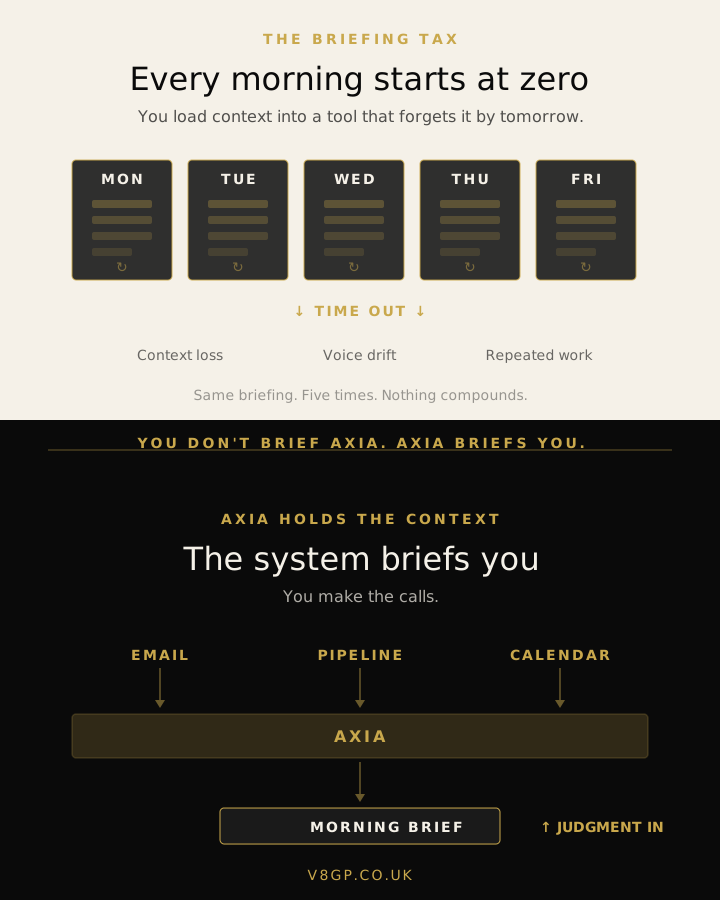
What the briefing tax actually costs
It’s not just the time. The time is the visible cost. The hidden costs are worse.
Context loss. Each session starts from zero. The tool doesn’t know what the previous email thread said. It doesn’t know which contacts are warm and which have gone quiet. It doesn’t know your pipeline state. So every output is built on whatever fragment you remembered to paste in.
Voice drift. When the same person re-briefs the same tool fifteen times across a week, each briefing is slightly different. The tool’s outputs drift accordingly. By Friday, your “voice” sounds like five different people.
Repeated work. The same context gets typed, pasted, summarised, and re-summarised across tools, sessions, and team members. Nothing accumulates. Nothing compounds.
The wrong question gets asked. When briefing is expensive, operators stop asking the small useful questions and start saving the tool for the big ones. The system gets used at a fraction of its actual capability — not because the capability isn’t there, but because the cost of getting to it is too high.
The category is starting to name this
The broader AI industry has begun acknowledging the problem. The productivity AI category — the tools that sit alongside email, documents, and chat — is building infrastructure to carry context between sessions. Memory layers. Persistent profiles. Connectors into CRMs and inboxes so the tool can pre-load before the human has to.
The direction is right. The framing is right. The category has correctly diagnosed that re-briefing is where most AI value leaks out.
What the category is solving for is a real problem. The question is whether bolting context onto a generic tool is the same thing as building a system where context is the architecture.
Why Axia is structurally different
Axia doesn’t need briefing because Axia accumulated context as a side effect of operating.
Every email Axia classifies adds to what it knows. Every pipeline change Axia detects adds to what it knows. Every contact, every thread, every meeting, every commercial signal — Axia has been holding all of it in operational memory because that’s what it takes to run sales and marketing in the first place.
The architecture is the answer. You don’t have to load context into Axia each morning because Axia never lost it.
This is the difference between a tool you brief and a system that operates. A tool you brief is a function — input goes in, output comes out, state evaporates. A system that operates is a continuous process — state persists, context compounds, every decision is informed by everything that came before.
A real example
The day before V8 Nexus launched, I uploaded the event payment and attendance list — 32 contacts — to Axia and asked it to update the CRM.
Axia did not create 32 new records.
Because Axia already held the pipeline state for every contact in our system, it cross-referenced the list automatically. For each contact that already existed in the pipeline, Axia surfaced the match, showed me the current pipeline status, and asked me to confirm: update the existing record, or create a new one. For contacts with no match, it queued them for creation.
I replied contact by contact. Update. Update. New. Update. Correction — wrong stage, change it. New. Update.
Axia applied each decision: appending the event attendance to existing task comments, updating last-contact dates, creating fresh records only where no match existed. It did not touch pipeline stage or any field I had not explicitly instructed.
That whole sequence took about twenty minutes, mostly me reading and confirming.
Without Axia, that same job is opening the CRM, searching each of 32 contacts by name, cross-referencing the payment list, deciding what to update, and making the edits manually. An afternoon, easily. And every one of those 32 lookups is a small briefing tax — re-loading context I already had in my head, into a system that didn’t.
The work that disappeared was the context retrieval. The work I kept was the judgment. That’s exactly the right division.
The inversion
The promise of the productivity AI category is: brief the tool well enough, and it will help you.
The promise of an operating system is the inverse: the system already holds the context. You make the calls.
You don’t brief Axia. Axia briefs you.
That sentence sounds like marketing copy. It isn’t. It’s the architectural fact. Every morning, Axia presents what changed overnight, what needs attention, what’s drifting, what’s ready to move. The operator reviews and decides. The system holds the context so the human can hold the judgment.
That’s the inversion. And it’s the reason the briefing tax doesn’t show up in V8’s operations — not because we worked hard to eliminate it, but because we built a system where it never accrued in the first place.