The standard pitch for AI-and-content goes like this: AI helps you create more content. Faster. Cheaper. More output.
It’s a productivity claim. It’s also generic. Anyone with a ChatGPT subscription can make it. Which is why every consultancy positioning around AI sounds the same right now — and why none of it is moving real buyers.
The actual selling point is structural, not productive. It’s not that AI produces more content. It’s that AI-disciplined operations can produce content consistently — and consistency is the thing the algorithms reward, the thing humans can’t fake under operational load, and the thing most SME founders cannot sustain while also running their business.
That gap is the asset. Not the content itself.
What consistency actually does
Search engines don’t reward cleverness. They reward predictability. Sites that publish on a regular cadence, update their content, maintain a coherent thematic identity, and connect new content to existing structure — those sites compound in search rankings. Sites that publish in bursts, then disappear for two months, do not.
Social platforms work the same way. The algorithm doesn’t reward a single brilliant post. It rewards a creator who shows up regularly enough that the platform learns who their audience is, who their adjacent audiences are, and how to route their content. Inconsistent posting starves the algorithm of the data it needs to surface the work.
Newsletter platforms reward consistency in cadence. SEO rewards consistency in output. AI assistants reward consistency in schema and structured data. Every meaningful distribution surface in 2026 is, structurally, a consistency engine.
The publishing tactic everyone obsesses over — the perfect headline, the viral hook, the algorithm trick of the month — is downstream of the structural input the algorithms are actually optimising for, which is showing up reliably.
Why solo operators can’t do this
Here is the honest version of how content operations break for SME founders.
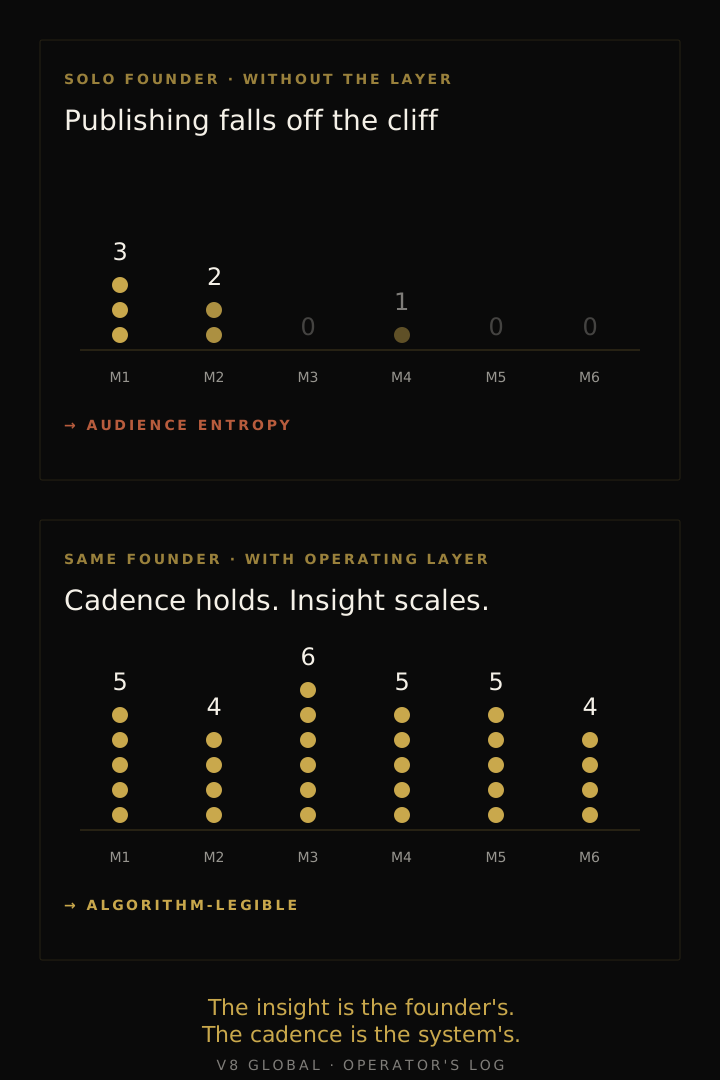
You start out enthusiastic. The first month you publish three posts. The second month you publish two. The third month a client engagement runs late, and you publish nothing. By month four you are catching up to last quarter’s posting commitment while also dealing with a billing issue. By month six you have stopped publishing entirely, and the audience you built in month one has stopped looking for you.
This is not a failure of discipline. It is a failure of load. A founder running an SME has commercial obligations that override content production every single time those obligations conflict. Which is most weeks.
The standard advice is “block out time for content.” It does not work, because the moment a real commercial pressure shows up, the content time is the first thing sacrificed. And it should be — the alternative is letting the actual business suffer in service of a marketing rhythm.
So the structural problem is not “founders are lazy about content.” It is “founders cannot reliably produce content while running a real business.” Anyone telling you otherwise is selling you a productivity tool that will sit unused by month three.
What changes when production becomes a system
When the content layer is operated by a disciplined system rather than the founder personally, the load problem disappears. The founder still holds the insight — that’s not delegable — but the production work happens reliably regardless of which client meeting ran long or which deal needed extra attention.
This is what V8 has built for itself. The blog you are reading right now publishes at a cadence I could not personally sustain while also running V8 Global, doing client work, building Axia, managing Gina’s V8 Nexus launch, and dealing with the incoming things every week. In the past week, V8 has shipped nearly a dozen new posts to this site — including this one. That is not a productivity claim. It is a structural claim — there is an operating layer running that produces this cadence to a documented standard, and I am not the person doing the production work.
The insight in every post is mine. The arguments came from me. The decisions about what to ship and what to cut came from me. But the construction work — the markdown, the infographic SVGs, the schema-valid FAQ entries, the OG cards, the build verification, the commit hygiene — that’s done by the system V8 built. Which is the whole point.
Why “AI wrote it” is the correct branding
The reflex when a founder uses AI to assist content is to hide it. To imply they wrote everything personally. To stage a productivity claim that does not match what is actually happening.
This is a mistake. It is also a missed positioning opportunity.
When V8 says “this content is AI-produced under operator direction,” it is making a stronger claim than the alternatives:
- It signals that V8 has solved a problem most SME founders have not solved — the production load problem.
- It demonstrates that AI-discipline can produce output that holds to a brand standard, with verification rigor, at SEO-relevant cadence.
- It removes the buyer’s anxiety about needing to learn AI personally — which is the most common reason SME founders disengage from AI-and-content pitches.
- It positions the founder correctly: as the insight-holder, not the content operator.
Most importantly, it is honest. The arguments in this post are mine, the construction is the system’s, the methodology is documented in the repo. That is what AI-assisted operation actually is. Pretending otherwise undersells the work in both directions.
The selling point underneath
Here is what V8 is actually demonstrating with this site, this cadence, and this transparency about how the work gets done:
If you are an SME owner, your insight is not the bottleneck. You already have years of commercial relationships, domain intuition, operational knowledge that lives in your head and your client history. What you do not have is the operational bandwidth to translate that insight into market presence at the cadence the algorithms reward.
That bandwidth is what V8 builds. Scaffold designs it. Axia runs it. The combined output is an operating layer where the insight you already have gets reliably converted into market-visible content, schema-valid structure, and audience growth at the rhythm consistency requires.
You stop being the content operator. You become the operator’s source of insight. The system handles the rest.
Which is exactly what most SME founders need, but almost nobody is offering, because most consultancies are still selling productivity tools instead of production systems.
The boring version of the argument
Stripped of positioning:
- Algorithms reward consistency
- Consistency is hard to sustain while running a business
- AI-disciplined operations close that gap
- V8 built it for itself first; the site is the proof
- The buyer’s job is the insight; V8’s job is the production
It is not a complicated claim. It is just a different claim from the one most consultancies are making, which is why most consultancies are still pitching to founders who have heard the productivity story too many times to find it credible.
The consistency story is more credible because it is verifiable. You are reading the demo right now.
Alan Law is founder of V8 Global and architect of Axia. Operator’s Log posts document how AI-native systems get built — and operated — in practice. The cadence and consistency of this site is the demonstration. For the build conversation, start with Scaffold.