I build AI systems for a living. Axia, my autonomous sales and marketing operating system, runs 24/7 on a live server. It processes emails, updates CRM records, drafts outreach, and powers a Discord interface for my team.
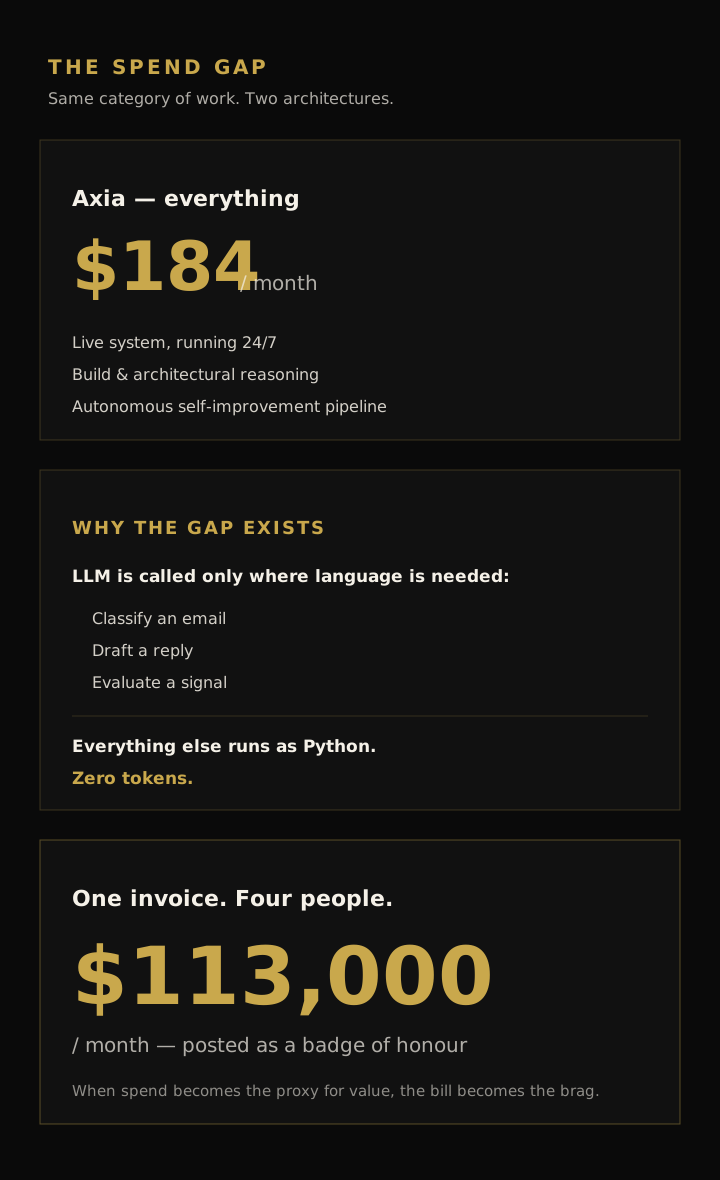
My total AI spend across everything: $184 a month.
And I mean everything. That covers the live system, the build environment, the architectural reasoning sessions, and the autonomous build pipeline that writes, tests, and deploys Axia’s own code updates, self-improvement loop included. Three line items. Nothing hidden.
So when a four-person startup posted its $113,000 monthly AI invoice as a badge of honour, and the news broke that a major enterprise had burned through its entire 2026 AI budget in four months, my first reaction wasn’t concern. It was genuine confusion.
How?
What’s actually happening
Take the Microsoft story first, because it’s the most misread. Microsoft is cancelling internal Claude Code licences across its Experiences and Devices division by the end of June, moving thousands of engineers onto GitHub Copilot. The bubble crowd read that as “even Microsoft is pulling back on AI.”
It isn’t. The reporting points to two ordinary causes: Claude Code’s token-based billing ran the division’s AI budget down faster than anyone modelled, and the cut-off lands on the last day of Microsoft’s fiscal year, which is exactly when you trim operating costs. A company moving engineers onto its own tool to control a runaway meter is not a failure of AI. It’s a procurement decision.
The enterprise budget-burn story is more instructive. Thousands of engineers, broad access to agentic coding tools, no per-team spend caps, adoption spreading faster than finance could model. The burn isn’t one expensive task. It’s thousands of engineers each being moderately inefficient, multiplied daily, with no feedback that any of it costs money.
Agentic coding tools accumulate context. Every file read, every test run, every edit appends to the conversation, and that whole conversation gets sent back to the API on the next call. A single non-trivial session can run past 100,000 tokens before anyone notices. Multiply that across thousands of engineers and a full working day and the maths stops being surprising.
The $113,000 startup is a different thing again. That’s a narrative spend. The four-person team builds AI agents for sales and marketing, and the implicit signal to investors is we’re so automated we barely need people. The founder reports seven-figure recurring revenue and frames the bill as deliberate scaling, not waste. He may be right. But I’d argue the compute number is doing double duty as the pitch, and when spend becomes the headline, it’s worth asking what it’s standing in for.
Why I can’t spend that much even if I tried
Axia only calls the API when a task genuinely requires language intelligence:
- Classify an inbound email: one call, bounded context
- Draft a reply: one call, bounded context
- Evaluate a signal: one call, bounded context
Everything else, the scheduling logic, pipeline advancement, CRM sync, state management, runs as Python. Zero tokens. The mechanical work stays mechanical.
The self-improvement layer works the same way. Axia’s autonomous build pipeline, the system that writes, tests, and deploys its own code updates, runs on a flat-rate subscription, not metered API calls. Architectural decisions happen in bounded sessions with a defined scope. The build agent executes inside a gated pipeline that requires human sign-off before anything touches production. No open-ended agentic loops. No speculative reasoning burning tokens in the background.
Every LLM call in the system has a defined job. The discipline isn’t accidental. It’s the architecture. Design before build. Decide what needs intelligence and what needs code. Never let the model interpret what should be a state machine.
The real problem behind the headlines
The companies burning through AI budgets aren’t underfunded or unsophisticated. They have architects. The problem is the architects are outvoted.
One person saying “we should design this properly before we ship it” against twenty product managers with sprint commitments and a board call on Friday loses every time. Technical debt accumulates because the incentive structure punishes the behaviour that prevents it.
The tokenmaxxing culture is that same problem made visible. When you can’t easily measure the productivity gain from AI, spend becomes the proxy. Dollars of compute instead of revenue per dollar of compute. The metric detaches from the value it was supposed to represent, and eventually the bill becomes the brag.
What this means
The tension in the market is real: large AI costs against uncertain productivity returns. But the popular conclusion, that this is a bubble deflating, is the wrong read. It’s a discipline gap made expensive.
The companies that win won’t be the ones spending the most. They’ll be the ones that ask, before every API call: does this actually need to be an LLM call?
That question costs nothing. The habit of not asking it, apparently, costs $113,000 a month.
And if you’re running a disciplined system on a flat-rate subscription, the metered-overage crowd is effectively subsidising the infrastructure everyone shares. A thank-you note might be in order. Just don’t send it with an outreach agent that can’t yet close a conversation on its own.
Ready to take the next step?
V8 builds AI operating systems for sales and marketing — and runs them. Scaffold is how that gets built around your operations.
See how Scaffold works