We shipped eight new blog posts to v8gp.co.uk today. Eight posts, eight infographics, eight social card images, fourteen new FAQ entries, two infrastructure scripts, one layout patch, complete schema updates, all live on the site by evening.
That’s the headline. It’s also the least interesting part of what happened.
The interesting part is what didn’t happen. Quality didn’t drift across the eight posts. The infographics didn’t degrade by post number five. The FAQ entries on the Axia page didn’t drift out of sync between the visible accordion and the JSON-LD schema. The brand voice held. The sources got verified. The build went green on every commit.
And the reason for that has nothing to do with how fast AI can write.
The shipping contract is the system
Earlier today I published a post on output drift — how quality fails in AI-assisted operations not through dramatic shortcuts but through invisible erosion, where each round refines the previous output instead of the original brief. The post argued that drift is a system design problem, not a discipline problem.
A few hours later, I published a post on the multi-agent AI debate — arguing that the role labels are the marketing layer and the reasoning constraints are the actual architecture.
Both posts shipped through the same mechanism. And the mechanism is the point.
V8’s website ships content under what I call the full content patch contract. Every blog post is one commit containing six things together: polished markdown, a mobile-first infographic SVG, an OG social card, a FAQ entry on the routed product page (updating both the visible accordion and the FAQPage JSON-LD schema in sync), a CHANGELOG entry, and copy-paste-ready commit commands. No partial drops. No standalone content. No “we’ll come back and add the social card later.”
It is one of the more boring sentences in the operating manual. It is also why eight posts didn’t degrade into six good ones plus two rushed ones.
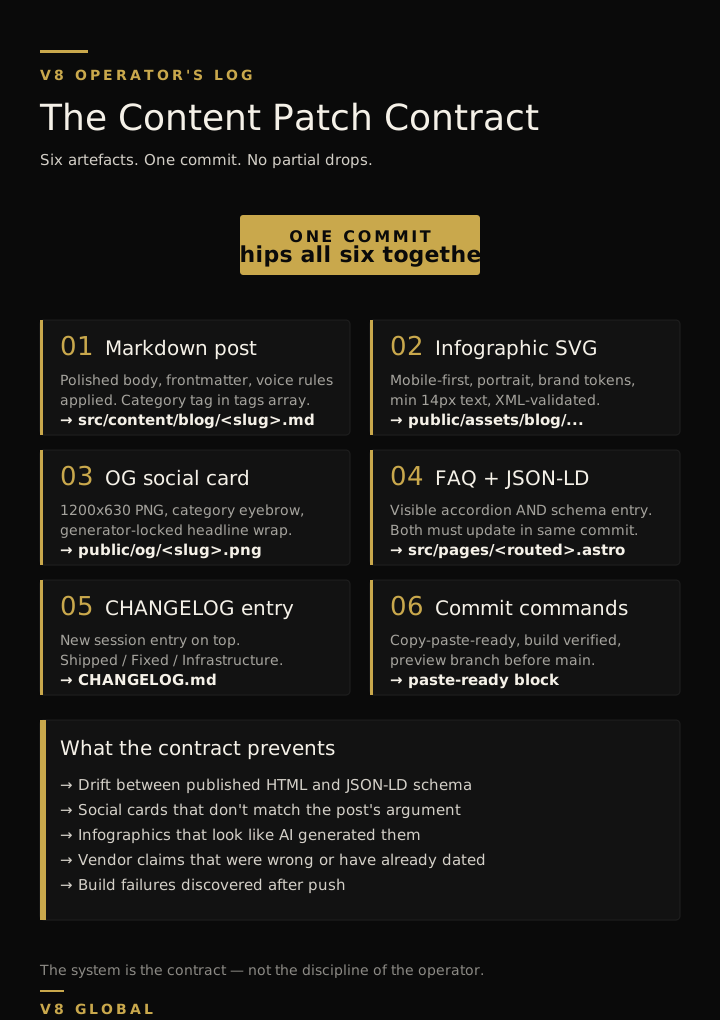
What the contract actually prevents
Most AI-assisted content operations break in predictable places. The contract is designed against each of those failure modes.
Drift between published HTML and structured data. A blog post mentions a fact; the FAQ accordion on the product page repeats it; the JSON-LD schema that search engines and AI assistants index either says something different or says nothing. The contract requires both surfaces to update in the same commit. Drift becomes structurally impossible because it would have to happen inside one batch.
Social cards that don’t match the post’s argument. Most AI-assisted blog operations either skip the social card entirely or use a generic site-wide image. The contract requires a per-post OG card with the correct category eyebrow, generated through a script that fails the build if the headline overflows the design template. The card is the post; the post is the card. They cannot drift apart.
Infographics that look like AI generated them. The discipline is mobile-first, portrait-oriented, brand-token-only, fonts locked to Cormorant Garamond and Montserrat, minimum 14 pixels at native viewport, validated XML before shipping. The constraint is what makes them recognisably V8 instead of recognisably algorithmic. Reusable across LinkedIn carousels and derivative posts without redrawing — but only because the design system was specified, not improvised.
Vendor claims that date themselves or were wrong from the start. Today’s post on competitive moats made a specific claim about Figma’s stock dropping 7% on Claude Design’s launch day. That claim got verified against three primary sources before shipping — not because the post was suspicious, but because the contract requires verification on any specific stat, market reaction, or competitor reference. The Anthropic Claude Code subagent claim in another post got corrected from “six internal agents” (wrong) to “multi-subagent architecture” (verified) for the same reason. Most AI-assisted blogging gets this wrong because the contract doesn’t ask.
Build failures discovered after push. Before staging, the contract requires a local Astro build. Schema validation, broken HTML inside the FAQ insert, layout patch errors, missing asset references — all caught locally, before the preview branch, before the merge. The Cloudflare preview is a verification step, not a discovery step.
Why the volume is downstream
Anyone with a half-decent prompt setup can produce eight blog posts in a day. The text is the cheapest part of the operation now.
What’s expensive is everything around the text. Infographic design that survives mobile rendering. Schema markup that doesn’t drift. Social cards that pass brand inspection. FAQ entries that connect blog content to product positioning. Verification on the load-bearing claims. Build verification before push. Commit hygiene. Preview-branch deployment.
Without the contract, eight posts becomes eight markdown files with placeholder imagery, broken JSON-LD, mismatched FAQ entries, and at least one fact that turns out to be from someone’s hallucinated training data. Six of them are probably fine. Two of them undermine the credibility of the other six.
The contract is the gate that prevents the second outcome. The volume is what’s possible once the gate holds.
The pattern that scales
Here’s the part that translates beyond blog publishing.
The reason this approach scales is that the contract is named and enforced — not aspirational. There is a CLAUDE.md file at the root of the repository that documents the contract in eleven sections. Any AI-assisted session that opens the project reads it on entry. The contract isn’t a habit anyone has to remember. It is a document the system loads before the work starts.
When the same approach gets applied to commercial operations — pipeline management, email triage, content generation, client onboarding — the same principle holds. The system is the contract, not the discipline of the operator. Discipline is what humans trade away under deadline pressure. Contracts persist.
That’s what we build at V8. Not text faster. Not images cheaper. Operating layers where the rules are loaded into the system, every cycle, before the work begins. The volume is downstream of the contract.
Eight posts in a day is the easy part. Eight posts in a day where every one of them is schema-valid, brand-consistent, source-verified, mobile-rendered, and structurally connected to the product positioning — that’s the design.
The boring sentence is the system.
Alan Law is founder of V8 Global and architect of Axia. Operator’s Log posts document how AI-native systems get built — and operated — in practice. Today’s eight-post run was a test of the contract; the contract held. For the build side of this approach, start with Scaffold.