I’ve been stress-testing this for weeks. Not as an academic exercise — as a survival question.
If you’re building a business on AI, or building a business that competes with people using AI, you need to know which advantages actually hold. Because most of them don’t. And the window to get on the right side of this is shorter than almost anyone is saying publicly.
Here’s what I found when I ran the logic all the way down.
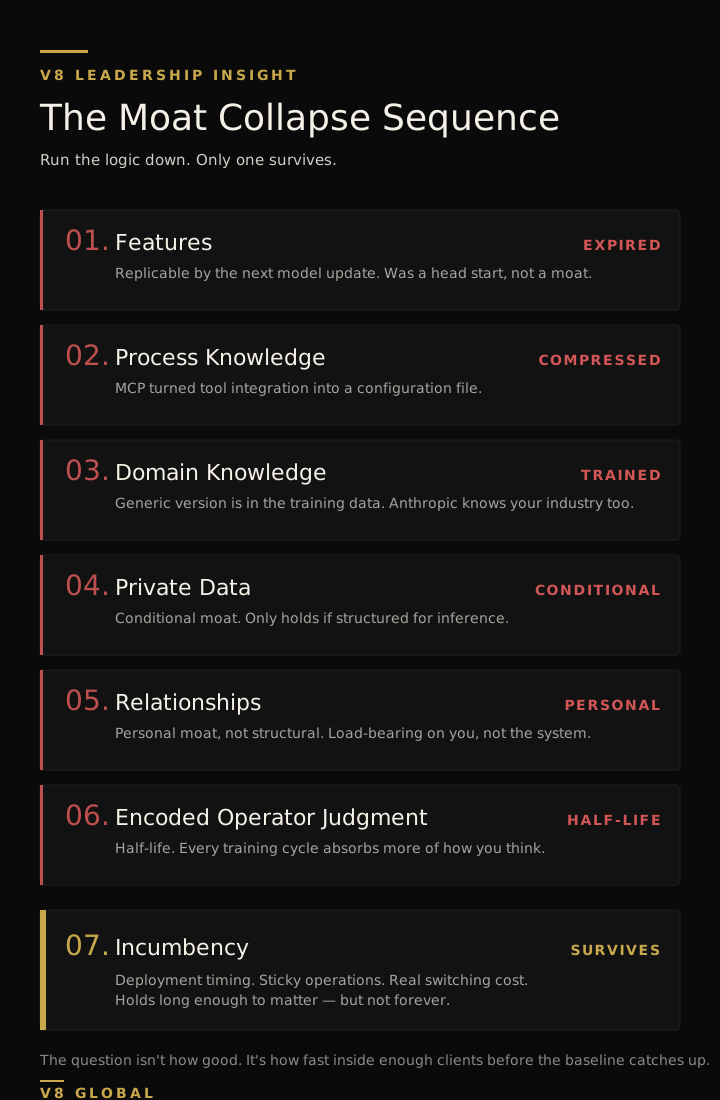
The moat collapse sequence
Every time a new AI capability ships, a category of competitive advantage quietly expires. Most founders and SME owners don’t notice until it’s already done.
Features go first. If your edge is a capability that a model update can replicate, it was never a moat. It was a head start. Jasper had one. Copy.ai had one. They’re still operating, but the market they pioneered is now table stakes in every writing interface.
Process knowledge goes next. Knowing how to connect systems, automate workflows, build integrations — this was a technical skill worth paying for two years ago. MCP — Model Context Protocol — made it a configuration file. The consultants and agencies who built businesses around “we connect your tools” are being asked to justify that value proposition in real time.
Domain knowledge — most people assume this is safe. It isn’t, at least not the version most people mean. Knowing your industry, knowing the terminology, understanding the landscape — Anthropic knows that too. It’s in the training data. Generic domain knowledge is not a moat.
Private data sounds better. And it is, conditionally. Structured, compounding, proprietary data — the kind that only exists because you’ve been running commercial operations for years — that’s different from a folder of old client decks. But it only holds as a moat if it’s organised in a way that produces inference. Most businesses are data-rich and structure-poor.
Relationships. This is where most people land as their final answer. Relationships are human. AI can’t replicate them. Except — relationships are stable until the person holding them isn’t. You move, you get sick, you price yourself out. The relationship was always load-bearing on your physical presence and continuous availability. That’s not a structural moat. It’s a personal one.
Encoded operator judgment — the idea that you train an AI system on your fifteen years of commercial decision-making, and the system carries that judgment at scale. This is the sophisticated version of the moat argument. It’s also real, but it has a half-life. Every time you teach a model how you think, you contribute to the training signal that makes the next model better at thinking that way without you.
I ran this sequence end to end. Every candidate moat collapses.
One thing survives: incumbency.
The only moat that actually holds
Not permanently. But long enough to matter.
If you are deployed inside a client’s operation — running their pipeline, managing their content, sitting inside their commercial workflow — before the generic alternative catches up to your specific capability, the switching cost is real. Trust transfer is slow. Operational dependency is sticky. A client who is running their business on your system has no incentive to rip it out for a marginal improvement from a generic tool.
This is not a technical advantage. It’s a deployment timing advantage.
Which means the question is not “how good is the system.” The question is “how fast can you get it inside enough clients that incumbency does the work.”
What this means practically
In April 2026, Anthropic launched Claude Design. By market close on launch day, Figma’s stock had dropped 7%. Three days earlier, Anthropic’s chief product officer had stepped down from Figma’s board. The launch wasn’t speculative pressure on Figma’s positioning — it was a direct entry into Figma’s category, with handoff to Claude Code completing the loop from idea to shipped product. Anthropic also launched Managed Agents in the same window, handling the long-horizon agent infrastructure that custom AI build firms used to charge for.
The pace is not slowing. Every quarter without deployed clients is a quarter where the window narrows.
This is not a technology problem. It’s a sequencing problem.
The businesses that survive the next eighteen to twenty-four months are the ones that get inside client operations before the baseline catches up. Not because their system is permanently superior — nothing is permanently superior in this environment. But because they moved first, earned the trust, and became operationally necessary before the decision to switch became easy.
The harder version of this
There’s a version of this argument I’ll say plainly, because I think about it more than most people want to.
If incumbency is the last real moat, and incumbency requires capital and speed to deploy, then the businesses that win the deployment race are disproportionately the ones that were already capitalised. Which means the structural outcome of this AI transition — if it plays out the way the logic suggests — is a concentration of operational control in the hands of whoever moved earliest.
For knowledge workers, this is a livelihood question, not a strategy question. The historical analogy is the industrial revolution. The problem is the pace is different. Industrial displacement happened over generations. This is happening within a single career span.
The people who don’t see this coming are not naive. The signals are quiet. Anthropic doesn’t hold press conferences to announce that another category just got compressed. It just ships a changelog, and someone’s product roadmap becomes redundant.
Where this leaves the SME owner
You are sitting on the one asset that doesn’t commoditise: years of commercial relationships, domain intuition, and operational knowledge that lives in your head and your client history.
The problem is that asset is personal, not structural. It doesn’t compound on its own. It doesn’t scale. And if you don’t convert it into an operational system before the baseline AI capability makes generic alternatives good enough, the window to convert it closes.
The businesses that will look back on 2025 and 2026 as the period where they secured their position are the ones that used this window to build the operating layer — not to wait until the technology was more mature, more affordable, or more obvious.
It’s already mature enough. It’s already affordable enough. And it’s already obvious to the people building it.
The question is whether you’re deploying, or watching.
Alan Law is founder of V8 Global and architect of Axia. Leadership Insight posts examine the structural shifts that change how commercial work gets done.