For most of the past three years, the foundation model companies — Anthropic, OpenAI, Google — have been selling something that looked, from the outside, like infrastructure. You bought API access, or you bought a chat product. The model was something other companies built on top of. The application layer — the actual software people opened to do work — was somewhere else, run by a different cast of companies entirely.
That arrangement has been quietly dissolving since the back half of 2025. Across April and May 2026, the dissolution became impossible to ignore.
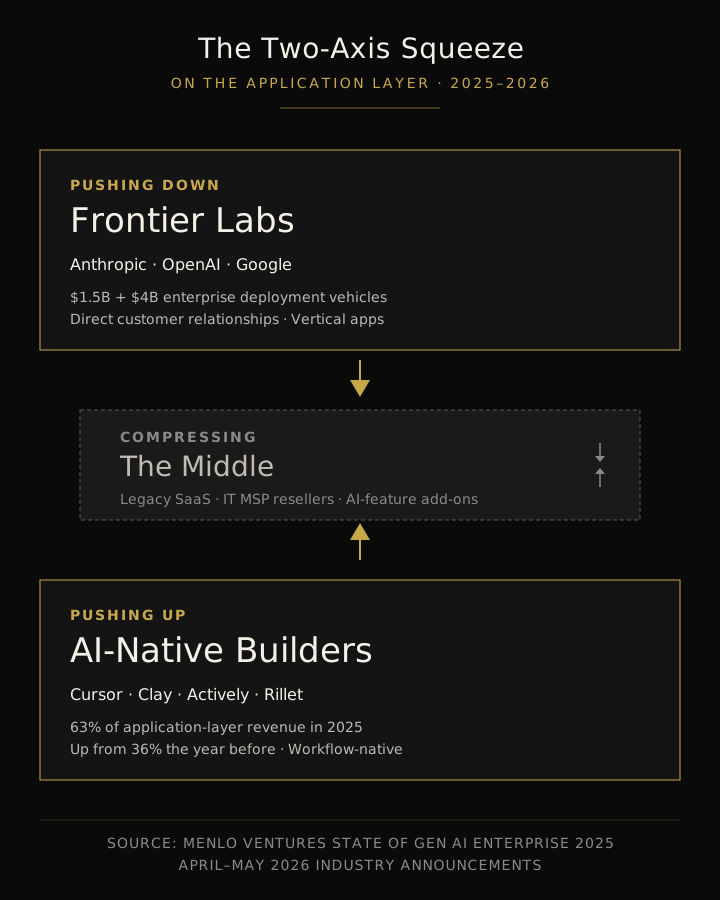
Anthropic announced a $1.5 billion joint venture with Blackstone, Hellman & Friedman, and Goldman Sachs, structured to deploy Claude directly inside enterprises rather than through partner software. OpenAI followed a week later with the OpenAI Deployment Company, a $4 billion vehicle backed by TPG, Brookfield, Bain, and Advent, aimed at the same enterprise deployment market. OpenAI’s Codex was expanded too — well beyond writing code, now into browser interaction, image generation, SSH access, PR review, and “repeatable tasks,” which is industry vocabulary for workflow automation. Anthropic shipped Claude Design as a research preview, putting slide decks, prototypes, and one-pagers directly inside Claude. Google rebranded Vertex AI as the Gemini Enterprise Agent Platform at Cloud Next 2026, with Workspace Studio as a no-code agent builder and a bench of partner agents from Box, Workday, Salesforce, and ServiceNow.
The pattern is the same in every direction. The model layer is no longer staying in its lane.
What “Moving Up the Stack” Actually Looks Like
The phrase has been in the trade press for a year, but the operational meaning has only recently become specific enough to plan around.
When Anthropic ships Claude Design, it competes with productivity software. When OpenAI’s Codex handles browser tasks and PR reviews, it competes with a sprawling set of workflow tools. When Google bundles partner agents from Salesforce and ServiceNow inside Gemini Enterprise, it does not stop being a model provider, but it starts being something else as well: a buyer’s first surface for a category of work that used to require a software purchase from elsewhere. The frontier labs are not building general SaaS. They are building specific verticals where the model is the product, the interface is theirs, and the customer relationship is direct.
What is novel here is not that frontier labs are moving into applications. That trajectory has been visible since GPT-3. What is new is the capital intensity of the move. The $1.5 billion and $4 billion vehicles are not for model training. They are for deployment — for putting senior engineers inside enterprises, designing systems around the model, and capturing the work that used to be done by integration consultancies and managed software providers. The bet is that the application-layer revenue dwarfs the API revenue, and that the labs are best positioned to capture it because they control the substrate.
The labs are not wrong about that. They are also not the only ones who have noticed.
The Other Side of the Same Story
If the only signal worth tracking were the frontier labs pushing down into applications, the picture would be straightforward: legacy software incumbents and AI-native startups both lose. But that is not what is happening.
The Menlo Ventures State of Generative AI in the Enterprise report, published in late 2025, tracked something that does not fit the “frontier labs win everything” narrative. AI-native startups captured 63% of the application-layer market in 2025 — up from 36% the year before. For every dollar of application-layer revenue earned by incumbents, AI-native startups earned two. The breakdown by category is sharper still. Sales workflows: 78% startup share. Product and engineering tools: 71% startup share. Finance and operations: 91% startup share.
This is the wrong outcome under the standard logic of incumbency. Salesforce had every advantage entering this fight — distribution, data, customer relationships, balance sheet. It is losing to startups like Clay and Actively, which attack the workflows the CRM does not own and build outward. QuickBooks had every advantage in SME finance. It is losing share downmarket to Rillet, Campfire, and Numeric. GitHub had Copilot first and shipped it through the largest developer audience on earth. Cursor took the share anyway by being faster on repo-level context, multi-file editing, and natural-language commands.
The structural story is that two categories of player are winning the application layer simultaneously, from opposite directions. The frontier labs are pushing down from the model layer, deploying capital to put their intelligence directly inside enterprises. AI-native startups are pushing up from the workflow layer, building software native to the problems the incumbents could not move on fast enough. Both are growing. Both are taking share.
What That Means for the Middle
There is a category of player that is not in either of those two winning positions. The diagnosis is uncomfortable but it is not subtle.
The middle is the legacy productivity SaaS vendor whose AI roadmap is a feature add-on to an existing product. It is the integration partner whose business is brokering vendor licences and configuring out-of-the-box deployments. It is the IT managed service provider repositioned as an “AI partner” through a Microsoft Copilot resale relationship. None of these positions are catastrophically bad businesses — they will all generate revenue for a while. But each of them is in the wrong place for the dynamic currently underway. They are competing for application-layer value against frontier labs above them and AI-native builders below them, with neither the capital depth of the first nor the workflow specificity of the second.
What collapses the middle is not a single event. It is the slow accumulation of evidence that the value the middle was extracting can be captured directly by one of the two adjacent layers. When Anthropic puts Claude Design inside Claude, the productivity vendor that depended on “AI features” loses the differentiating story. When a $4 billion vehicle deploys senior engineers directly into enterprises, the integration consultancy that priced itself on vendor relationships loses the procurement cycle. When OpenAI’s Codex handles repeatable browser tasks, the workflow tool that automated those tasks the old way loses its category.
The owners of small and medium businesses do not need to follow this dynamic in detail. They do need to notice which side of it their AI provider is on.
What This Means for SME Owners Specifically
If your current AI strategy is built on a relationship with a reseller — a managed service provider, a productivity SaaS vendor with AI features, a vendor that brokers your software licences and positions itself as your AI partner — you are placing a bet on the middle. The bet may pay out in the short term, because the middle does not collapse instantly. The bet does not look strong in the medium term, because the underlying dynamic is structural.
The two positions that look defensible right now are not adjacent to each other. The first is a direct relationship with a frontier lab, mediated by enterprise services that the lab itself runs — appropriate for organisations large enough to absorb $4 billion deployment vehicles as a procurement category. The second is an AI-native build, designed around the specific commercial workflow of the business it serves, owned and operated by people whose discipline is the workflow, not the licence resale. The first is for the Fortune 500. The second is what the application-layer revenue numbers say is actually winning in the under-500-million-revenue band where SMEs live.
The mistake to avoid is treating “we have an AI provider” as if it answered the question. The question worth asking is whether the AI provider sits in a category that is structurally growing, or in the category that is structurally compressing. The answer is usually obvious once it is asked. The reseller will tell you they are your AI partner. The frontier lab will not bother selling to you directly. The AI-native builder will be small enough that the conversation starts from the workflow, not the logo.
The Build Position
V8 sits in the second category by design. Not as a vendor of a model. Not as a reseller of someone else’s product. As a builder of commercial operating systems for SMEs, designed around the specific workflow of the business — pipeline, follow-up, content, referral, inbox — and operated as an ongoing layer through Axia.
This is not a coincidence of positioning. The category emerged from looking honestly at where the application-layer dynamic is going and recognising that the middle does not survive it. The choice was between becoming a partner to a frontier lab’s enterprise deployment vehicle (which closes the door to SMEs by definition) or building inside the workflow specificity that the labs cannot reach economically and the legacy vendors cannot reach technically. The second was the only commercial position that makes sense given the dynamic.
The signal from the past month is that the dynamic is now visible to everyone who is looking. Anthropic and OpenAI are no longer pretending to stay in the infrastructure lane. Google has consolidated its agent platform with explicit ambition to own the stack from chip to inbox. AI-native startups have crossed the threshold where they earn more application-layer revenue than incumbents do. The middle is doing what middles do when both adjacent layers are accumulating capital and capability: it is shrinking.
For SME owners, the operational question is small and concrete. Is the AI in your business being run by someone whose discipline is reselling vendor products, or by someone whose discipline is building commercial systems around your specific workflow? The answer to that question, asked honestly, tells you which side of the structural dynamic you are sitting on right now. Six months from now the question becomes harder to ask and the answer becomes more expensive to act on. The cleanest week to look at it is the week the trade press is full of $4 billion deployment vehicles and frontier-lab vertical apps, because at that point the dynamic is not theoretical any more.
That week is this week.