At a recent investor sharing session, someone said something that stuck with me.
He was frustrated. Not with AI — with founders pitching AI. The pitch decks all sounded the same. Capability claims stacked on top of each other, demo screenshots, a slide about the bot. And at the end of it, he said something I keep coming back to: investors aren’t investing in bots. They’re investing in humans.
He’s right. But I think he was diagnosing the symptom, not the disease.
The real problem isn’t AI outreach. It’s context-free AI outreach.
Most AI-assisted BD fails for a simple reason. The agent goes into every conversation knowing nothing. No background on the contact. No understanding of what they’ve been thinking about lately. No awareness of what’s shifting in their market. It fires a personalised-sounding message built on surface data — a job title, a company name, maybe a recent post — and calls it intelligent outreach.
It isn’t. It’s a mail merge with better grammar.
What makes a human BD professional effective isn’t their ability to send volume. It’s that they remember things. They read the trades. They notice when a contact’s company just announced a new hire or pivoted their positioning. They walk into a conversation with context, and that context shapes everything — what they lead with, what they ask, what they don’t say.
If you want AI to do what a good BD professional does, you have to give it the same foundation.
Context is infrastructure, not a prompt
This is where most implementations get it backwards. Founders treat the conversation agent as the product. They spend weeks tuning the message, testing hooks, iterating on tone. And the agent still underperforms because the problem was never the words. It was what the agent knew before it said them.
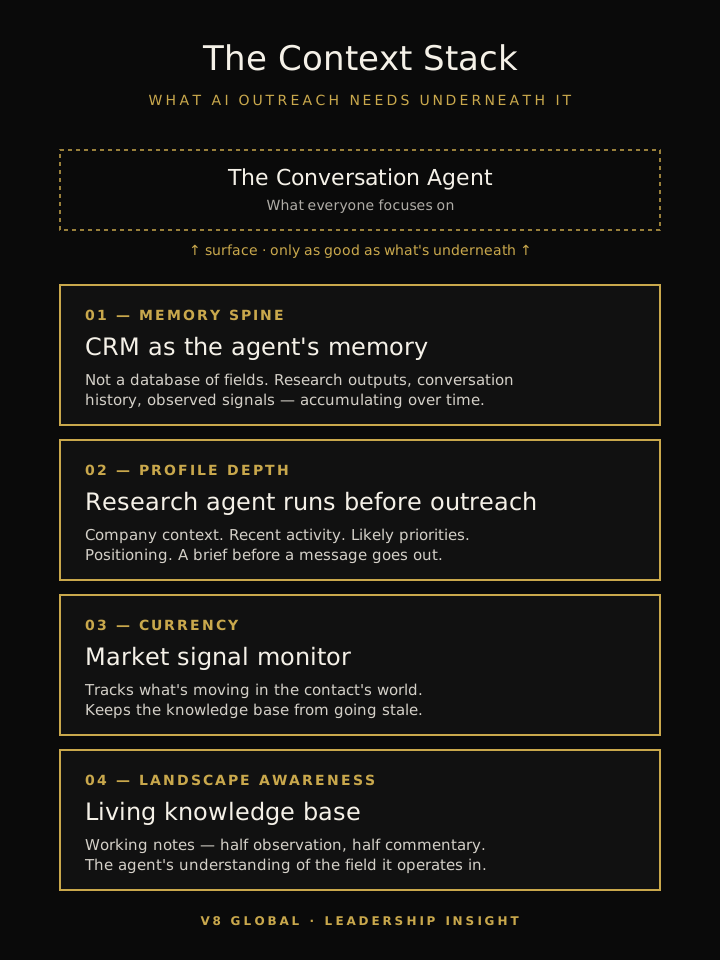
The stack that actually works has four layers underneath the conversation:
- A CRM spine that holds everything the agent has learned about a contact. Not just static fields — research outputs, conversation history, observed signals over time. The CRM isn’t a database. It’s the agent’s memory.
- A research agent that builds a profile on each contact before any outreach begins. Company context, recent activity, likely priorities, positioning in their market.
- A market signal monitor that tracks what’s moving in the contact’s world. Not in real time, but consistently enough that the agent’s knowledge base stays current rather than stale.
- A living knowledge base — in my case, a blog and internal wiki that gets updated in roughly 30-minute sessions: half observation, half commentary. Not polished content. Working notes. But those working notes become the agent’s understanding of the landscape it’s operating in.
When all of that is in place, the agent stops sounding like a bot. It sounds like someone who’s been paying attention.
What 20% actually means
My current cold outreach converts connection request to booked meeting at around 20%. That number gets attention, but I want to be careful about how I frame it. It is my number, not a forecast for yours. When we plan with a client, we assume around 10% of conversations turn into a meeting, because rates differ by industry.
It isn’t evidence that AI outreach is magic. It’s evidence that preparation compounds. Every contact in the pipeline has been researched before a message goes out. Every message reflects something real about that person’s context. The agent isn’t winging it — it’s working from a brief.
That’s not different from how a good human would operate. The AI just means I can do it at a scale and consistency a solo operator couldn’t sustain manually.
Back to the investor
His frustration was real, and I think it points to something important for anyone building in this space.
The founders who pitch AI as the thing are going to keep losing the room. The founders who show what they built underneath the AI — the thinking, the architecture, the understanding of what makes a conversation earn trust — those are the ones worth backing.
The bot is not the product. The judgment that shaped the bot is.
That’s what investors are investing in. That’s what clients are buying. And honestly, that’s what makes the difference between an AI system that closes meetings and one that just sends them.
Alan Law is co-founder of V8 Global Company Limited. V8 builds and runs AI operating systems for SME sales and marketing — including Axia, the managed operating layer the methodology in this piece is built around.