Most of the conversation around AI search treats getting found as the destination. It isn’t. It’s confirmation that the foundation is in place.
A contact told me recently that he’d had four inbound queries in two weeks from people who found him through AI. He said it almost as a defence — proof that he didn’t need to do anything. I told him it meant the opposite. Not that he was behind. That he was ready.
What LLM referral traffic actually tells you
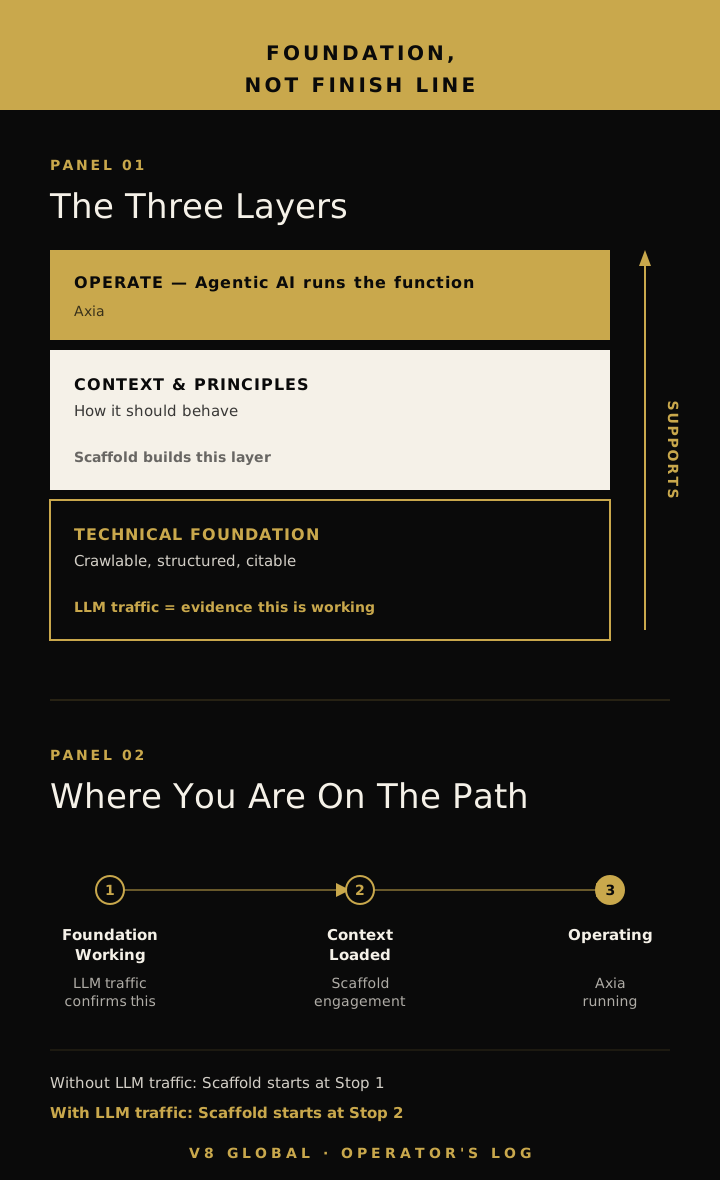
When an AI assistant names your business in response to a buyer’s query, three things had to be true at the technical level:
- AI crawlers could read your site — ClaudeBot, GPTBot, CCBot were not blocked in your robots.txt or silently suppressed by your CDN
- Your content was structured extractably — FAQ schema, clear service definitions, named entities that an AI can retrieve in a single pass
- Your entity authority was sufficient to be cited — consistent named-entity references across LinkedIn, Companies House, directories, structured schema linking them together
That combination is what we call the technical foundation layer. The majority of SMEs have not passed this test. Some have never thought to check it. Others had it silently broken by a hosting provider’s “AI protection” setting. If AI is already sending you clients, your foundation is working.
That is genuinely good news. It is also only the first layer.
The foundation is not the operation
Here is what the technical layer does not cover: it does not tell the AI how you work, who you work with, what you will not do, how you handle a first conversation with a new prospect, what to say when someone raises a specific objection, how to follow up without being persistent to the point of irritating, or when to stop and route to a human.
That is the context and principles layer. It is what separates an AI agent that can fetch your information from one that can operate your commercial function.
Agentic AI — outreach automation, conversation nurturing, ongoing relationship management, eventually customer service — works at the level of the context it holds. The more precise and principled that context, the more it can handle autonomously without constant re-briefing, without hallucinating your offer, and without making a call you would not have made.
Most businesses that think about AI-assisted operations focus on the tool. The tool is the least important variable. The context is what determines whether the tool behaves like a professional or like an expensive autocomplete.
What building the context layer actually looked like
V8’s own site shipped in an afternoon in April 2026. Astro, Cloudflare, no CMS, blog pipeline ready from day one. The technical build was fast because the architecture was clear.
The harder build was the operational layer. Running in parallel with the site:
A CLAUDE.md file that tells every AI agent working on V8 what the business is for, what it is not for, how decisions get made, and what language is and is not appropriate in external-facing work. Not a style guide — an instruction layer.
An internal wiki that holds the competitive positioning, objection handling, pricing guardrails, roadmap context, FAQ bank, and weekly intelligence digests. Not documentation for humans to read. A structured knowledge source for AI agents to reference when they need to know what V8 thinks about something.
A set of SKILL.md files — citation protocols, outreach SOPs, persona definitions, verification flags — that encode the behaviours, not just the facts. What to do when a prospect challenges a stat. How to classify a hot reply versus a cold inbound. When to escalate to Alan versus when to draft and proceed.
The SOPs evolve in real time. The citation protocol we formalised today — internal knowledge first, external source second, approval gate before sending — did not exist as a written rule six weeks ago. It existed as practice. A live edge case surfaced in a prospect conversation, we resolved it, and we encoded it. Version by version. That is what the habit layer looks like in practice: not a document you write once and file, but a system that gets more specific every time a real situation is handled.
The habit principle — and why it matters for Axia onboarding
Most businesses that try to deploy AI-assisted commercial operations discover a gap they did not expect. The infrastructure is there. The tools are there. But the agent does not behave the way they would.
It hedges on pricing when it should not. It uses the wrong tone with a warm contact versus a cold one. It over-explains the product when the prospect already understands it. It does not know when to stop following up.
These are not tool problems. They are principles problems. The agent has not been told how to behave, so it defaults to its training data — which was not built around your commercial instincts, your client relationships, or your specific offer.
V8 spent months of operational testing building and running these principles on our own pipeline before any client touched them. Every outreach sequence, every reply protocol, every escalation rule was tested under real commercial pressure — on V8’s own business, with real prospects, with real reputational risk attached to every message that went out.
That is what Scaffold delivers: not a blank-slate AI system that you then have to teach to behave professionally, but one where the BD principles arrive pre-installed. When you open the box, the agent already knows how to handle a first conversation, how to follow up without overreaching, when to escalate, and how to represent your offer accurately.
Why LLM-referred businesses are the fastest Axia deployment
When your website is already structured correctly for AI retrieval — and your LLM referral traffic is the evidence — the Scaffold engagement looks different.
We are not starting with a technical audit to find out why AI crawlers cannot read your site. We are not fixing robots.txt, adding missing schema, or rebuilding service pages around FAQ structure. That work is already done.
We start at the context layer: enriching the specificity of your service definitions, deepening the niche-specific content that earns authority for the exact query types your best clients are asking, and beginning to load the operational principles that govern how Axia represents you in commercial conversations.
The agent can start fetching your data from day one — because the structure is already there to fetch. The time from onboarding to a working commercial agent is shorter. The first outreach runs sooner. The first drafts are closer to publishable from the start.
For a business without LLM traffic, we rebuild the foundation first, then build on it. For a business with LLM traffic already, we build on what exists. It is the difference between laying a slab and raising walls.
What to do with that signal
If you are seeing AI-referred sessions in your analytics, that data point is telling you something specific: the technical preconditions for agentic AI to work in your business are already met. What it cannot tell you is whether you are being recommended for the right queries — the specific niche questions your best clients ask, not just the generic category searches.
The next step is the context layer: enriching what the AI knows about you beyond the structural basics, and beginning to inject the principles that govern how it should operate on your behalf.
That is what Scaffold is built around. And if your foundation is already sound, the engagement starts further along the path.
Alan Law is the founder of V8 Global and the architect of Axia. V8 builds and operates AI commercial systems for professional services firms and SME founders in London and Hong Kong.