There is a gap between what looks correct on a surface and what actually works under real conditions. Most build days don’t surface it. One day last week I hit it three times, on three different surfaces, before lunch. By evening it had a name.
The day was supposed to be a 30-minute closeout. Rotate a Discord token, restart a sandbox bot, promote yesterday’s commit to production. Boring infrastructure hygiene, written into the morning plan as a half-hour task. By 14:59 UTC the day had eaten itself. By 17:19 we had shipped a production-grade defense layer that wasn’t on any roadmap that morning. By 20:30 the system was running unattended overnight stress tests.
What changed between the morning plan and the evening reality is the subject of this post. It’s not a story about the work. It’s a story about the gap that work kept exposing.
Variant one — the parallel infrastructure that wasn’t parallel
Promoting yesterday’s commit to live production: standard merge, standard push, watch the deploy fire. Discord notification arrived: “Live deploy FAILED.”
The cause was filesystem permissions. The github-runner user couldn’t traverse a parent directory whose mode was set to root-only. Sandbox passed because sandbox runs as root. Live failed because live deliberately doesn’t.
Yesterday’s session log had flagged this asymmetry as drift but not resolved it. The thinking at the time was reasonable: the rebuild proved green on sandbox; live would prove green on first promotion. But sandbox passing means sandbox passing. It does not extend to live when filesystem layouts diverge.
The principle hidden in this: parallel infrastructure that isn’t actually parallel is invisible until first parallel run. The cost of not surfacing it earlier was hours of recovery work that should have been weeks-old hygiene.
The fix was a path migration. Move the live repo to match the canonical pattern self-hosted runners use — /home/{user}/repo, not /root/repo. Twelve-minute outage. Eight cron jobs to repath. Two systemd service files to update. One helper script with three references. One workflow YAML with four references. All single-pass sed commands once the runbook was clear, but the runbook had to come from prior-art research, because that’s what the canonical pattern actually looks like.
Variant two — patches all the way down
Second deploy attempt failed before the first deploy attempt’s recovery had finished landing. New error: bad interpreter. The Python virtual environment had baked the old absolute path into its shebangs at creation time. Moving the parent directory of a venv invalidates the venv. Python’s official documentation is unambiguous on this point: recreate, don’t repath.
I caught myself reaching for sed first. Patch the shebangs across all the venv scripts. Faster than recreating from scratch. Should work.
That instinct is the problem. It was patch number three on the same surface in two days. Patch one had been the watcher script that was eventually retired in favour of GitHub Actions. Patch two had been the chown attempt to make the repo accessible without moving it, which couldn’t bypass the parent directory’s restrictive mode. Patch three would have been the shebang rewrite, fragile against any future move, brittle against any future contributor doing the obvious thing.
When the patch surface keeps revealing more patches, the architecture is wrong. Adopting the canonical pattern is more work upfront and less work forever. We recreated the venv, hardened the workflow with idempotent recreate-if-broken logic, and shipped it.
The signal I should have read at patch one instead of patch three: if you find yourself three patches deep into the same surface, stop patching. Find the canonical pattern. Adopt it. Pay the upfront cost.
Variant three — capability landing in a room
V8 Nexus launched its inaugural gathering forty-eight hours before this build day. Operators in the room responded enthusiastically to a demo of Phase 1 and Phase 2 capability. Several said the equivalent of “I want this for my business.” The signal was clear: there is demand for what V8 builds.
Mid-afternoon on the build day, that signal got reframed. Phase 1 and Phase 2 capability is operable by V8 — technically deep, system-aware, comfortable with the rough edges of an early-stage system. It is not yet operable by a non-V8 operator without the defense layer that AD-032 and AD-035 will provide.
The room responded to what the system does. They didn’t see how robustly it does it under messy human input. They didn’t see what happens when an operator hits the system with a request shaped wrong. They didn’t see the silent failure modes that show up at scale. They saw the demo. The demo is real. The demo is also the easy surface.
The defense layer is shipping prerequisite, not optional. Without it, capability that landed beautifully in a Nexus room cannot be handed to non-V8 operators. The misinterpretation in front of a buyer kills the commercial story faster than good demos build it.
So the day’s afternoon work was not the content engine, which would otherwise have been the next priority — we are hardening the foundation it will run on first. It was Layer 3 of the defense layer. Brief drafted in 90 minutes, implementation handed to Claude Code on the Mac Mini, twelve minutes of build, 32 new tests passing alongside 138 regression tests, sandbox deploy autonomous and green by 18:30. Layer 3 live on sandbox, overnight stress orchestrator running by 20:30, the operator walking away.
The principle hidden in this: capability landing in a demo room is not capability shipping to operators. Demo capability is cheap. Operator capability is expensive. The gap between them is exactly the kind of work that gets descoped when buyers say nice things about early demos.
The pattern named
Three variants. One pattern.
What looks correct on a surface and what actually works under real conditions are different things. Sandbox passing didn’t mean live passing. Patching the symptom didn’t fix the architecture. Capability landing in a room didn’t mean capability shipping to operators.
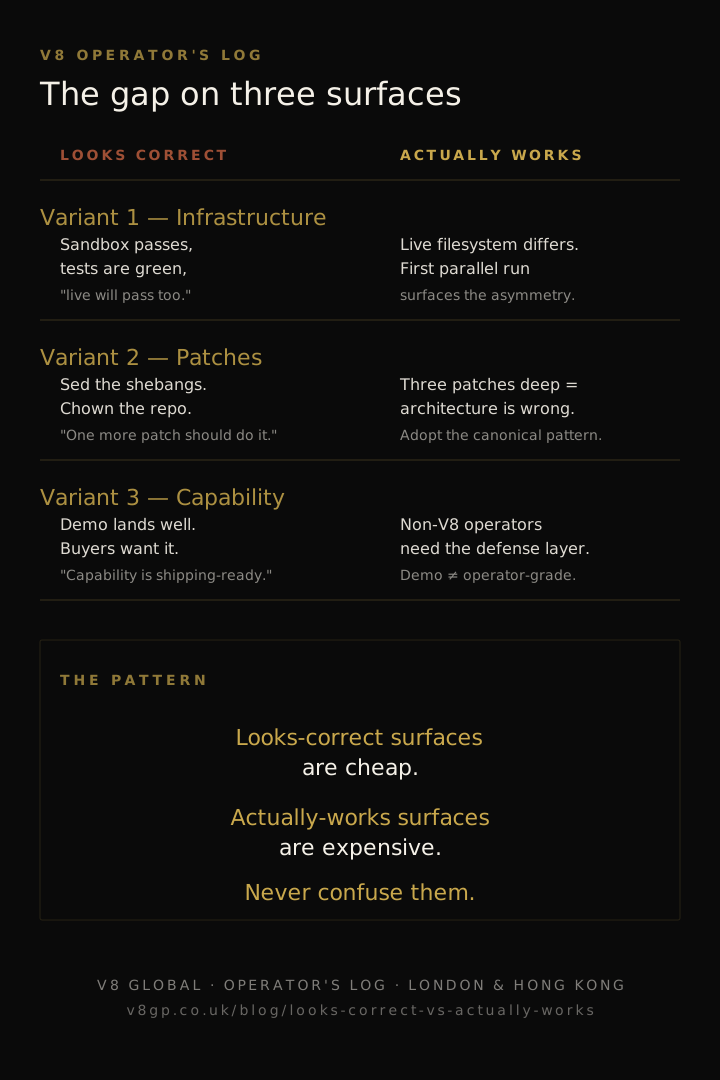
Looks-correct surfaces are cheap. Actually-works surfaces are expensive. The temptation is always to confuse them, because confusing them feels like progress. Sandbox passes, ship it. Patch works, move on. Demo lands, the rest is detail.
It rarely is. The detail is where everything either holds or breaks.
The days that look least productive — the day that lost a 30-minute closeout to a path migration that bled into a venv rebuild that exposed a workflow gap that surfaced a defense layer reprioritisation — are sometimes the days that ship the thing that actually mattered. Not because the original plan was wrong, but because the plan didn’t yet know what was load-bearing.
What this means for buyers
If you are evaluating an AI build vendor, the question that separates serious operators from demo-stage providers is this: what did your last bad day look like?
A vendor whose answer is “we don’t have bad days” is selling demos. A vendor whose answer is “here is the gap we hit, here is how we found the canonical pattern instead of patching, here is what shipped that wasn’t on the plan that morning” is selling operator-grade work.
V8 ships operator-grade work because V8 has bad days on its own systems first. The blog you are reading is one such system. Axia is another. The architecture you’d be buying is the architecture we have already broken and rebuilt on our own commercial pressure, in public.
That is the difference between a system that demos well and a system that runs.
For the build conversation about your specific operations, start with Scaffold.
Alan Law is founder of V8 Global and architect of Axia. Operator’s Log posts document how AI-native systems get built — and operated — in practice. The pattern of looks-correct versus actually-works generalises beyond infrastructure: it shows up in pipeline forecasting, content production, hiring decisions, and any surface where a check-the-box answer competes with the right answer.