McKinsey published their blueprint for the organisation of the future. It looks a lot like what an SME can run today for a fraction of enterprise transformation cost.
In September 2025, McKinsey published “The Agentic Organization: Contours of the Next Paradigm for the AI Era” — research describing how the winning companies of the next decade will be structured. The core argument: hierarchical pyramids are obsolete. AI agents handle the execution layer. Humans operate above it, making decisions rather than processing information. Organisations get flatter, faster, and structurally cheaper.
It is a compelling blueprint. It is also, at enterprise scale, an expensive one to implement.
What caught our attention was not the research itself. It was the gap it did not address.
What McKinsey is describing
The central claim is what the research calls hierarchical flattening. Traditional organisations have been adding layers — in many cases one to three additional management tiers between the CEO and the frontline over the past decade. More layers, more approval chains, slower decisions, higher cost per outcome.
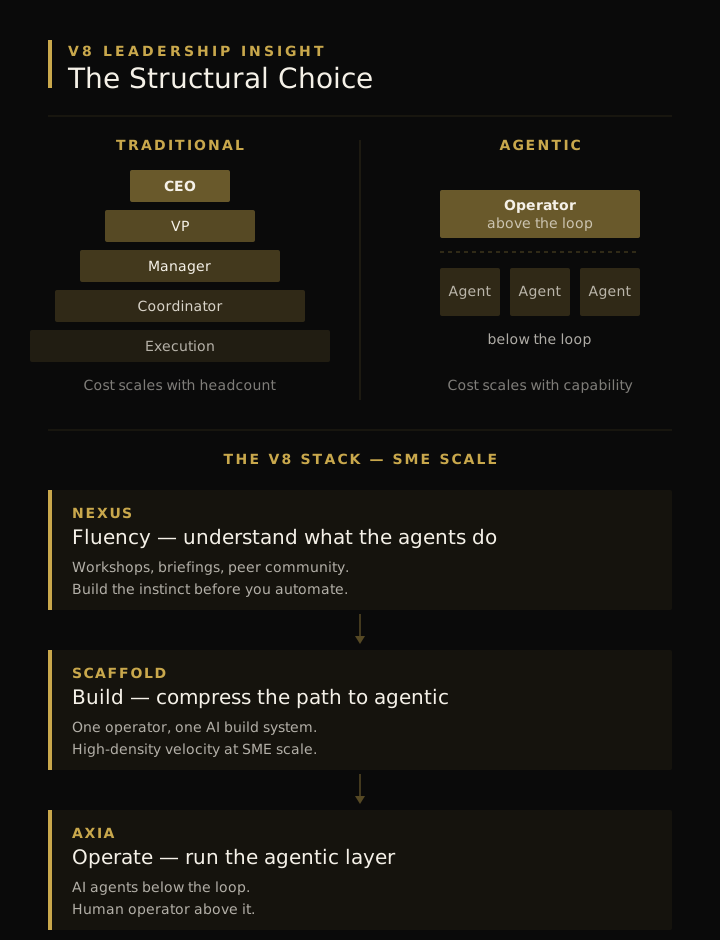
McKinsey’s proposed solution is the agentic organisation: AI agents running below the loop on execution, human operators sitting above the loop on judgement. The result is a smaller, faster structure where the unit of value is not a headcount — it is a human-agent team.
The talent model is specific. The framework calls for more than 70 percent of digital talent in-house, more than 70 percent of them operating as hands-on builders rather than managers, and more than 70 percent of those builders working at competent-to-expert level. The underlying logic is that experienced builders working directly with AI systems massively outperform large teams of lower-skilled staff.
It is a rigorous framework. It is also built for organisations that can afford McKinsey to help them implement it.
The SME problem McKinsey did not solve
The organisations McKinsey profiles in this research are large enough to build internal agent platforms, restructure talent pipelines, and commission implementation programmes spanning twelve to eighteen months.
Most SMEs in London’s professional services market are not in that position. They have four people, twelve tools, no integrated data layer, and a marketing coordinator who spends most of their time doing things that could be automated. The management structure is not a pyramid — it is a flat tangle. And the problem is not too many layers. It is that execution happens manually, at a cost that scales with headcount.
The McKinsey blueprint assumes you are restructuring from something. Most SMEs are trying to build something.
Where Axia and Scaffold fit
We did not set out to implement McKinsey’s framework. We set out to solve the operational problem we had been watching SMEs run into for fifteen years: too much execution, not enough decision-making.
But when you look at what Axia and Scaffold actually do through the lens of the agentic organisation model, the structural alignment is hard to ignore.
Axia is the below-the-loop layer. It reads inbound email, classifies it, updates the CRM, extracts action items, monitors follow-ups, and prepares decisions for human approval. The human never enters data. The human never chases a follow-up. The human approves or adjusts what the system surfaces. That is above-the-loop operation — exactly what McKinsey describes as the model.
Scaffold is how you get there. The talent model McKinsey recommends — builders over managers, in-house over outsourced — assumes you have the capacity to build. Most SMEs do not. Not because of skill, but because building takes time, and time is the scarcest thing a small business has. Scaffold compresses that gap. One operator, one AI build system, working at the kind of high-density technical velocity the McKinsey framework assumes you can already produce internally.
Nexus is the education layer. The talent framework only works if the people running above the loop understand what is happening below it. You do not need to be a developer. But you need to be fluent enough to make good decisions with AI outputs. Nexus exists to build that fluency — practically, through workshops, briefings, and direct access to tools — before you automate anything.
The real implication
McKinsey is telling large organisations to restructure toward something that a well-designed SME can run from day one.
The agentic organisation is not an enterprise transformation project. It is a structural choice — a decision about whether execution lives with people or with systems, and what humans do with the time that frees up.
For SMEs that make that choice deliberately, the structural advantage is significant. You are not competing against companies your size. You are competing against companies with four people who have effectively acquired the operating capacity of twelve — because the other eight are running autonomously in the background.
That is not a technology claim. It is an organisational design claim, and one of the largest management consultancies in the world has now put research behind it.
The question for any SME owner reading this is not whether the agentic organisation is real. It is whether you want to be building it, or waiting for your competitors to finish theirs first.
For the build conversation about your specific operations, Scaffold is the engagement that gets you there.
Alan Law is founder of V8 Global and architect of Axia. Leadership Insight posts cover the strategic infrastructure SME owners need to operate AI-native businesses without becoming the production layer themselves.