Gartner published a forecast in June 2025 that has aged unkindly. By the end of 2027, the firm expects more than 40% of agentic AI projects to be cancelled — driven by escalating costs, unclear business value, and inadequate risk controls. The phrasing was clinical. The underlying reality is messier. A lot of organisations spent a lot of money getting language models to do work that did not need a language model, and the bills have started arriving.
The diagnosis from the same Gartner research — credited to senior director analyst Anushree Verma — is sharp enough to repeat: “Many use cases positioned as agentic today don’t require agentic implementations.” That single sentence is doing more work than the headline statistic. It is naming the failure mode underneath the cost overruns. People are using LLM reasoning in places where a deterministic mechanism would have done the job more reliably, more cheaply, and more transparently.
This pattern is not isolated to large enterprises with large budgets. It is showing up everywhere in the SME AI conversation, often invisibly, because the language used to describe AI systems does not distinguish well between the two things it could mean. “AI-powered” can describe a deterministic rule that calls a model once, or a model that decides the entire workflow on the fly. The difference matters more than most buyers realise.
What “Mechanism” and “Reasoning” Actually Mean
These two words get used loosely, so it is worth being specific.
Mechanism in a working AI system means deterministic logic — rules, routing, workflow scaffolding, conditional steps, defined transformations. A mechanism behaves the same way on the same input every time. It can be audited, debugged, version-controlled, and reasoned about by humans. It does not call a language model unless the workflow explicitly asks it to. It is, in essence, software in the traditional sense, with AI capability summoned only when needed.
Reasoning in a working AI system means an LLM call. The model is given context and asked to interpret, classify, generate, decide, or judge. Reasoning is non-deterministic by nature — the same input may produce different outputs across calls, and the system has to be designed to accommodate that variance. Reasoning is powerful in the way humans are powerful, and unpredictable in the way humans are unpredictable.
A real AI workflow contains both. The question is the ratio. The systems that work in production tend to use mechanism heavily and reasoning sparingly. The systems that get cancelled tend to do the opposite. The build heuristic that separates the two is straightforward to state and harder to apply: mechanism where you can, reasoning where you must.
The Three Tests
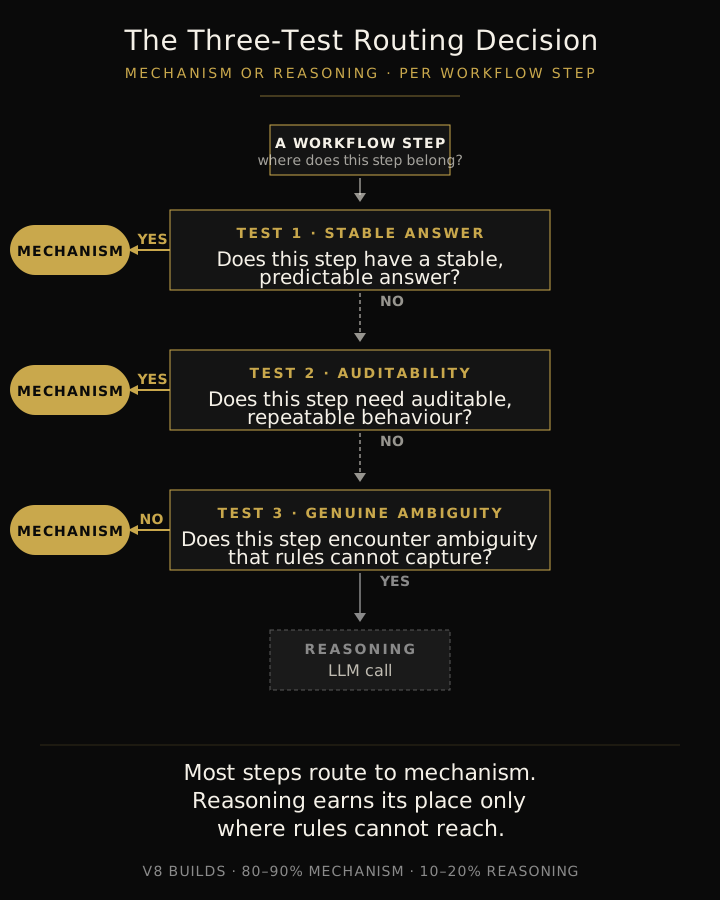
For any given step in a workflow, three questions decide whether mechanism or reasoning is the right architectural choice.
Test one: does this step have a stable, predictable answer? If the input space is bounded and the output is determined by the input, a mechanism handles it. Routing an inbound email by sender domain is a mechanism. Calculating a follow-up date from a meeting timestamp is a mechanism. Looking up a contact in a database is a mechanism. None of these need an LLM. Asking a language model to do them anyway is paying inference costs and accepting non-determinism for work that a few lines of deterministic code did better in 1995.
Test two: does this step need auditable, repeatable behaviour? If the workflow must produce the same output every time for the same input, or must be inspectable for compliance, or must be explainable to a regulator, an auditor, or a client, mechanism is the only safe answer. LLM reasoning cannot guarantee repeatability. It cannot produce an audit trail in the form that compliance systems expect. It can be reasoned about probabilistically, but not deterministically. For anything with a “must always” or a “must never” attached to it, the right tool is rules.
Test three: does this step encounter genuine ambiguity that rules cannot capture? This is the test that earns reasoning. If the step requires interpreting an unstructured input — reading a sales reply for tone and intent, summarising a long document, generating prose that fits a specific voice, judging which of several possible classifications fits an edge case — a mechanism cannot do it. A rule cannot encode the judgement required. This is the territory where LLM reasoning genuinely adds value, and where the cost and unpredictability of reasoning are worth paying for.
A step that fails test one and passes test three needs reasoning. A step that passes test one or test two does not. The mistake most failed AI projects make is calling for reasoning on steps that passed test one — paying for an LLM to do work a rule handles trivially.
What This Looks Like in an SME
The pattern repeats across every SME workflow V8 has built or audited.
A typical sales pipeline workflow runs something like: an inbound enquiry arrives, gets routed to the right responder, prompts a personalised reply, gets logged in the CRM, schedules a follow-up, and surfaces a reminder if the lead goes cold. Of those six steps, exactly one needs reasoning. Generating the personalised reply has genuine ambiguity — the reply has to match the prospect’s tone, address their specific question, and feel human. Every other step is mechanism. Routing by criteria, logging by schema, scheduling by rule, reminder triggering by timer. All deterministic. All cheap. All auditable.
A typical content workflow runs similarly. A topic arrives, gets researched, gets drafted, gets reviewed, gets scheduled, gets published. Drafting needs reasoning. Research often does. Review can be a mix — mechanism for spelling and format, reasoning for tone and accuracy. Scheduling and publishing are pure mechanism.
A workflow that uses LLM reasoning at every step — the kind that gets sold as “an AI agent that runs your sales process end-to-end” — is paying for reasoning on the deterministic steps, accepting non-determinism on work that should be repeatable, and creating an audit nightmare on top of it. The bill for inference compounds. The reliability degrades. The team loses trust in the system because every step might do something unexpected. After a few months, the project gets cancelled. That is the 40% figure Gartner is describing.
The systems that survive are the ones that put reasoning behind glass. The LLM is summoned for the specific work it is uniquely good at, and stays out of the rest of the workflow entirely. Most of the system is software in the conventional sense. The AI is a precise tool, not an ambient presence.
The Build Position
V8’s Scaffold engagements start by mapping the workflow and identifying which steps need reasoning and which need mechanism. The map almost always comes back the same shape — 80 to 90% mechanism, 10 to 20% reasoning, with the reasoning concentrated in specific named steps where genuine ambiguity lives. From there, the architecture writes itself. The mechanism layer is conventional software, integrated with the tools the business already uses. The reasoning layer is LLM calls, scoped tightly to the steps that earn them, with structured outputs and validation around every call.
This is the opposite of what most AI consultancies pitch. The standard pitch frames the LLM as the centre of the system and treats mechanism as a fallback. The standard pitch is also the one that produces the cancelled projects. V8’s order is reversed: the workflow comes first, mechanism does most of the work, and reasoning is added precisely where the workflow requires interpretation that rules cannot reach.
For SME owners evaluating AI proposals, the three-test framework is also a buyer’s tool. When a vendor pitches an AI workflow, ask which steps are deterministic and which require LLM calls. Ask why. If every step is LLM-driven, the vendor is either selling reasoning where mechanism would do, or has not thought about the workflow carefully enough to know the difference. Either way, the project is heading toward the 40% bucket.
The systems that actually run commercial operations for a business are not the ones that reason most aggressively. They are the ones that reason exactly as much as they need to and not a step more. That is the build discipline. That is what mechanism-first architecture means in practice. And that is why V8 builds the way V8 builds.