Ask most founders where their next opportunity comes from and they’ll point to their close circle — the people they talk to every week, the clients they know well, the partners on speed-dial. It’s a reasonable guess. It’s also, according to the largest study ever run on the question, wrong.
The finding that reversed the intuition
In 2022, researchers from Stanford, MIT, Harvard and LinkedIn published a study in Science that did something the theory had waited fifty years for. They ran randomised experiments across more than 20 million people over five years — 2 billion new connections, 600,000 new jobs — to test which relationships actually cause opportunity to move. Not correlate with. Cause.
The origin of the idea is older. In 1973, sociologist Mark Granovetter argued that weak ties — acquaintances, not close friends — carry more novel opportunity, because your close circle mostly knows what you already know. Your acquaintances live in different worlds, and different worlds are where new information is.
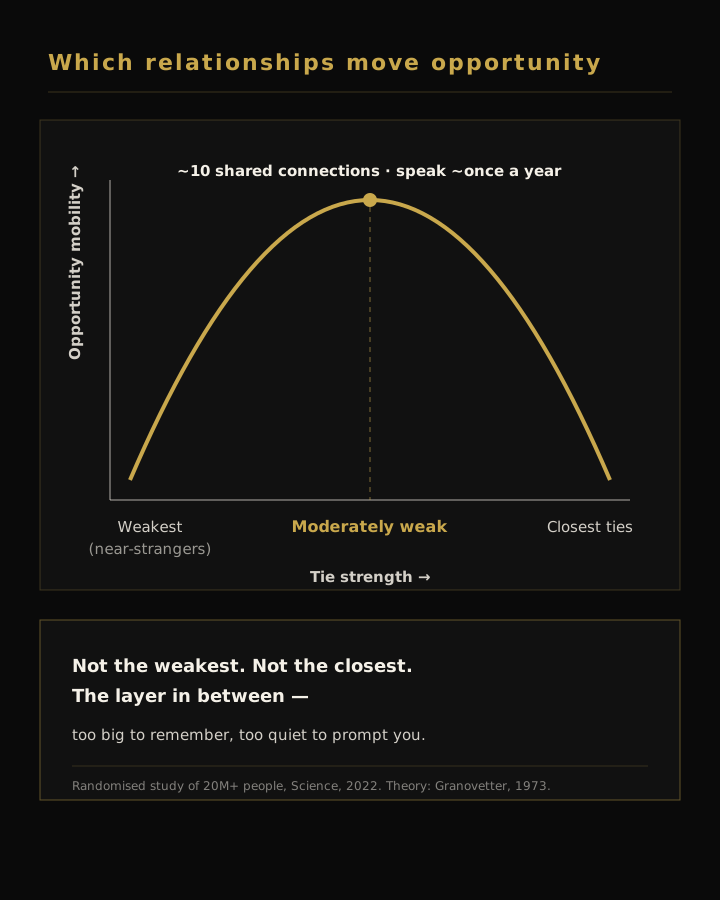
The 2022 study confirmed Granovetter causally, and then added the twist that matters. It isn’t “the weaker the better.” The relationship between tie strength and opportunity is an inverted U. The connections that move the most opportunity aren’t your closest contacts — and they aren’t near-strangers either. They’re the moderately weak ones: the people you share around ten connections with and speak to maybe once a year.
Why that specific layer is the one that rots
Now look at where that layer sits in your actual working life.
Your close ties look after themselves. You talk to them anyway; they’re on your calendar, in your inbox, top of mind. And your true weak ties — the near-strangers — never mattered enough to track.
The moderately-weak layer is different, and it’s dangerous precisely because of where it sits. It’s too large to hold in your head. Fifty, a hundred, two hundred people you have a real but low-frequency relationship with. And it’s too quiet to prompt you — none of them are the “obvious” follow-up, because by definition you don’t speak to them often. So they slip. Not through neglect you’d notice — through a gap in human attention that’s structural, not a failure of diligence. Nobody can actively work two hundred low-frequency relationships from memory. The layer the evidence says matters most is the layer we’re built to lose.
Why a better dashboard doesn’t fix it
The obvious answer is a CRM. And the newest AI-native CRMs are genuinely beautiful at this — they’ll map your whole network, enrich every contact, show you a clean, current picture of everyone you know.
But a picture isn’t a portfolio you’re working. A dashboard is passive: it tells you what’s there when you go and look. The moderately-weak layer doesn’t fail because you lack a view of it. It fails because nothing is actively working it — noticing that someone’s gone quiet, that a signal came in worth a reply, that it’s been eleven months and this is a relationship worth not losing. That’s not a visualisation problem. It’s an operator problem.
This is the distinction that matters, and most tools blur it. A CRM is a system of record — it stores the relationship. What the evidence calls for is a system of decision — something that works the portfolio: surfaces who to reach, drafts the reply in your voice, advances what’s worth advancing, and asks for your judgement at the point it matters. A picture tells you the network exists. An operator keeps it alive.
There’s a human side to this too — the network you already have is often warmer than you assume, and worth activating deliberately. I’ve written about that side of it separately. This piece is about the part underneath: which relationships the evidence says to work, and why a system of record was never going to work them for you.
The reframe
Every tool in your stack automates a task — send the sequence, log the call, update the field. That’s useful, and it’s not what’s failing you.
What’s failing you is that no task-automator is managing the relationship portfolio — deciding, across hundreds of low-frequency connections, which ones the evidence says are worth your attention this week. That’s the layer that drives opportunity, it’s the layer you’re structurally built to neglect, and it’s the one thing a system of record was never designed to do.
The network you already have is more valuable than you think. The moderately-weak part of it — the part you’re not working — is where the next opportunity is most likely to come from. The question isn’t whether you have that network. It’s whether anything is actually working it.