You’ve probably noticed it too.
You open Instagram, TikTok, or YouTube, and within thirty seconds you’ve been served three takes on the same story — one outraged, one contrarian, one milking the drama for views. You close the app feeling vaguely worse, and slightly less informed than when you opened it.
That’s not an accident. That’s the algorithm doing exactly what it was designed to do.
Here’s the thing though: all that noise? It’s actually telling us something.
The problem isn’t the noise. It’s what we do with it.
There’s been a recurring conversation in Hong Kong content creator circles about what happens when AI makes it even easier to strip, repurpose, and redistribute content without credit. A long, carefully produced interview gets auto-clipped, watermarks removed, and reposted across platforms as someone else’s content. The original creator gets nothing. The algorithm rewards the thief.
It’s frustrating. And it’s getting harder to fight.
But here’s the angle most people miss: the fact that a piece of content spreads — even if it spreads as noise, even if it spreads badly — tells us something real about the people watching it. What they responded to. What made them stop scrolling. What emotion got triggered.
Noise has a pattern. And pattern is research.
What AI amplifies isn’t random
One thing worth understanding: social media noise isn’t evenly distributed. Anger, fear, and outrage consistently outperform neutral content on every major platform. So the noise you’re seeing isn’t a random sample of what people think — it’s a post-algorithm selection of the most emotionally charged content in any given moment.
That’s a distortion. But it’s also a data point.
When we see the same anxiety, the same frustration, the same desire showing up again and again — across different formats, different creators, different platforms — that repetition is signal. It’s the market telling you what it actually cares about, underneath all the performance.
The trick is knowing how to read it, rather than just absorbing it.
What this means for how we do research
At V8 Global, we’ve been thinking about this a lot in the context of how we build audience intelligence for clients.
The instinct is always to filter noise out — to only collect “quality” content, credible sources, verified takes. But that filters out a layer of real human behaviour that matters enormously for marketing.
So instead, we collect broadly. We let the noise in. And then we look for what’s consistent over time, across sources, across emotional registers.
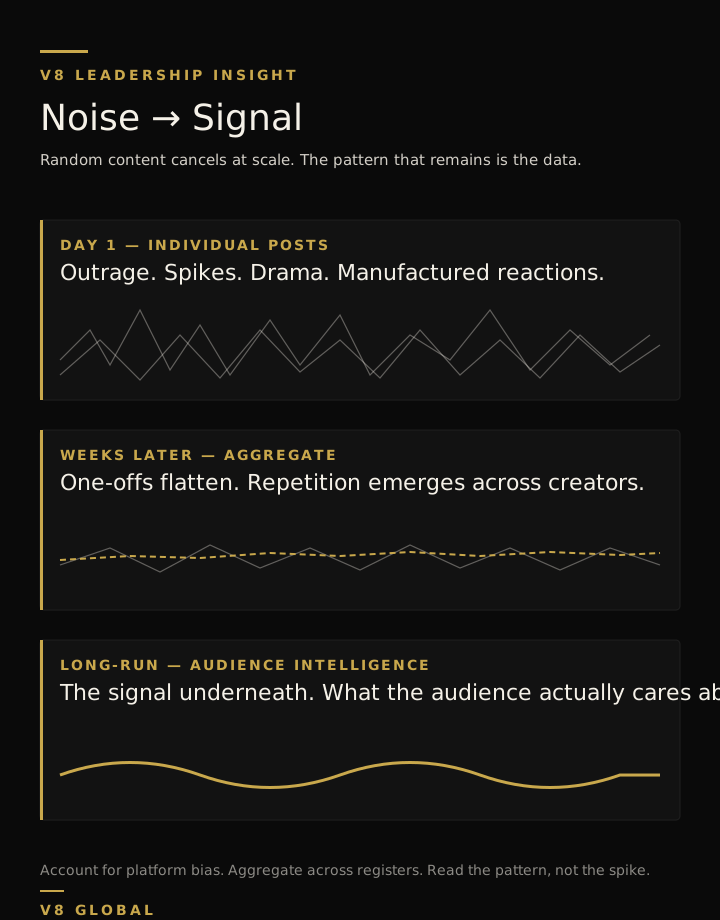
Here’s the principle that guides it: random noise cancels at scale. If you collect enough data over a long enough period, the random stuff — the one-off reactions, the manufactured outrage, the content that spiked and died — starts to flatten out. What remains is the pattern that kept showing up regardless.
The caveat — and this matters — is that social media noise isn’t fully random. Platform algorithms systematically amplify certain emotions over others. So the research layer also has to account for where data is coming from, not just how much of it there is. A LinkedIn conversation and a TikTok comment section on the same topic will look structurally different. Not because the audience believes differently, but because each platform selects for a different emotional register.
When you factor that in, what you end up with isn’t noise anymore. It’s a mapped picture of what your audience is actually responding to, stripped of the platform’s own bias.
That’s the difference between content marketing and audience intelligence.
The conscious choice, every time
I want to come back to where this thinking lands.
Some people argue that the market will eventually sort this out. Good content will survive. Bad content will be forgotten.
I hope they’re right. I’m not sure they are.
Instagram and YouTube have been running for over a decade, and the volume of low-quality content has never gone down. It’s gone up. The market hasn’t cleaned it. It’s adapted to it.
Which means the responsibility lands somewhere else: with us. With every click, every share, every minute of attention we give. Creators who do the work deserve subscribers, not just views stolen through someone else’s feed.
And for those of us building systems to understand audiences, the answer isn’t to pretend the noise doesn’t exist. It’s to read it honestly, weight it carefully, and let it tell us what it actually knows.
Gina Cheng is V8 Nexus Founder & President and a marketing strategist at V8 Global. Leadership Insight posts examine the structural shifts that change how commercial work gets done.