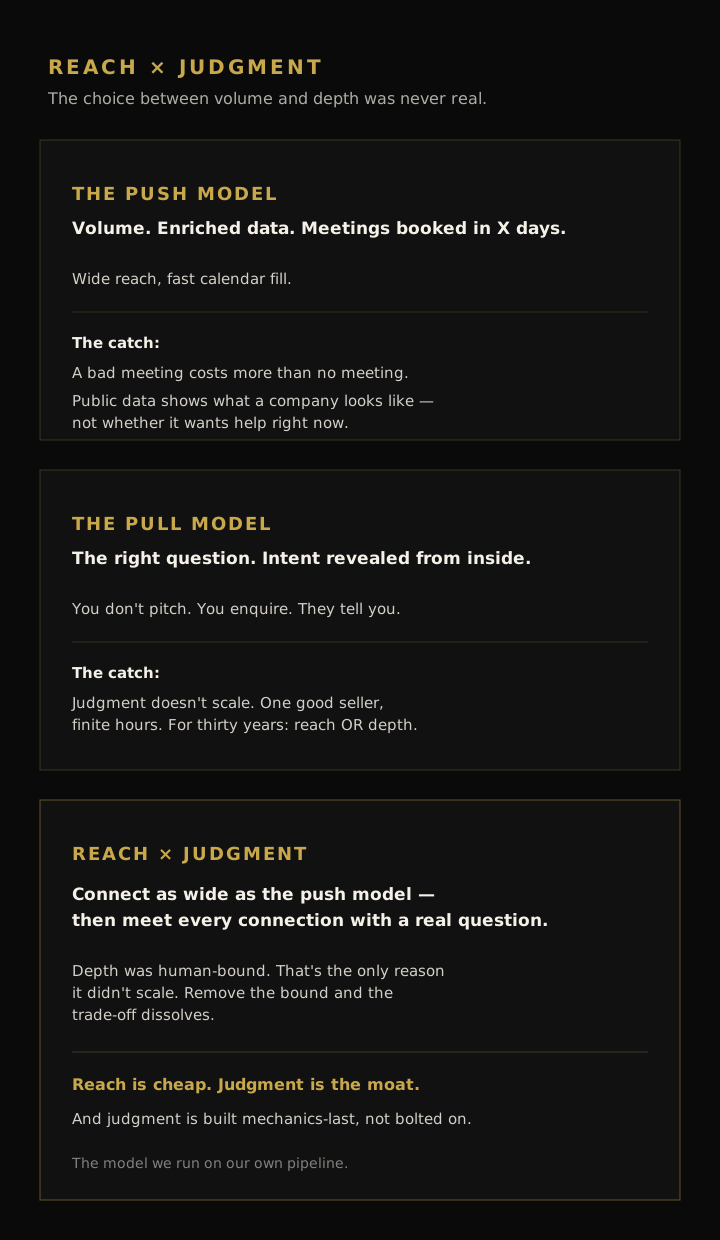
A bad meeting costs more than no meeting. Any consultative seller knows this in their body. An unqualified conversation burns an hour you won’t get back, spends positioning you can’t easily rebuild, and sometimes damages a relationship that might have converted later if you’d simply waited. Yet the entire AI outreach category is built on the opposite belief: that more meetings, booked faster, is self-evidently good.
It is the wrong optimisation target, and most of the market has not noticed.
The metric problem
The AI SDR category competes on a single number: meetings booked in a fixed window. It is a clean, demoable metric, and it is the wrong one.
For a transactional, high-volume product, filling a calendar might be fine. For consultative selling — the kind most SME founders and senior operators actually do — it is corrosive:
- A meeting with someone who has no intent isn’t a neutral event. It costs your time and theirs.
- It trains your pipeline to look busy while converting nothing.
- It positions you as a vendor chasing a number, not a peer worth talking to.
- And it can spend a relationship you’d have been better off nurturing for another quarter.
The real skill in consultative selling has always included knowing when not to reach out. A system optimised purely for booking volume cannot have that skill, because the skill is a restraint and the system is rewarded for the opposite.
The data illusion
The category’s answer to “how do we book better meetings” is “buy more data.” Platforms are built on databases of hundreds of millions of contacts, wrapped in enrichment layers: funding signals, tech stack, headcount, recent job changes. The pitch is that with enough signal, you can infer intent from the outside.
You cannot. All of that is supply-side inference. It tells you what a company looks like. It cannot tell you whether the timing is right, whether they’re ready to buy, whether they’ve just been burned by something adjacent, or whether the person reading your email had a terrible morning and will never forgive a cold pitch today.
There is a structural problem underneath this, too. At scale, everyone is pulling from the same data sources. So the “personalisation” that’s supposed to differentiate your outreach is built from inputs identical to your competitors’. Everyone arrives at the same prospect, on the same signal, with the same enriched opener. The personalisation cancels out.
Public data describes. It does not reveal. And intent is something you can only get from the inside.
The pull model
If you can’t infer intent from the outside, you create it from the inside — by starting a real conversation and asking a question good enough that the prospect tells you where they actually are.
This is how senior consultative sellers have always worked. You don’t pitch. You enquire. The question that makes the other person stop and think is worth more than any enriched data point, because it surfaces the one thing no database holds: what they want, right now, in their own words.
The catch has always been that this doesn’t scale. Asking the right question at the right moment, then genuinely listening to the answer, is judgment work. One good seller has finite hours. So for thirty years the trade-off has been brutally simple: you could have reach, or you could have depth, and the volume tools exist precisely because most people, forced to choose, chose reach.
You don’t have to choose
Here is what has actually changed, and it is not “AI books more meetings.”
The reason reach and depth were a trade-off is that depth was human-bound. The judgment lived in one person’s head and ran at one person’s pace. If you could hold a genuine, intent-revealing conversation at scale — connect as widely as the volume game allows, and still meet every one of those connections with a real question rather than a templated pitch — the trade-off dissolves. You get the reach of the push model and the judgment of the pull model in the same motion.
That is the model I run on my own pipeline. We use Axia, our own AI operating system, to do exactly this: connect broadly, then carry each conversation properly — asking, not pitching — until the person reveals whether there’s something real here or not. The reach is wide. The conversations are still consultative. I’m sharing how we do it, not selling it to you.
But here is the part the category keeps missing, and it’s the reason most of these platforms can’t do it even with more compute and more data:
The founder gap
You cannot automate a judgment you have never had.
Most AI outreach platforms are built by technical founders who are excellent engineers and have never carried a quota. They automate the mechanics they can see — sending, sequencing, enriching — and miss the intelligence they’ve never practised, because it was never visible to them. The gap isn’t compute or data. It’s commercial judgment, the kind that only comes from years of being in the room when a deal lived or died on a single question.
And you can’t hire your way out of that quickly. Bringing a senior sales operator in to teach an agent how to sell requires the right person, real authority over the product, and time — usually more time than a funding cycle allows. A system built mechanics-first and judgment-bolted-on-later carries that order of operations in its bones.
The alternative is to build from the judgment outward: encode how a good conversation actually works first, then add the reach. That ordering is the whole difference, and it is not something you can retrofit.
So if you are evaluating AI for outreach, stop asking how many meetings it books. Ask what it does in the conversation, who taught it to do that, and whether the people who built it have ever had to ask the question that decides a deal. Reach is cheap now. Judgment is the moat — and judgment is still the thing you cannot buy by the database.
Ready to take the next step?
Most AI is sold as a tool. Axia is built as the operating layer your business actually runs on.
How V8 thinks about AI architecture