A prospect asked me this week what makes V8 different from a firm that had cold-pitched her.
It’s a fair question. I don’t think she expected the answer she got.
The short version is that V8 isn’t a reseller, isn’t a SaaS subscription, and isn’t a consultancy that hands you tools and wishes you luck. The long version is a story about a business I used to run, a category that disappeared, and what I decided to build instead.
This is the long version.
The business that worked
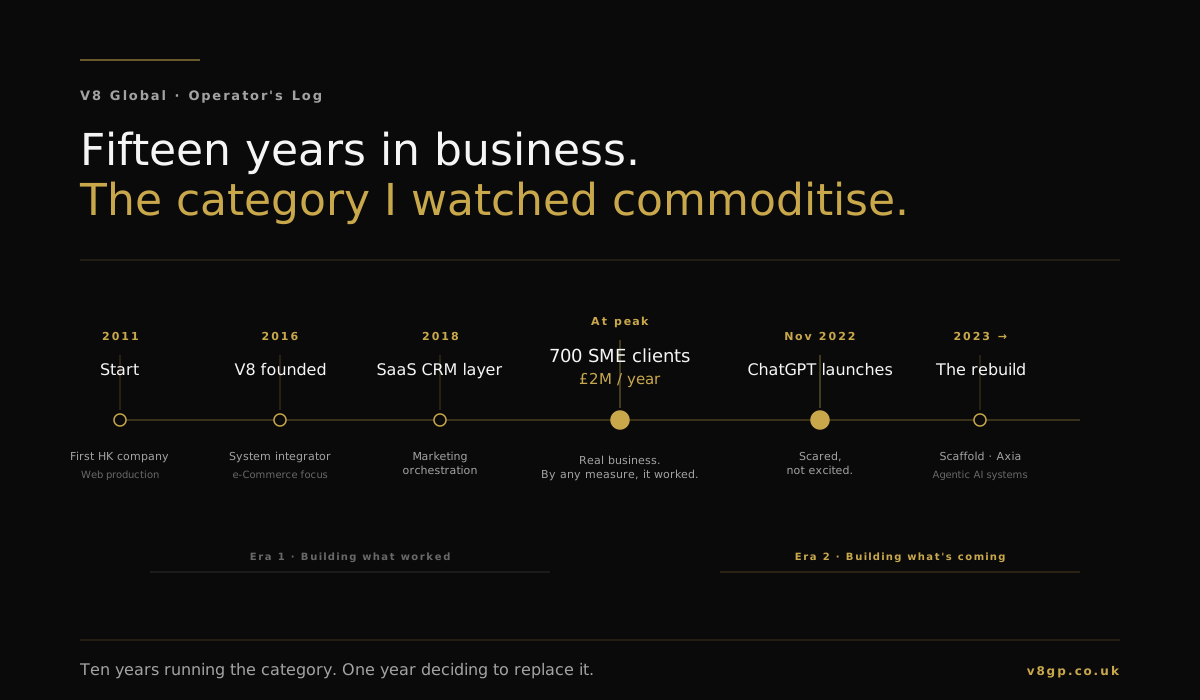
V8 Global started in Hong Kong about ten years ago. I’ve been in business fifteen years across two companies.
We began as a web and mobile production firm. Simple work. Clients came to us with a brief, we built the thing, they went away.
Then the briefs started changing. Clients stopped asking for websites and started asking how to get the website to generate business. That question pulled us into marketing. And once you’re in marketing for an SME, you can’t stay in one layer — you need the CRM, the pipeline, the customer journey, the whole commercial stack pulling in the same direction.
So we became a system integrator. Then from 2018, we layered a SaaS CRM model on top — and alongside it, we acted as a marketing orchestration layer between clients and their external agencies. Making sure nothing was pulling against anything else.
At peak, we had 700 SME clients in Hong Kong. Revenue around two million pounds a year. Every one of those clients was a real transaction, auditable.
That was a real business. By any honest measure, it worked.
The moment I understood it wouldn’t keep working
Then ChatGPT launched.
My technical team had already been working with custom AI models for clients, so the launch itself wasn’t the shock. The shock was what I saw when I looked at what we’d built.
Most operators I knew felt excited. I didn’t. I felt scared.
Because I looked at our sales workflows, our marketing sequences, our CRM logic — years of accumulated IP — and I realised a single person with a good prompt could replicate most of it. Not all of it. But enough. And the gap between “some of it” and “all of it” was going to close fast.
That’s not a threat you can argue with. It’s physics.
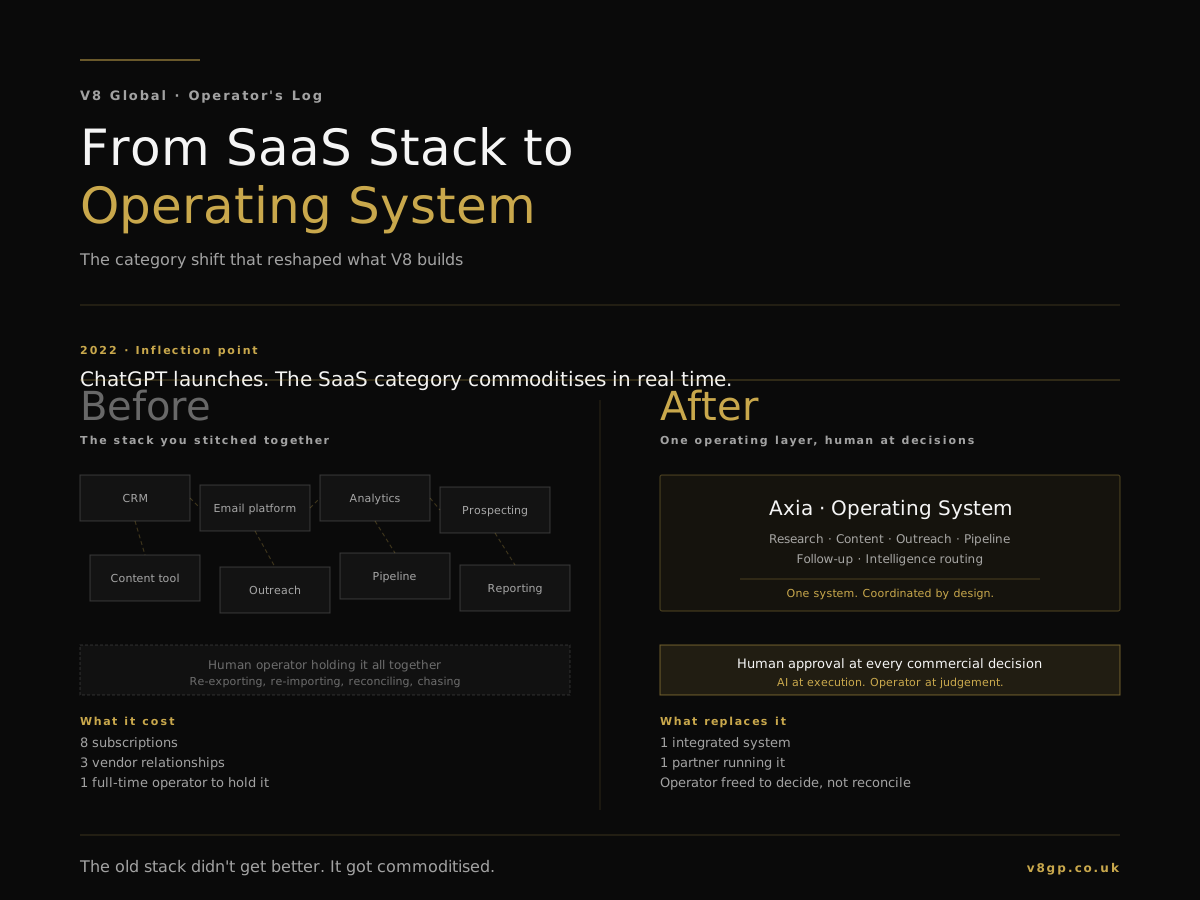
Then SaaS valuations corrected hard. The category I’d built my business on got commoditised in real time. Tools that used to cost thousands a month got compressed into features inside larger platforms. Marketing orchestration, the thing we specialised in, stopped being a product category and started being a checkbox.
I watched this happen with a specific feeling. Not panic. Recognition.
The decision
I had two options. Defend what we’d built — squeeze another few years out of the model, ride the curve down. Or stop defending, and start building what was coming.
I chose the second. That’s what V8 Global is now.
I went deep into AI, not as a tool but as an engineering discipline. Learned the architectures. Built systems. Tested what actually worked in commercial operations, what didn’t, and where the real gaps were.
What I found is this: you can run a full marketing operation — research, content generation, outreach, pipeline management, follow-up, intelligence routing — with a fraction of the team it used to require. Not a worse version. An actually better one. Faster, more consistent, and with human approval at every commercial decision.
That’s the system V8 now builds. Scaffold is the build service. Axia is the managed operating layer. Both exist because I spent ten years running the thing they’re replacing, and I understood why the old model was breaking before most of the market did.
Where this leaves V8
Most of the firms now entering the AI-for-business space are coming from one of three directions.
IT providers are reselling productivity tools. Microsoft Copilot, generic document AI, internal admin efficiency. That’s a legitimate business — but it’s IT infrastructure work, not commercial operations work. They’re positioned to help you file things faster, not to run your pipeline.
SaaS platforms are bolting AI onto existing products. An AI feature inside a CRM, a prospecting tool with AI enrichment, an email platform with generative drafts. Also legitimate — but you still have to operate them. You still have to make them talk to each other. You still have to be the one holding the thing together.
Consultancies are selling strategy. Which is fine until you realise strategy without build capability is a deck.
V8 is positioned differently because the path here was different. The technical depth comes from building commercial systems for a decade. The domain expertise comes from running a 700-client marketing orchestration business. The decision to go agentic-AI-first came from watching the previous category collapse and deciding to get ahead of the next one rather than defend the last one.
That’s not a feature list. It’s an operator’s history.
What the prospect wanted to hear
She didn’t want a comparison chart. She wanted to know whether we’d understood the problem she was actually facing — which was that her current tooling had fragmented into eight subscriptions, nobody was operating them in a joined-up way, and she didn’t have the internal capability to change that.
That’s the gap V8 was built for. Not because we designed a solution and went looking for people who fit. Because we ran that exact business, watched it break, and rebuilt it as one system instead of eight.
If you’re in the same position — a commercial operation stitched together from tools that don’t talk to each other, and nobody internal with the bandwidth to fix it — Scaffold is how that gets audited and rebuilt. Axia is how it runs afterwards.
Not every prospect needs that. Some need a better CRM. Some need a junior marketer. Some need to stop buying tools and start deciding what they actually want their business to do next.
But for the ones who do need it — V8 is what we built because we lived through the reason it needs to exist.
Alan Law is founder of V8 Global and architect of Axia. Operator’s Log posts document how AI-native systems get built — and operated — in practice. For the community side of V8, follow Gina Cheng.