At AI Engineer Europe this April, Matt Pocock — one of the most watched developer educators in the TypeScript space — made an argument that runs against the current hype.
AI coding tools accelerate code generation. But without sound architecture underneath, they accelerate entropy just as fast.
The pattern he describes is consistent: teams that hand everything to AI and skip the fundamentals end up with codebases nobody can maintain — including the AI. The teams that succeed combine AI execution with classical engineering principles: deep modules, test-driven development, ubiquitous language, vertical slices.
His talk is worth 20 minutes of anyone’s time: It Ain’t Broke: Why Software Fundamentals Matter More Than Ever
What struck me was not that his argument was new. It was that he arrived at the same place we did — from a completely different direction.
We built Axia before we read Pocock
Axia is an AI business operating system for sales and marketing operations. It runs on a server. It monitors signals, evaluates pipeline movements, drafts outreach, and proposes actions for human approval before anything goes out.
The build methodology underneath it — what we call Scaffold — is: human in at decisions, AI in at execution.
Pocock calls it “strategic programming.” We call it human-in-the-loop. The shape is identical.
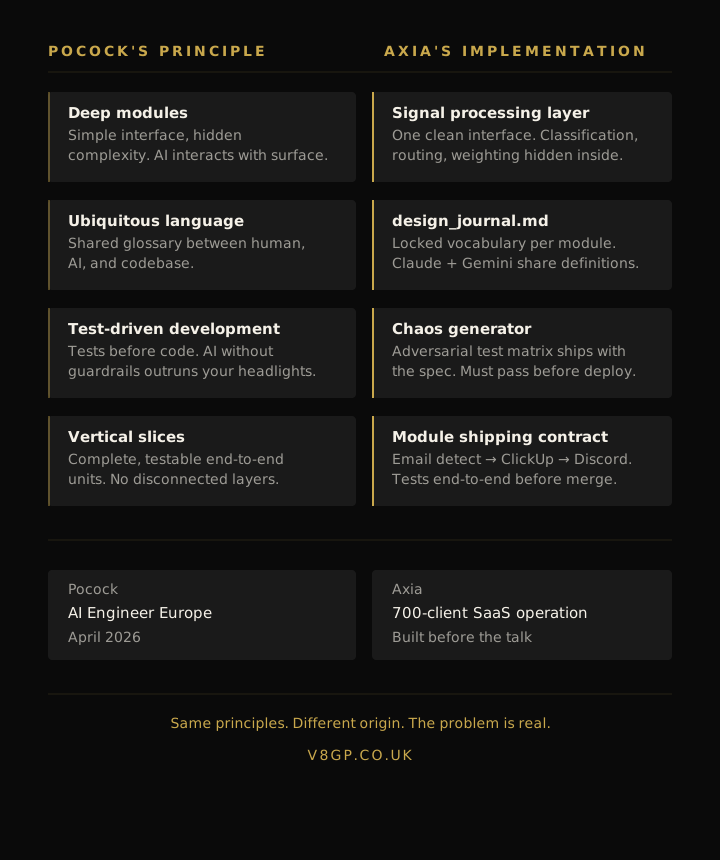
Here is what we built, and what Pocock prescribes:
Deep modules. Axia’s signal processing layer has one clean interface. The internals — how signals are classified, confidence-weighted, and routed — are hidden behind it. AI agents interact with the interface. They do not need to understand what happens inside. Pocock’s argument exactly.
Ubiquitous language. Every design decision in Axia is documented in a design_journal.md. Every module has a locked vocabulary — what a “signal” means, what “propose mode” means, what a “protected status” means. When Claude Code builds a module and Gemini generates adversarial test cases against it, they are working from the same glossary. Pocock calls this the most underrated failure mode in AI-assisted development.
Test-first, not test-after. Before Axia builds anything, it generates chaos cases — adversarial scenarios designed to break the module before it ships. The test matrix ships with the spec, not after the build. Pocock’s TDD argument is that AI without test guardrails will outrun your headlights. We built the guardrails first.
Vertical slices. Each module in Axia ships as a complete, testable vertical — email detection to ClickUp update to Discord notification. No horizontal layers sitting unconnected. If a slice cannot be tested end to end, it does not ship.
We did not design Axia by reading Pocock’s slides. We designed it by running a 700-client SaaS marketing operation and watching what breaks when humans are not in the loop at the right moments. The principles converged because the problem is real, not because the methodology is fashionable.
Why this matters for three different people
If you are considering using AI in your business operations:
The “vibe coding” failure Pocock describes is not just a developer problem. It shows up in any business that hands an AI tool a task without a designed process underneath it. You get a good first run. The fifth iteration is a mess. The tenth is unusable. The problem is not the AI — it is the absence of architecture around what the AI is doing.
Axia exists precisely because the architecture is the hard part. The AI is the executor. The system — the design, the guardrails, the human approval gates — is what we build and operate for you.
If you are evaluating Axia as an investment or partnership:
Pocock’s talk is a data point on where serious engineers are landing. The methodology is not Alan Law’s theory — it is the field converging. Axia’s build decisions were made before this talk existed. The alignment is evidence of direction, not positioning.
The defensible moat in AI-assisted commercial systems is not the AI. Every competitor has access to the same models. The moat is the accumulated design decisions, the documented variants, the test infrastructure, and the operator history that tells you what breaks in production and what does not. That is what Axia is building into its architecture with every deployed module.
If you are building with us:
This is why the design journal exists. Why the chaos generator runs before the build starts. Why the module-design protocol has three tiers of decision-making before a line of code is written.
You are not just following process for its own sake. You are building the kind of system Pocock describes as the only sustainable path for AI-era development. The teams that skip this step will be rewriting from scratch in 12 months. We will not.
The short version
AI makes good engineering more important, not less. The teams that understand this — and build accordingly — will have systems that compound in value. The teams that don’t will have expensive maintenance problems wearing an AI badge.
We built Axia on this principle before it became a conference talk. That is the only kind of validation worth having.
Ready to take the next step?
Most AI is sold as a tool. Axia is built as the operating layer your business actually runs on.
See how Axia works