Yesterday I shipped a post about three production regressions caught and recovered the day before. The post argued that recoveries are the proof point — that V8 ships operator-grade work because we have bad days first, and each one becomes permanent discipline.
That post landed yesterday morning. Today is the day after.
This post is the other half of the answer.
What today looked like
The discipline is what catches things when they go wrong. The cadence is what builds them when they go right. Today was the second kind of day.
Working backwards from the close:
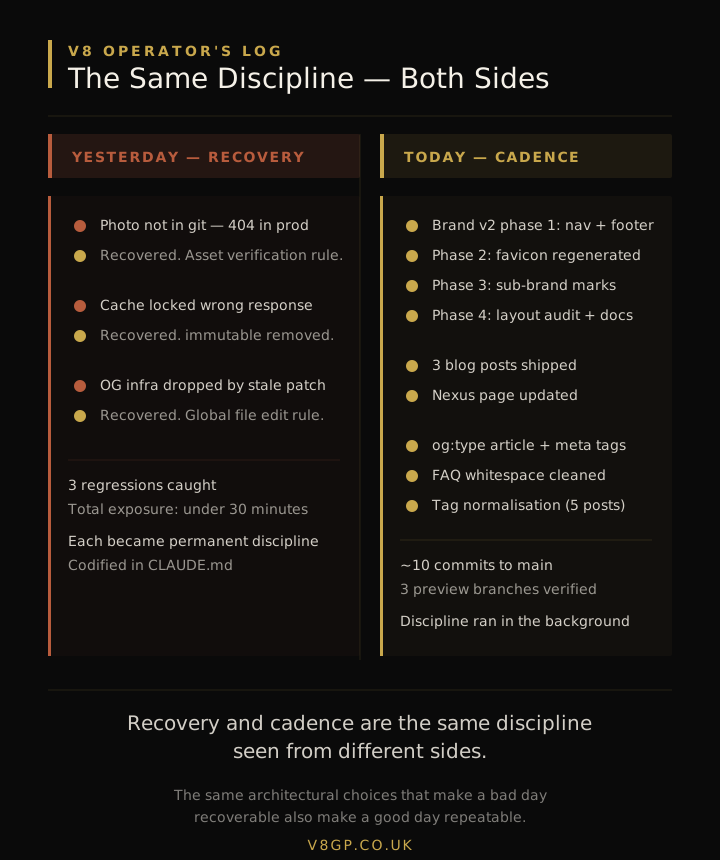
- The full V8 brand identity rolled out across the live site in four phases, end to end. Nav, footer, favicon, sub-brand marks on three pillar page heroes, brand documentation rewritten to match
- Three blog posts shipped to production — one Operator’s Log, one Leadership Insight, one Community Intelligence
- The Nexus page Gatherings section updated from pre-event placeholder text to a past-tense recap of the launch night, with a link to the new post
- SEO and GEO infrastructure tightened —
og:typecorrected on blog posts fromwebsitetoarticle, four article-specific meta tags now populating from frontmatter, FAQ JSON-LD whitespace artefacts cleaned across two product pages, five early posts category-tag normalised - The operating contract document updated with eight new operational rules drawn from the previous arc, plus a current-state progress note for session continuity
- Roughly ten commits to main, three preview branches verified before merge
That is the surface. The texture underneath is what makes the post worth writing.
The point is not the volume. It is the cadence.
I shipped a post earlier this week called Consistency Is the Asset — about why search engines, social platforms, and AI assistants reward predictable output rather than occasional brilliance. Most SME founders cannot sustain that cadence while running the business.
What today demonstrated, more than the specific deliverables, is what the production layer feels like when it actually runs. The brand rollout was four phases shipped across two days. Each phase ran the same workflow: editorial decisions made in chat, mechanical execution in the local terminal, preview branch verification before merge to main, production curl checks after deploy. No phase shipped without going through the full discipline. No phase took longer than it should have.
The volume that came out of those two days — call it twelve commits, three blog posts, four brand phases, a Nexus page rebuild, a CLAUDE.md consolidation — would have been an unsustainable sprint at any prior moment of V8’s history. The reason it was sustainable now is that the production layer is built. The discipline runs in the background. The operator’s attention can stay on judgement calls because the mechanical work is contained.
The one moment worth zooming in on
The whole arc had moments, but one stands out as the kind of judgement call that demonstrates how the operating method actually behaves under pressure.
In the brand rollout, phase 3 deployed combined V8 + sub-brand marks on the three pillar page heroes — /axia/, /nexus/, /scaffold/. The marks landed cleanly. The visual was right. The system felt complete.
Then I noticed the homepage.
The homepage’s “What we build” section uses a different visual treatment for the same three pillars — bespoke typographic lettermarks. Large gold serif A, N, S, with small numerals 01, 02, 03 above. Editorial design, magazine-style — the kind of thing you would see in a Monocle feature, not a software-product page.
The brand-system-consistency instinct was clear: replace the lettermarks with the new combined marks. Make the homepage match the pillar pages. Close the system loop.
I almost did it.
What stopped me was a small, sharper question: do the lettermarks earn their place, or are they an artefact of an earlier moment? Looking at them carefully against the new combined marks, the answer was unambiguous. The lettermarks were not a stale design choice waiting to be replaced. They were doing rhetorical work the combined marks could not — operating in a different register, asserting a different visual hierarchy, signalling that the homepage is not the same surface as a product page.
Replacing them in the name of system consistency would have flattened the homepage. The combined marks belong on product pages where the pillar identity is being asserted directly. The lettermarks belong on the homepage where the editorial register is the point.
Different surfaces, different visual jobs. Both align with the brand voice. Neither is an inconsistency that wants fixing.
We documented the decision in the brand identity doc, specifically so a future session — or a future me, three months from now — does not “fix” it as an oversight.
This is what the production layer actually does. It does not just execute. It also defends judgement calls against the system pressure to homogenise. The lettermarks survive because the operator chose to preserve them. The combined marks ship because the operator chose to deploy them. Different choices, both deliberate, both documented.
The pairing
Yesterday’s post was about what happens when things go wrong. Three regressions, three recoveries, three new permanent rules in the operating contract.
Today is what happens when things go right. Volume that would have been unsustainable two months ago, shipped through a discipline that absorbs the mechanical work and surfaces the judgement calls.
Read together, the two posts tell the operator-grade story more completely than either tells it alone. Recovery and cadence are not opposites. They are the same discipline seen from different sides — the same architectural choices that make a bad day recoverable also make a good day repeatable.
That is what V8 sells, when V8 sells AI operating systems for sales and marketing. The production layer that catches things when they go wrong, and ships things when they go right. The same layer either way.
What this is for
If you are running an SME and you find yourself doing operator work — content production, follow-up sequences, social posting, schema maintenance, brand consistency, the small accumulating tasks that keep a business visible — you already know the gap between being able to do the work occasionally and running it as ongoing operations.
Most weeks, most operators close the gap with willpower. Some weeks the willpower runs out and the website goes stale. The follow-ups slip. The pipeline thins. The systems work when the operator is fresh and degrade when the operator is tired.
The alternative is not “automate the operator out.” It is “build the production layer underneath the operator.” The mechanical work moves into a discipline that runs whether the operator is fresh or not. The judgement work stays with the operator, where it belongs.
That is what Scaffold builds. The production layer for sales and marketing operations, designed for the SME owner who cannot afford to be the production layer themselves.
Yesterday’s post was about catching things. Today’s post is about shipping things. The two are the same thing.
For the build conversation about your specific operations, start with Scaffold.
Alan Law is founder of V8 Global and architect of Axia. Operator’s Log posts document how AI-native systems get built — and operated — in practice. The blog you are reading is one of the systems doing it.