There’s a question that exposes most AI sales tools immediately.
Who runs it tomorrow morning?
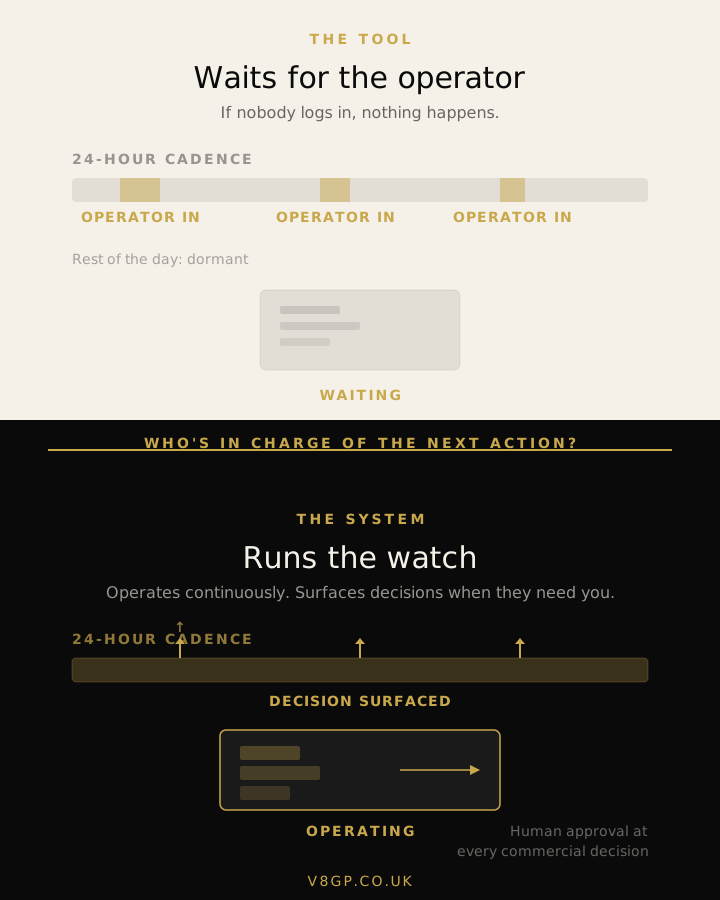
If the answer is you, what you’ve bought is a tool. A tool sits there until someone picks it up, briefs it, runs the workflow, reviews the output, and pushes the result somewhere it can have effect. Without a daily operator, a tool is dormant.
If the answer is the system, what you’ve bought is something different in category. A system that operates is running whether you’re watching it or not. It surfaces what changed, drafts what’s needed, flags what’s drifting, and presents the result to the human at the decision point.
The gap between those two answers is the operator gap. And it’s the gap that decides whether AI in your business is a productivity boost or actual leverage.
Why most AI sales tools sit on the tool side
The current market is dense with AI sales tools. Outbound prospecting platforms. Data enrichment layers. CRM-embedded assistants. Meeting notetakers. Email sequencers. Pipeline analytics layers.
Each of them is genuinely useful. Each of them solves a specific function well.
And each of them requires a person to operate it daily.
Someone has to set up the campaign. Someone has to review the enriched contacts. Someone has to brief the meeting summariser on what to flag. Someone has to write the follow-up sequence the AI personalises. Someone has to log into the dashboard, check the alerts, and decide whether to act.
This isn’t a flaw in those tools. It’s their design. They were built as enhancements to a human operator’s workflow. The operator does less of the manual work, but the operator still has to operate.
The result, for most SMEs, is the operator gap: AI tools sitting half-used because nobody on the team has the time, attention, or expertise to run them properly. The leverage is theoretical. The tools are paid for. Nothing compounds.
What a system that operates does differently
A system that operates is built around a different assumption: the human is the decision-maker, not the operator.
The system runs the function. It classifies inbound messages, tracks pipeline state, monitors follow-up timing, drafts responses, surfaces signals worth attention, queues tasks for human approval. It does this on its own cadence, not on the cadence of whoever logged in this morning.
The human reviews, decides, edits, approves. The work the human does is the work that requires judgement. Everything else has already happened.
This sounds like the same thing as a tool with good automation. It isn’t. The structural difference is who’s in charge of the next action.
In a tool: the human is in charge of the next action. The tool waits.
In a system that operates: the system is in charge of the next action. The human is in charge of the decisions the system surfaces.
That inversion is the entire point.
A real example from this week
The post you’re reading is a downstream artefact of Axia operating without an operator at the wheel.
This week, Axia processed a competitive intelligence run — pulling signals from across the AI sales and marketing category, classifying them by relevance to V8’s positioning, generating an executive digest with verification flags, recommended actions, and proposed public-facing outputs.
I did not run the research. I did not write the digest. I did not select which signals were significant enough to surface.
The system did all of that. I read the digest, made calls on what to act on, and three of those calls became blog posts — including this one.
The work that disappeared was the operating layer — the daily research, classification, summarisation, prioritisation. The work I kept was the judgement layer — what matters, what to ship, how to position.
That’s what an operating system does. It collapses the gap between AI capability exists and AI capability gets used, because nobody has to operate the AI for it to operate the function.
The smoke detector and the security guard
There’s a useful analogy here.
A smoke detector and a security guard both alert you to fire. The detector is cheap, reliable, and ubiquitous — but it only works when someone’s in the building to hear it. If the alarm goes off at 3am and no one’s there, the building burns.
A security guard works whether you’re in the building or not. The guard walks the perimeter, checks the cameras, responds to the alarm directly, and only escalates to you when a decision needs to be made.
Both protect against fire. The cost structures are different. The leverage is different. The fundamental design intent is different.
Most AI sales tools are smoke detectors. Useful, alerting, dormant unless someone’s there to act. Axia is the security guard. It runs the watch. It only surfaces what needs you.
That’s the operator gap. And it’s the difference between AI that costs you and AI that earns for you.
What to ask before buying any AI sales tool
If you’re evaluating an AI sales or marketing tool, there’s a single question that separates the tool category from the system category:
If nobody on my team logged into this for a week, what would happen?
If the answer is nothing — the tool would sit there waiting — what you’re looking at is a tool. Useful, but it’s adding work to your team’s capacity, not replacing it.
If the answer is the work would still get done, the system would just queue more decisions for me when I’m back — what you’re looking at is a system that operates.
Most AI sales tools fail that test. Axia is built to pass it. Every morning, Axia tells you who to talk to, what to say, and why today. The system has already done the operating. Your job is to make the calls.
That’s the inversion. And the operator gap is the line that decides which AI tools actually compound and which ones sit on a shelf.