Here’s a situation I hear about more than you’d expect. A consultant or agency owner has a genuinely strong offer. Their results are real, their clients are happy, their network respects them. And then a prospect comes in, gets a quote, and says: “That’s a lot — I thought I’d just use Squarespace.”
Not because Squarespace is actually the right answer. Because that’s the frame they arrived with.
By the time you’re in a pitch meeting, it’s already very hard to fix this. The prospect has mentally categorised your offer alongside every other “build something for me” option, and they’re comparing on price. You’re fighting a comparison that was never fair to begin with — and you didn’t set the frame, so you’re not in control of it.
This is the proposition gap. It’s not a proposal problem. It’s a positioning problem that sits upstream of every conversation you’ll ever have.
Why the frame arrives broken
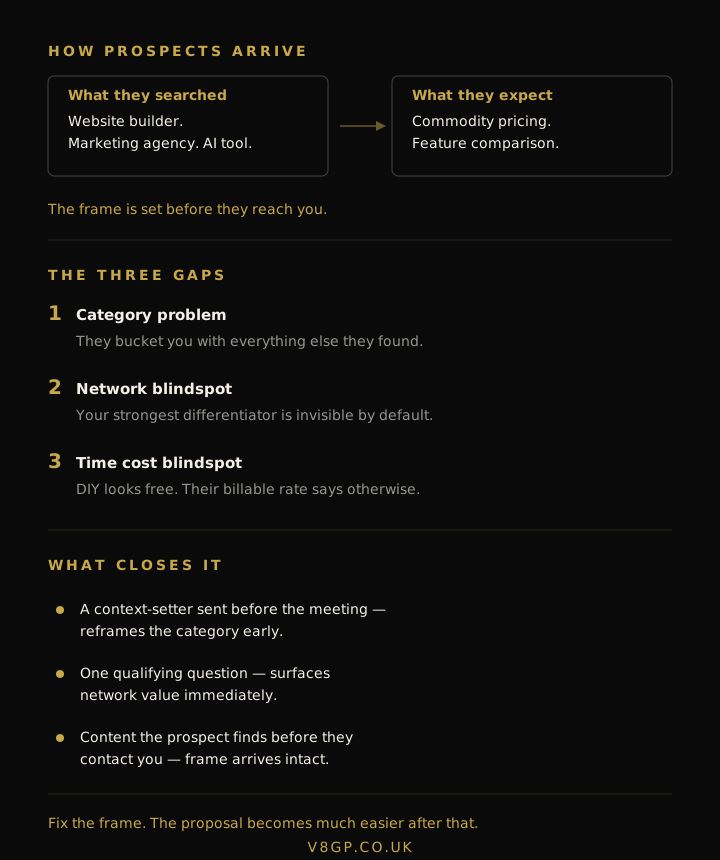
When a business owner decides they need help — with marketing, with digital presence, with AI, with growth — they don’t start by researching providers. They start by searching for a category. “Website builder.” “Marketing agency.” “AI tool.” That search sets the reference point, and the reference point sets the price expectation.
Unless something interrupts that process before they reach you, they arrive having already decided what category you’re in. And if they’ve put you in the wrong category, your pitch is working against a frame you didn’t choose.
The correction has to happen before the meeting, not during it. By the time someone is sitting across from you — or reading your proposal — they’ve already done most of their mental processing. Reframing at that stage feels like a sales tactic rather than a genuine insight.
The three gaps that compound
The category problem. A client searches “help with AI for my business” and finds a mix of SaaS tools, IT providers, and training courses. They arrive with a rough price expectation built on whatever they saw first. If your offer doesn’t explicitly sit outside that category before they talk to you, it gets bucketed with everything else they found.
The network blindspot. If you have a strong professional network — or access to one — that’s one of your most powerful differentiators. But it’s invisible unless you surface it early. A client comparing you to a freelancer on a platform has no idea they’re also comparing eighteen months of cold outreach against one warm introduction from someone who already knows them. That comparison needs to be made explicit and made early. Otherwise it simply doesn’t register.
The time cost blindspot. DIY looks free. It isn’t. Every hour a specialist spends learning a tool they’ll use twice is an hour of their own billable rate spent invisibly. That calculation almost never gets done spontaneously — someone has to do it for them, and do it before they’ve already decided to DIY.
What actually closes the gap
Three things, none of which is a better proposal.
A context-setter before any pitch. Not a brochure, not a credentials deck — a short piece of communication that reframes the category before the conversation starts. Something that says: here’s what problem you actually have, here’s why the solutions you’ve been looking at don’t address it, here’s what does. Sent before the meeting. Read before they’ve formed a strong view. This is the document that determines whether your pitch lands in the right category.
One question that surfaces the network value early. Something like: “How are you currently finding your best clients — ads, referrals, or introductions?” The answer tells you immediately what they understand about relationship-led growth. And the question itself signals that you operate in a different frame than a typical provider.
Content that does the positioning work passively. The best version of this is content a prospect encounters before they ever contact you — that already explains the category distinction, already does the DIY cost calculation for them, already places you in the right comparison set. By the time they reach out, the frame is set. The pitch confirms rather than corrects.
This is why community matters more than most people give it credit for. A warm introduction from someone who has already explained what you do — and why it’s different — is worth more than any amount of pre-pitch content you could create yourself. The frame arrives intact because someone the prospect already trusts set it for them.
V8 Nexus exists partly for this reason. A room of people who understand what intelligent, relationship-led growth looks like — and who introduce each other accordingly — is a positioning asset. Not just a network.
The practical implication
If you’re losing pitches you should be winning, the instinct is usually to improve the proposal. Add more case studies, sharpen the pricing, tighten the deliverables.
That’s rarely where the problem is. The problem is usually upstream — in what the prospect believed before they read the proposal at all.
Fix the frame. The proposal becomes much easier after that.
Ready to take the next step?
Most AI is sold as a tool. Axia is built as the operating layer your business actually runs on.
Join V8 Nexus