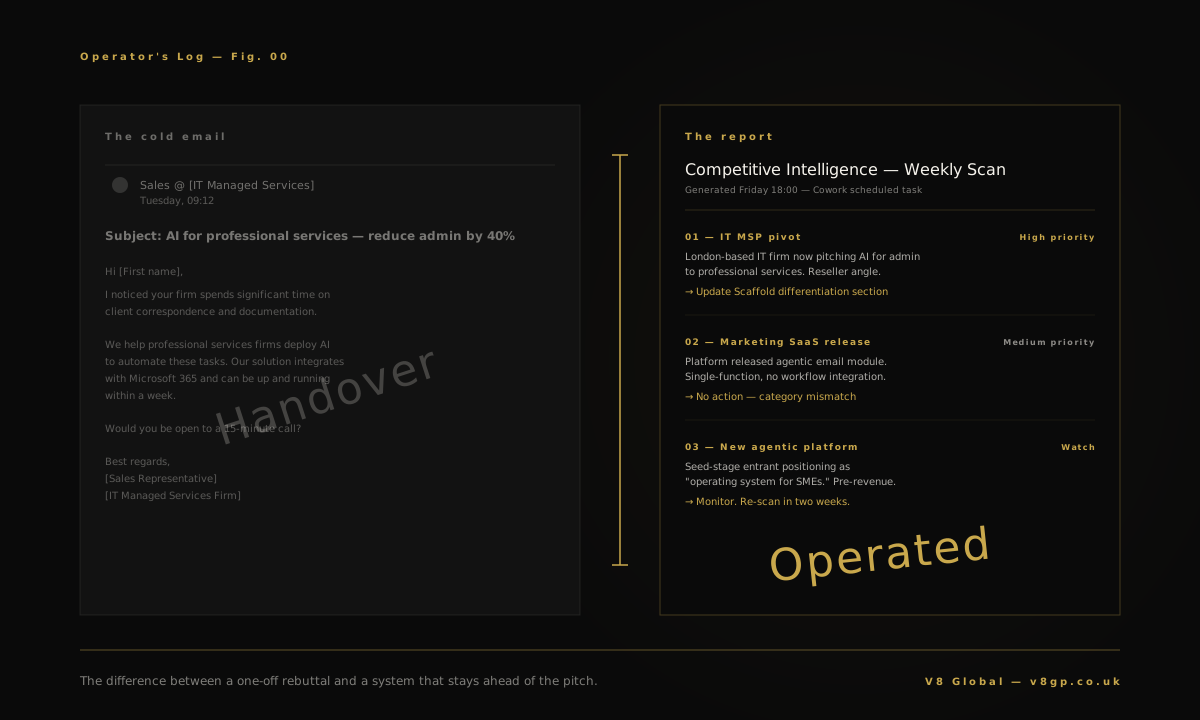
A client forwarded me a competitor’s cold email last week. The subject line was professional, the angle was reasonable — they’d spotted that professional services firms spend too much time on admin and correspondence, and were pitching AI as the answer.
The email was from an IT managed services firm.
My client added three words: “Competition for you!”
He was right. And wrong.
What the email was actually selling
The firm behind the email — an IT MSP based in London — was pitching an angle every provider is running right now. AI for admin. Document management. Internal efficiency. It’s a real pain point, and it’s not a bad entry.
But when I looked at what they actually do, the picture got clearer. They manage IT infrastructure. Cybersecurity. Remote support. The AI play in that email was almost certainly a reseller position — Microsoft Copilot, or something equivalent — bolted onto an existing managed services practice.
That is a tool handover. You get the product, they wish you luck, and you figure out how to make it useful on your own.
What V8 builds is different. But the problem is that “AI for your business” looks like a single category from the outside — especially when every provider is using the same language.
That’s a positioning problem. And it needs a system, not a one-off rebuttal.
The real differentiation — why it’s not obvious
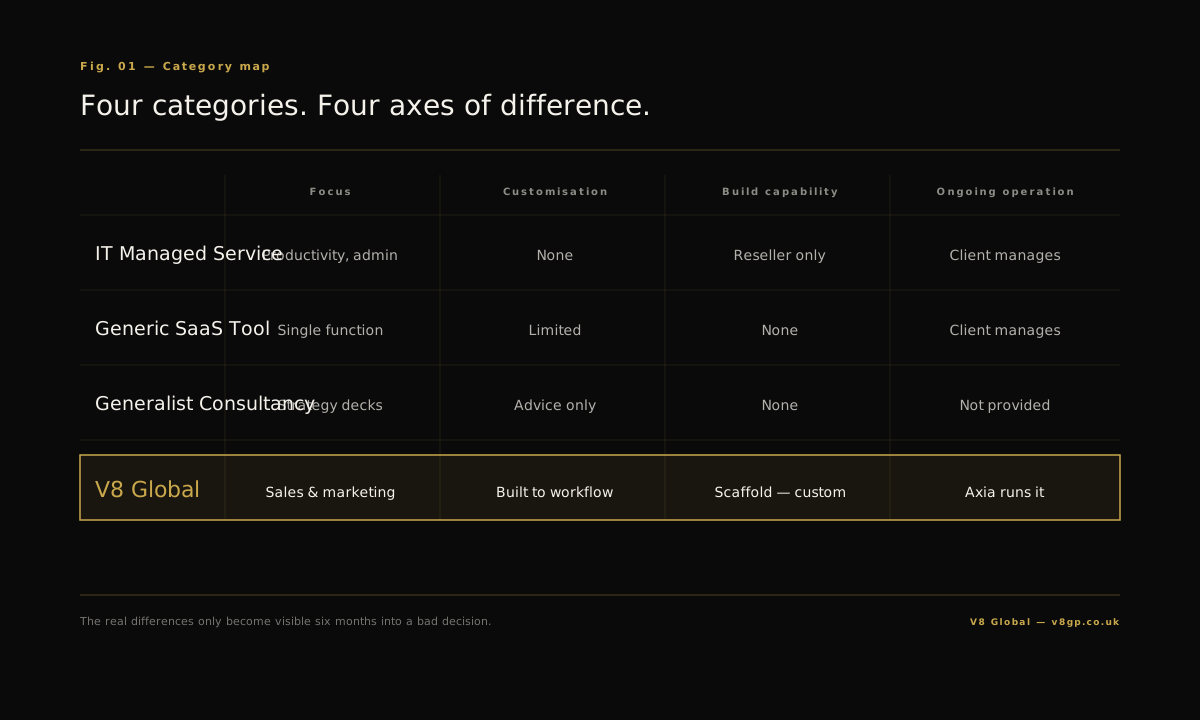
The distinction between an IT firm pivoting to AI and what V8 actually does comes down to three things.
1. The focus is sales and marketing, not productivity.
Axia — V8’s AI operating system — handles the commercial operations of a business. Email intelligence. Pipeline management. Follow-up monitoring. Content generation. Outreach. These are revenue-generating functions, not admin functions. When Axia reads an inbound email, it’s not helping you type faster. It’s classifying the lead, updating the CRM, tracking the action item, and telling you when to follow up — with human approval at every commercial decision.
An IT firm selling a productivity tool cannot make that claim. Their AI helps you draft documents. Axia runs your pipeline.
2. The build is custom, not pre-packaged.
Scaffold — V8’s consulting and build arm — starts from the specific business problem. We map how a business actually operates, identify where AI agents create the most value, and build systems that integrate with what’s already in use. No rip-and-replace. The engagement ends with a working system, not a licence key.
An MSP reselling Microsoft Copilot is handing you a product and moving on. Scaffold builds the architecture around your workflow, then hands it to Axia for ongoing management.
3. We run it. We don’t hand it over.
This is where most AI vendors fall short. They sell the tool. You manage it. When it stops working or drifts out of alignment with how your business operates, that’s your problem.
Axia is a managed operation. After Scaffold builds the system, Axia runs it — checking email, updating records, drafting replies, escalating decisions — while every commercial action routes through a human for approval before it executes. The client doesn’t need to become a technical operator. V8 handles that.
Why this keeps happening — and what to do about it
The competitor email wasn’t a threat. It was a signal.
As AI adoption accelerates across professional services, the number of providers claiming AI capability is growing faster than the quality of what’s being delivered. IT firms are pivoting. SaaS tools are bolting AI onto existing products. Generic automation platforms are positioning as operating systems.
For a business owner trying to evaluate options, the surface looks crowded and confusing. Everyone is using the same words. The real differences only become visible six months into a bad decision.
The right response is not a better sales email. It’s a cleaner, more specific positioning — and a system that keeps it updated as the market moves.
The system V8 built for this
After this conversation, I did two things.
First, I pulled together a competitive differentiation brief — a structured document mapping where V8 sits against every category of competitor currently entering this space. IT MSPs. Generic SaaS tools. New agentic platforms. For each, the brief records what they target, where they overlap with V8, and where the clear differentiation sits. That brief feeds directly into the website — copy updates, page positioning, the comparison language that helps a prospect understand the difference without having to ask.
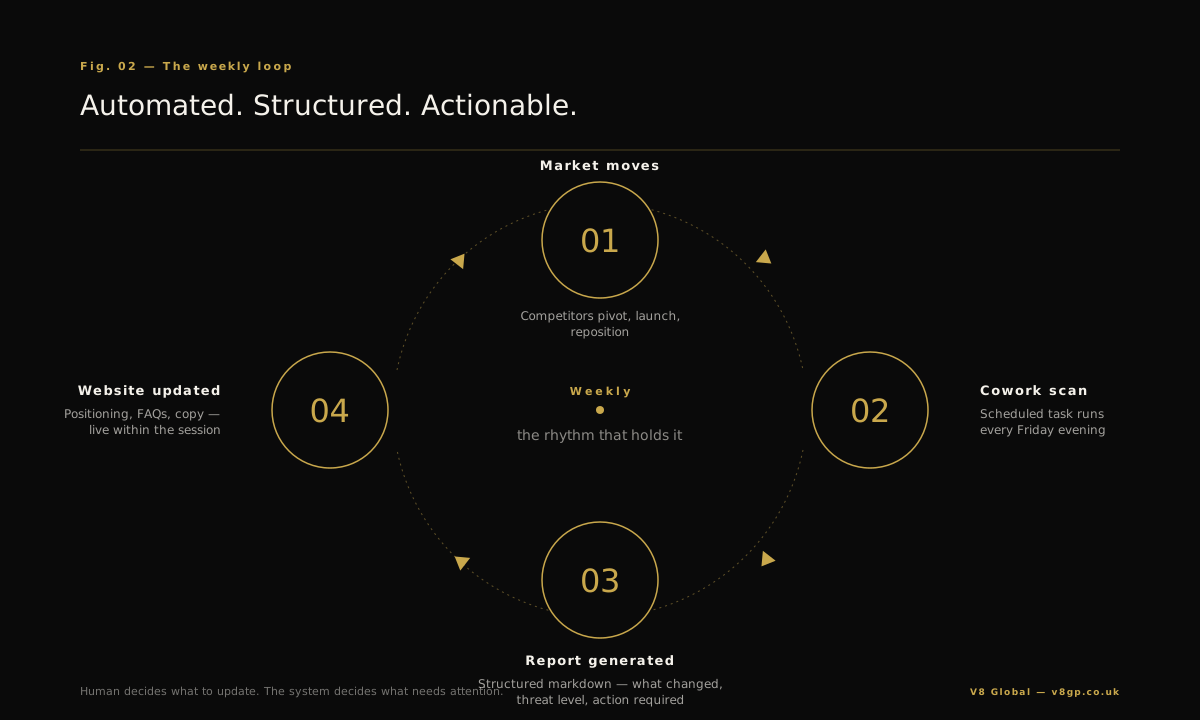
Second, I built a Cowork scheduled task that runs every Friday evening. It searches across competitor categories — IT MSPs pivoting to AI, marketing SaaS updates, new agentic platforms launching — and generates a structured markdown report. The report flags what changed, what the threat level is, and what the website should update in response. It drops into a folder on my desktop, ready for the weekly build session.
The loop is: market moves → system detects it → report generated → website updated. No manual monitoring. No reactive scrambling. The differentiation stays current because the system maintains it.
What this means for any SME in a competitive market
The pattern is not specific to AI or marketing technology. Any SME in a sector where the competitive landscape is moving quickly faces the same problem: competitors evolve, positioning drifts, and the website that made sense twelve months ago no longer says the right thing.
The answer is not to monitor manually. It is to build a system that monitors, reports, and flags what needs attention — so the human decision is about what to update, not whether to look.
That is the difference between running a business reactively and running it intelligently.
What V8 can build for you
If your business is facing a similar problem — competitors changing their pitch, new entrants appearing in your category, your positioning no longer landing the way it should — this is exactly the kind of system Scaffold builds.
The competitive intelligence loop described in this post took one session to design and one session to implement. The ongoing operation is automated. The output is actionable every week.
If you want to see how it works for your business, start a conversation with us.
Alan Law is Co-Founder of V8 Global and architect of Axia and Scaffold. He writes Operator’s Log posts on how AI-native systems are built and operated in practice. For community and client-facing work, follow Gina Cheng.