Someone asked Gina this at a recent event. It’s a fair question. And it contains a category error worth unpacking properly.
“Why do you need Axia when Claude can do the things?”
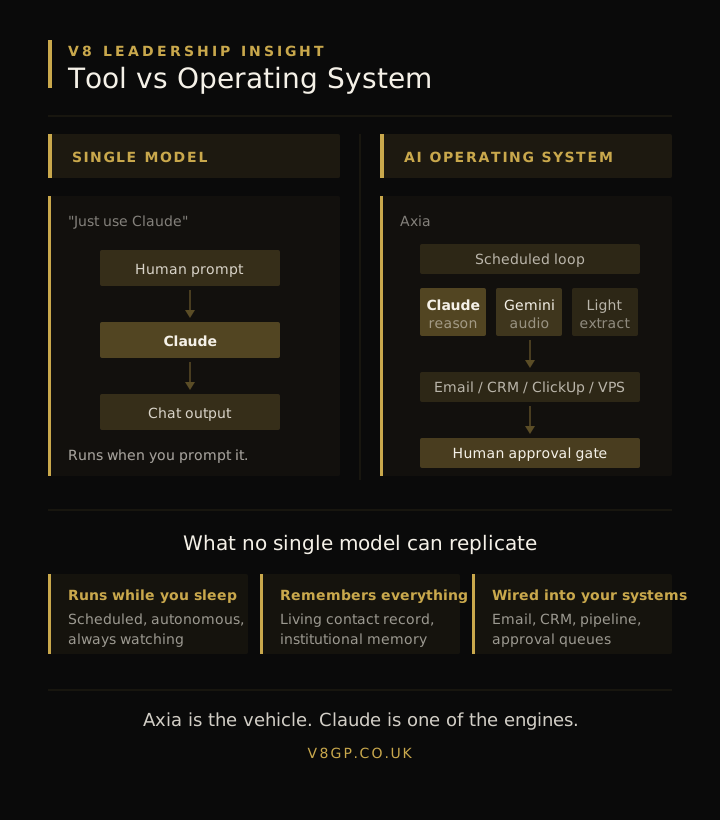
The short answer: Claude is one reasoning model. Axia is an orchestrated operating system that deploys the right AI at the right moment — automatically, on a schedule, connected to your actual business systems. They are not alternatives to each other. One is a component of the other.
But the longer answer is more useful, because the question reveals something important about how most people think about AI — and why that thinking keeps them stuck at the tool level, rather than the system level.
The category error
When someone says “Claude can do the things,” they’re imagining a workflow: open a chat window, paste something in, get a smart output. That works. For one task, once, when you’re present.
The moment you close the tab, it stops.
Claude has no memory of your contacts. No connection to your email. No awareness of your pipeline. No knowledge of what was said in last quarter’s follow-up. No ability to act on a signal you weren’t watching for.
Every Claude output begins with a human prompt. Axia doesn’t wait for one.
This is the category difference. Claude is a capable tool you operate. Axia is a system that operates.
Axia doesn’t run on a single model
Here’s the part that often surprises people: Axia isn’t even a “Claude system.” It’s a multi-model architecture.
Different tasks require genuinely different capabilities:
- Classification, contextual reasoning, and persona-driven content drafts — Claude handles these. The inference is deep, the output needs to sound like a specific person, and the reasoning has to hold up against nuance.
- Audio processing and structured test case generation — Gemini handles these. Its multimodal architecture and structured output capabilities are the better fit for these specific task types.
- High-volume, structured formatting and extraction tasks — these route to lighter infrastructure where appropriate. Not every task needs a frontier model, and the cost difference is significant at scale.
The architecture is built around a single principle: match the model to the task requirement, not to a brand preference. What I called the “imagination gap” in an earlier post — the meaningful difference between models that generate and models that reason past the document — shapes how Axia routes its workload.
“Just use Claude” standardises on one capability. Axia routes to the right one.
The three things no single model can replicate
1. It runs while you sleep.
Axia operates on a scheduled loop — classifying inbound emails, updating the CRM, advancing pipeline stages, flagging decisions to your phone. Nobody triggers it. It watches the inputs you don’t have time to watch, and acts on the ones that matter.
The commercial value of this is not in the AI quality per task. It’s in the coverage. The inbound that arrives at 11pm. The contact that’s gone quiet for six months and just sent a signal. The pipeline task that should have moved last week. Axia catches these. A chat window catches nothing you didn’t bring to it.
2. It remembers everything.
Axia maintains a living record of every contact — what they said, when they said it, what stage they’re at, what signals have been detected since. That institutional memory is the product. It’s why the weak-tie thesis underpins Axia’s commercial architecture: most B2B revenue doesn’t come from new prospects, it comes from relationships that went quiet. Axia keeps those relationships commercially active at a scale no human can sustain.
Claude resets to zero every conversation. There is no carry-forward, no context, no history — unless you build it yourself and paste it in every time. That is not a workflow. That is manual CRM.
3. It’s wired into your actual systems.
Axia reads from your email, writes to ClickUp, logs to your VPS, routes persona-appropriate drafts to Discord for approval. It operates inside the infrastructure your business already runs on. The output isn’t a chat response. It’s a pipeline update, a draft in your approval queue, a notification on your phone.
Claude operates in a tab you switch to. Axia operates in the systems you’d otherwise have to run manually.
Where Claude fits in this picture
Claude is one of Axia’s reasoning engines. It handles the tasks that require genuine inference — classification, contextual summary, content generation in a specific voice, edge case analysis. It is not a replacement for the system. It is a component deployed by the system for the right category of work.
The engine analogy holds: a high-performance engine is brilliant. It doesn’t drive itself. It doesn’t know where you’re going. It doesn’t remember the route. It doesn’t alert you when something needs attention. It does exactly what it’s asked to do, nothing more, and only when you’re there to ask.
Axia is the vehicle. Claude is one of the engines under the bonnet.
The competitive context
Every provider in this space — IT firms reselling Copilot, SaaS tools with AI bolted on, consultancies delivering strategy decks — hands the client a tool and walks away. The client becomes the operator.
That’s the same limitation as “just use Claude.” You’ve acquired a capable thing. You’re still responsible for running it. You still need to choose the right model for each task, build the memory layer, manage the system integrations, write the scheduling logic, set the approval gates, and show up every time something needs prompting.
The businesses that win with AI are not the ones who found the best model. They’re the ones who built the system around it — human approval at every commercial decision, AI at every execution step, the right model routing to the right task without anyone thinking about it.
That’s what Axia is. Not a smarter chat window. An operating layer.
V8 Global builds and operates AI systems for sales and marketing. Axia is the managed operating layer — built for businesses that understand the value and want it running, not handed over.
Ready to take the next step?
Most AI is sold as a tool. Axia is built as the operating layer your business actually runs on.
See how Axia works