The standard educator stack for AI products is Claude plus Vercel plus v0. It’s taught because it gets a working prototype in front of someone fast. Nothing wrong with that — fast feedback is how you learn what to build.
But there’s a version of that advice that reaches people who aren’t building prototypes. They’re building commercial systems they intend to deploy inside client infrastructure. And for that problem, the educator default is the wrong foundation.
Axia runs on Linux VPS. Here’s why that decision was made, and what it means for any AI system built to operate inside a real business.
Portability is a commercial feature
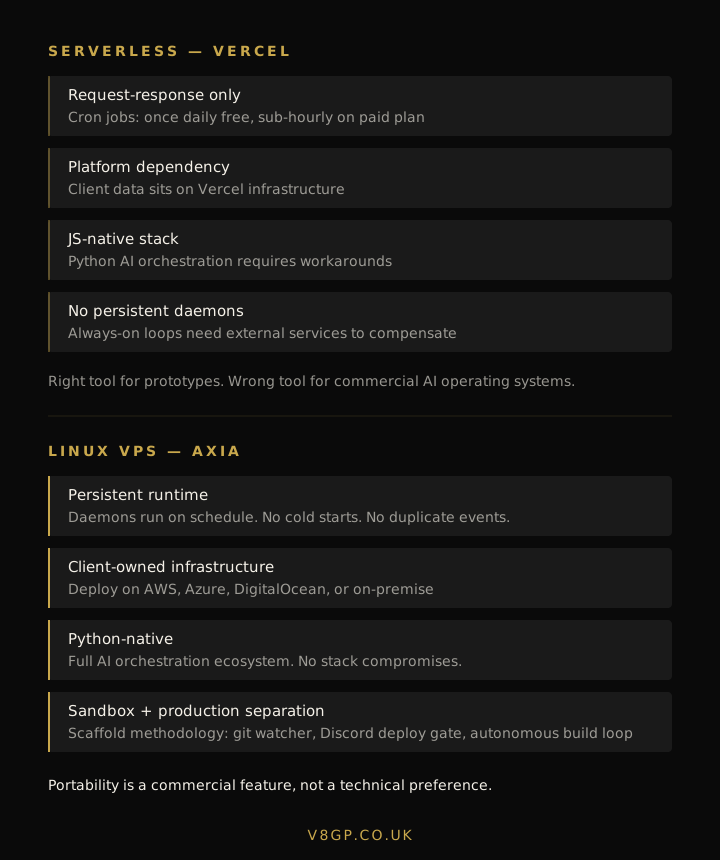
Axia deploys on any Linux environment — DigitalOcean, AWS, Azure, on-premise. The client owns their infrastructure, their data, and their runtime. On Vercel, you’re renting someone else’s platform and asking your enterprise client to do the same.
For any client with data residency requirements, an existing cloud contract, or a security policy that governs where data can sit — that conversation ends quickly. “It runs on Vercel” is not an answer that clears procurement. “It deploys on your existing AWS environment” is.
Portability isn’t a technical preference. It’s what makes the product sellable to the clients who have the budget.
Persistent processes need a persistent runtime
Axia’s core loop runs on a schedule — email monitor, CRM sync, pipeline advancement, Discord approval routing. These are always-on daemons, not request-response functions.
Vercel’s architecture is built for request-response. Cron jobs on the free tier run once daily. Pro unlocks sub-hourly — but you’re paying for something Linux cron does natively at zero marginal cost, with better timing precision and no duplicate-event risk from cold-start latency.
The moment your AI system needs to do something on a schedule without a human triggering it, you’ve outgrown a serverless deployment model. That’s not a criticism of Vercel — it’s the right tool for what it’s designed for. An always-on operating loop is not what it’s designed for.
The sandbox is methodology, not DevOps overhead
Axia runs on a two-VPS architecture: a sandbox environment where the autonomous Claude Code build loop runs, and a production environment where the commercial system operates. A git watcher on sandbox triggers a deploy gate — a 👍 in Discord promotes a build to production.
Vercel preview URLs replace deployment staging. They don’t replace an autonomous AI build agent running your entire development pipeline. The sandbox isn’t infrastructure cost — it’s where the Scaffold methodology lives. That separation has IP value independent of what it runs.
Claude Design closed the one genuine Vercel advantage
The honest argument for Vercel was v0 — fast UI prototyping with a shareable preview URL that a client could click without setting anything up. That was real.
Claude Design shipped in April and does the same job, inside the tool already running the entire build. The referral flow that would have gone to Vercel now stays within the same ecosystem. No additional platform dependency, same price bracket, better integration with the build context.
The day-one trade-off compounds the wrong way
Vercel is easier on day one in a JavaScript-native project. Axia is Python — not by accident. Python’s AI orchestration ecosystem is richer, the deployment model is infrastructure-agnostic, and the operator stays in control of the full stack.
The SQLite migration cost is real. It’s also one-time. The portability advantage runs permanently.
Every shortcut that makes day one easier by coupling you to a platform will surface as a constraint the moment a client asks where their data lives, who controls the runtime, or whether the system can run inside their own cloud account.
The question to ask before choosing an infrastructure dependency isn’t “does this work?” It’s “does this work when a paying client with a procurement process asks me to deploy inside their environment?”
V8 Global builds AI operating systems for sales and marketing on infrastructure clients can own. Scaffold is the build methodology. Axia is the commercial layer.
Ready to take the next step?
Most AI is sold as a tool. Axia is built as the operating layer your business actually runs on.
See how Axia is built