There’s a quiet shift happening in the UK SME market right now.
IT managed service providers — the firms that handle your infrastructure, your cybersecurity, your remote support — have started repositioning as “external technology directors.” The pitch extends from keeping your systems running into advising on AI adoption, building automation workflows, and shipping agent-based tools.
The pitch has obvious appeal. You already have a relationship with your IT provider. They already have access. They’re already trusted with the technical layer of your business. Adding AI to that scope feels like a natural extension.
It isn’t.
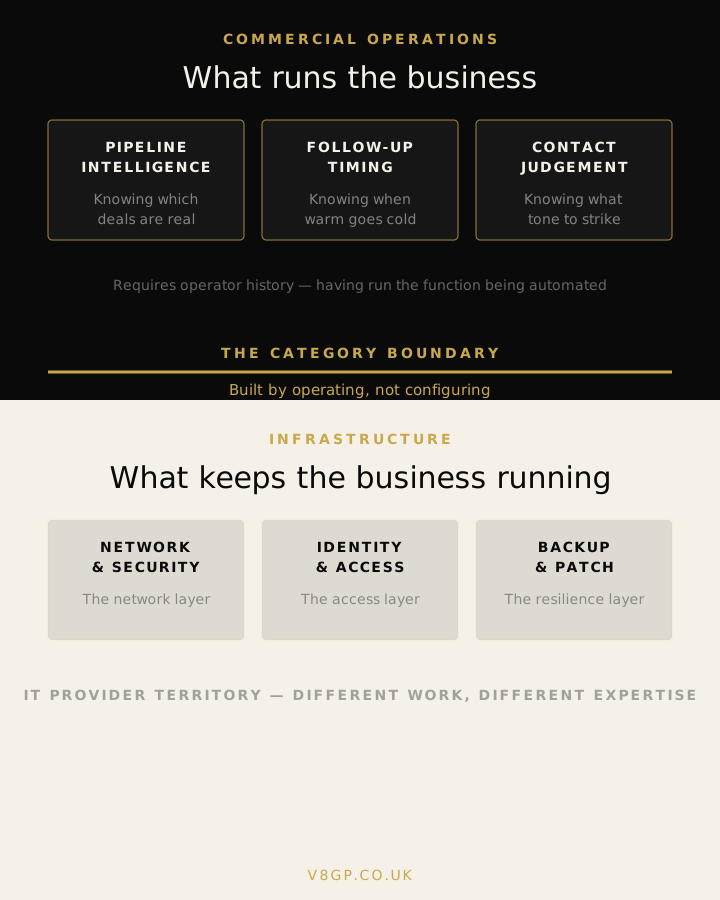
What an IT provider is actually good at
This isn’t a swipe. IT providers have real expertise. They’re good at infrastructure resilience, network security, identity management, vendor relationships, ticket SLAs, patch cycles, backup strategy. The good ones run twenty or thirty client environments and keep them all stable.
That work matters. It’s the layer underneath your business that has to keep working so the business itself can run.
But it’s a different category of work from designing a system that runs the business.
The category boundary
An IT firm pivoting to AI typically does one of three things:
Resells productivity tooling. Microsoft Copilot, document AI, transcription tools, generic productivity layers. The IT firm becomes a reseller-with-setup. The buyer figures out what to do with it from there.
Configures off-the-shelf agents. Wires existing AI tools — chatbots, knowledge base assistants, internal Q&A — into the buyer’s environment. Useful for internal admin. Not the same as building a system that operates the commercial function.
Recommends a strategy deck. Workshops on AI readiness, frameworks for adoption, positioning advice. The buyer ends up with a deck and still no working system.
None of these reach the layer where AI actually runs sales and marketing operations.
What it takes to build a system that operates
Building an AI operating system for sales and marketing requires two things that don’t usually live in the same provider.
The technical depth to build it. Agentic architecture, message classification, pipeline state management, multi-step orchestration, integration with email, calendar, CRM, accounting. This is non-trivial engineering. IT providers can ramp into it, given time.
The domain expertise to know what to build. What does a sales pipeline actually need to do? Which signals matter and which are noise? When does a contact go from warm to cold? What does a competent follow-up look like, in tone and timing? When should a system act autonomously and when should it route to a human?
The second part is what separates someone who can build an AI tool from someone who can build an AI system that operates a sales and marketing function.
The second part is operator history.
The single question
If you’re evaluating whether a provider can build an AI system to run your sales and marketing, there’s one question that cuts through the marketing layer immediately:
How many SME sales pipelines have you personally managed?
Not configured CRMs for. Not advised on. Not run analytics over. Managed — owned the pipeline, made the calls, handled the contacts, navigated the deals, lost the deals you lost and won the ones you won.
If the answer is zero, the provider can probably ship you a tool. They cannot ship you a system that operates your commercial function, because they have never operated one.
This is not gatekeeping. It is a category boundary. The same way you wouldn’t ask a structural engineer to design your interior, you don’t ask an infrastructure provider to design your commercial operations layer.
The V8 answer to that question
I have personally managed SME sales pipelines for fifteen years across two companies.
The previous business — a SaaS CRM and marketing orchestration platform run out of Hong Kong — reached around 700 active SME clients at peak, with annual revenue near £2M. Every one of those clients had a pipeline. Every one of those pipelines surfaced a different combination of objections, signals, follow-up rhythms, and decision-making patterns. Fifteen years of that is what gets compounded into Axia’s design decisions every week.
Combine that with a decade of marketing technology engineering — building the orchestration tools the platform ran on — and you get the only combination that matters for this category: someone who can build the system and knows what the system needs to do.
That combination is structurally hard for an IT firm to assemble quickly. It requires either acquiring an experienced marketing operator (which most won’t), or running a full sales and marketing function for a decade (which most haven’t, because that isn’t their business).
The category boundary stays where it is.
What this means in practice
If you’re an SME owner being pitched AI marketing automation by your existing IT provider, the right move is not to refuse — there’s nothing wrong with using IT firms for what IT firms do well. The right move is to ask the question.
If the answer to how many SME sales pipelines have you personally managed is anything other than a specific, credible number, you’re being sold something the provider doesn’t have the depth to deliver. Use the relationship for what it’s good for. Buy the operating system from someone who has run the operation.
That’s what Scaffold is. That’s what Axia is. The build sits on top of fifteen years of running the function being automated. The technical layer is comparable to what a strong IT firm could ship eventually. The domain layer is not.