You probably know the story. You watched the YouTube videos. You signed up for the course because the system looked like exactly what your business needed. The instructor walked you through the tools — the list builder, the enrichment engine, the email platform, the video tool, maybe a setter rubric. You paid. You learned it. You assembled it.
And it worked. For a while.
Then six months in, you found yourself opening the laptop on a Sunday afternoon to fix something. A list import broke. An email sequence had been pausing for a week and nobody noticed. The setter you trained went on holiday and the warm replies just sat there. The tool you were excited about last quarter now charges twice what it did when you signed up.
You’re still doing the work the course taught you to do. The course wasn’t wrong. The system wasn’t wrong. So what happened?
Sound familiar?
What the courses don’t teach
Here’s the bit nobody mentions in the sales page. The systems these courses teach you to build are real, and they do work. But they were designed to be run by a team. A founder with a setter. An agency with three operators. A senior marketer with a junior to handle the maintenance.
The course teaches you how to build the system. It doesn’t teach you how to be the only person keeping it alive at 2 AM when something breaks the night before a launch.
That’s not a course problem. That’s a structural problem. You bought a system. What you actually needed was a system and the people around it.
This is where most solo operators and small-team founders get stuck. The course got you 80% of the way. The remaining 20% — the bit that decides whether the system holds together over a year, or quietly stops working — isn’t in any course. It’s in the rooms where people running comparable systems compare notes.
Why the room matters more than the tools
Think about the last time you debugged something on your own. You were probably searching forums, scrolling through someone’s Discord, reading old blog posts, trying things that worked for someone in 2024 and might still work in 2026.
Now think about the last time you debugged something with someone who’d already solved it. They told you the answer in two minutes. You moved on with your day.
That’s the difference. It’s not glamorous. It doesn’t fit on a sales page. But over the course of a year, the difference between solo debugging and warm-room debugging is roughly the difference between a system that scales and a system that quietly burns out the operator running it.
There’s another bit nobody warns you about when you’re stitching tools together yourself. Every one of those tools updates on its own schedule. An integration changes. A vendor adjusts their pricing or shifts how one tool talks to another. Most of the time it’s fine. Occasionally something that worked yesterday needs ten minutes of attention today. The cumulative effect over a year is real, and it’s load you didn’t sign up for when you bought the course.
When tools are wired together by you, those small adjustments are your problem to handle. When tools live inside one integrated system, the adjustments get absorbed before they reach you. Same outputs, less load on the operator. Most courses don’t mention this because most courses don’t run the system long enough to feel it accumulate.
What the courses sell is the system. What you actually need is the system plus a room of people running comparable systems, plus eventually an integrated layer that absorbs the upkeep instead of passing it to you. Without the room, you’re alone with the toolchain. With the room, you’re part of a network that surfaces what’s breaking before it breaks for you.
This isn’t a knock on the courses. The courses do what they say they do. But they sell you the manual. They don’t sell you the colleagues — and they don’t sell you the layer that holds together when the underlying tools shift.
What V8 Nexus is built around
This is exactly the gap V8 Nexus exists to fill.
Nexus isn’t another course. It isn’t a Slack channel with a thousand silent members. It’s a curated executive community in London — small enough that everyone knows who else is in the room, deliberate enough that the conversations are about real systems running in real businesses, warm enough that asking “is anyone else seeing X?” gets you an answer the same day.
Members are mostly SME founders, professionals, and operators running real commercial workloads — not students, not aspiring, not theorists. People who already bought the courses, already assembled the stacks, and now want a room to run the long game with.
What you get isn’t a curriculum. It’s:
- A room. People who are running the same kind of systems you’re running. People who’ve already solved the things you’re stuck on, and people who are stuck on things you’ve already solved.
- Curated introductions. Not random networking. Specific connections, made when there’s a real reason — partner needs, supplier gaps, talent referrals, client introductions.
- Briefings on what’s actually moving. AI tools, platform changes, what’s working this month, what’s quietly broken, what to watch. The kind of thing you’d otherwise piece together from twenty newsletters and miss anyway.
- Permission to admit what’s not working. This is the underrated part. The course Slack channels are full of people performing success. The Nexus room is small enough that people can say “this stopped working, what are you all doing?” and get a real answer.
Free to join. London-based, with curated digital programming for international members. Selective on quality, not on volume.
Where Axia fits
Some Nexus members reach a point where running the stack themselves — even with the room behind them — is no longer the right use of their time. The system works. The community supports it. But the founder’s hours have become more valuable than the operational layer should consume.
That’s where Axia enters.
Axia is V8’s managed AI operating system. Same functions as the stack the courses teach — list intelligence, enrichment, sending, qualification, routing — but built as one operating layer rather than five separate tools held together by an operator. V8 runs it on your behalf, with human approval at every commercial decision. You stop being the person debugging late at night. The system runs. You approve the work that matters.
Most Axia clients arrive through Nexus. They’ve already done the course route. They’ve assembled the stack. They’ve felt the maintenance load. By the time they ask for Axia, they’re not asking “is this worth it” — they’re asking “how soon can we start?”
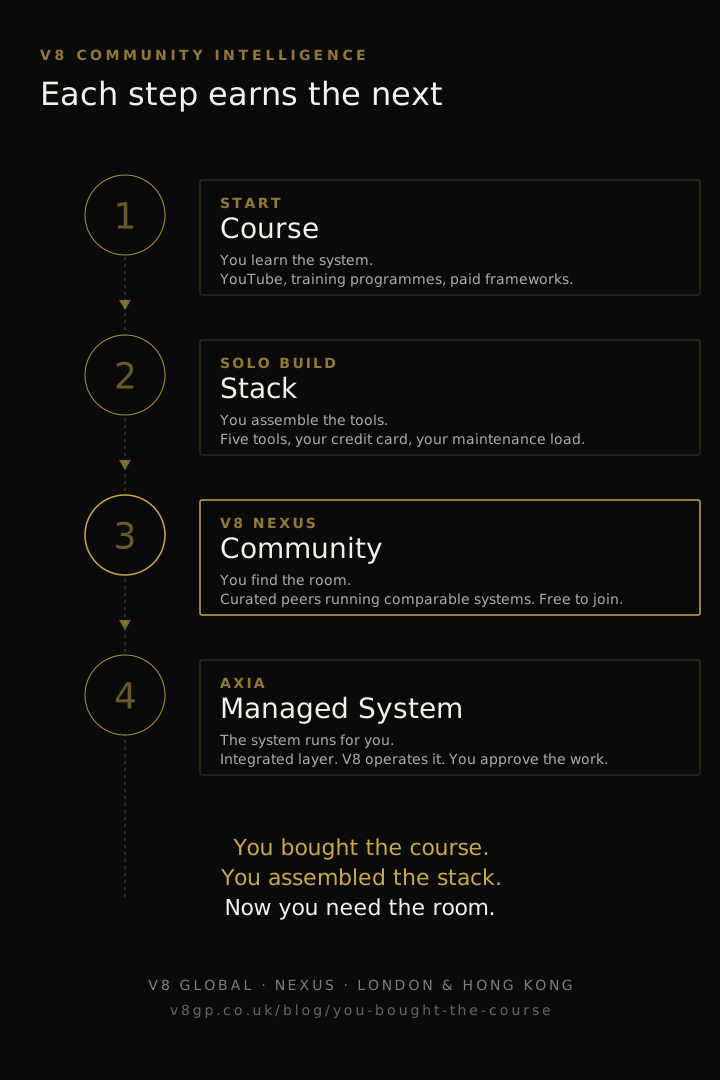
The path goes: course → stack → community → managed system. Each step earns the next. Nexus is where the community step lives. Axia is the destination when the maths on operator time catches up with the maths on managed infrastructure.
What to do if any of this sounds like you
If you bought the course and the stack is working but the maintenance is eating your weekends, join V8 Nexus. Free. The room is the bit you’ve been missing, and you don’t have to commit to anything else to start.
If the maintenance load is already past the point where community support fixes it — if you’re ready to hand the operational layer to someone who runs it for a living — explore Axia.
Either way, you don’t have to keep being the only one keeping the system running.
You bought the course. You did the work. You built the thing. The next step isn’t another course. It’s the room of people running comparable systems, and eventually the managed infrastructure that takes the operator load off your hands.
That’s what V8 is for.
Gina Cheng leads V8 Nexus, London’s curated executive community for the AI era. Community Intelligence posts share what V8 hears in the room — the patterns, the lessons, the questions members are actually wrestling with. To join the conversation, visit V8 Nexus.