When did you last actually browse a website to find an answer?
Not click a link, land on a page, and scroll — I mean genuinely navigate a website the way we used to. Menu bar, About page, Services page, maybe a blog. Working your way through someone’s digital brochure until you found what you needed.
If you’re honest, it’s been a while. Because now you just ask.
You ask Google. You ask ChatGPT. You ask whatever AI tool is sitting in your browser. And you get an answer — without ever visiting the website that technically contains that information.
Here’s the thing: your customers are doing exactly the same thing. And it’s changing what your website actually needs to do.
What just happened at Google I/O 2026
Google just made it official. At their annual developer conference this week, they announced that Search is getting a complete overhaul — one that replaces the traditional list of links with something they’re calling generative UI.
Instead of showing you ten blue links, Google now builds a custom interactive page in response to your question. Ask about meal planning, it generates a planner. Ask about a financial decision, it builds a calculator. Ask about how a business can help you — it might just answer that without sending you anywhere at all.
They also announced “information agents” — AI that monitors the web on your behalf 24/7 and reports back when something relevant happens. And mini-apps that users can build just by describing what they need, in plain language, right inside Search.
The era of “rank on Google, get traffic, convert visitors” — that model is structurally broken. Not declining. Broken.
And publisher data backs it up. Press Gazette and Chartbeat tracked a roughly 33% drop in Google referral traffic to publishers globally in the year to November 2025. Tech publishers fared worse — Digital Trends saw a 97% decline, The Verge and HowToGeek down 85% or more. DMG Media reported click-through rate drops as high as 89% when AI Overviews appeared in search results. These aren’t soft trends. They’re structural shifts that are already done.
So does your website still matter?
Yes. But not in the way you’ve been thinking about it.
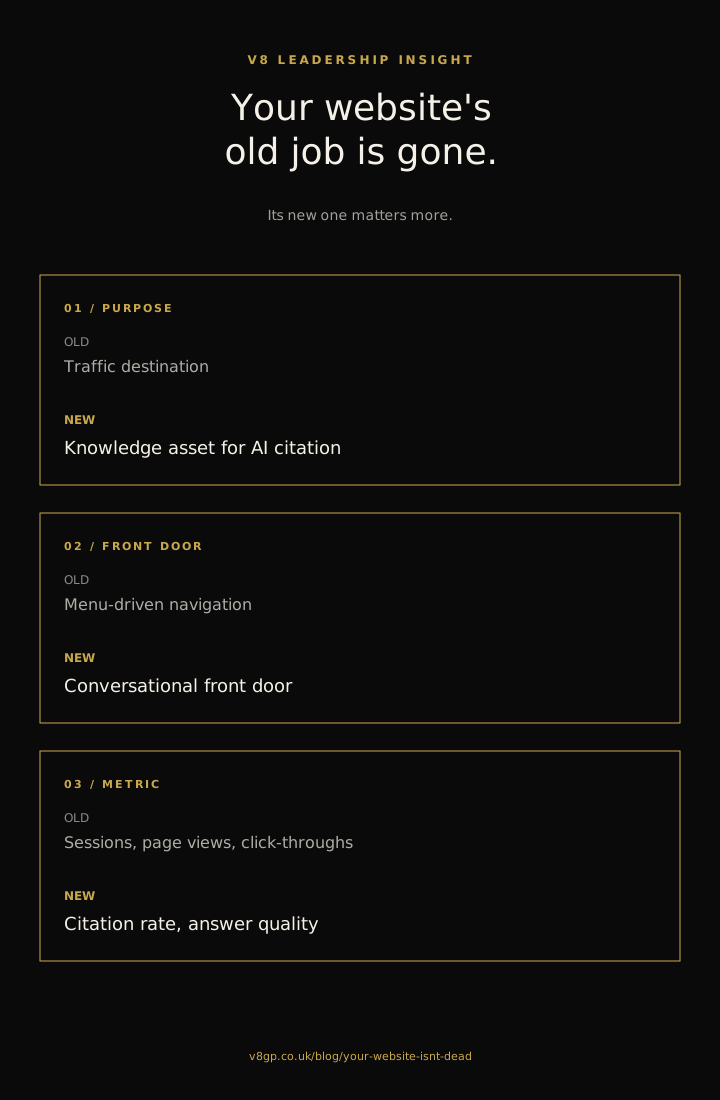
Your website used to have one primary job: capture someone’s search intent and convert it into an enquiry. It was a traffic destination.
That job is largely gone for most SMEs — and honestly, it was already going before this week’s announcements.
What your website still does — and does critically — is feed the AI layer.
When someone asks an AI tool about businesses like yours, what it says is shaped by what it can find and read about you. Your website is the source material. The structured content, the clear description of who you help and how, the case studies and positioning — all of that is being indexed and used to formulate answers, whether or not anyone ever clicks through to read it.
You’re not optimising for a click anymore. You’re optimising to be cited.
The front door is changing too
Here’s where it gets interesting — and honestly, a bit exciting.
If the website is becoming a knowledge base rather than a destination, then the interface people use to access that knowledge doesn’t have to be a static page anymore.
Think about the next evolution: a website where the hero section isn’t a big banner and a tagline. It’s a brief, human introduction — maybe even a short video or an avatar — followed immediately by a simple prompt: What can I help you with today?
The conversation does the work. It answers questions, surfaces relevant case studies, explains your services in context, and captures contact details naturally — the way a good sales conversation does, not the way a contact form does.
And if someone arrives from a specific campaign, a LinkedIn post, a referral — the agent already knows why they’re likely there. The opening message echoes their intent. It feels personal because it is, at least contextually.
No twelve-page website to maintain. No nav bar that nobody clicks past the third item. Just a knowledge base with a conversational front door.
What this means practically, right now
You don’t need to rebuild everything tomorrow. But it’s worth shifting how you think about what your website is for.
Stop measuring it by traffic alone. Sessions and page views are the wrong primary metric now. How well does your content answer the questions your prospects are actually asking? That’s what matters.
Invest in depth over breadth. One well-structured page that clearly explains what you do, who you help, and what outcomes you deliver is worth more than ten thin pages stuffed with keywords nobody searches anymore.
Think about the agent reader. When an AI tool reads your website to answer a prospect’s question, what does it find? Is it clear? Is it specific? Does it actually explain your point of difference? If not, that’s the gap to close.
Consider the conversational layer. Not every SME needs to build a full agent interface on their website right now. But it’s worth knowing this is where things are heading — and designing your content architecture with that in mind from the start.
The businesses that will struggle in the next two to three years are the ones waiting for their Google rankings to come back. They won’t — not in the way they were.
The ones that will do well are the ones who realise their website’s job has changed, and build accordingly. Less digital brochure, more intelligent knowledge asset. Less “look at us,” more “let us help you figure this out.”
Your website isn’t dead. It just has a completely different job description now.