I had a full day of meetings in central London recently. A lunch that ran ninety minutes, a call in the afternoon, a networking event in the evening. I arranged none of it.
Axia did the outreach, held the conversations that decided who was worth meeting, proposed the times, and handled the reschedules when two things collided. What was left for me was the part that needs a person in a room: the meeting, and the close.
That is not a happy accident. It is the whole design.
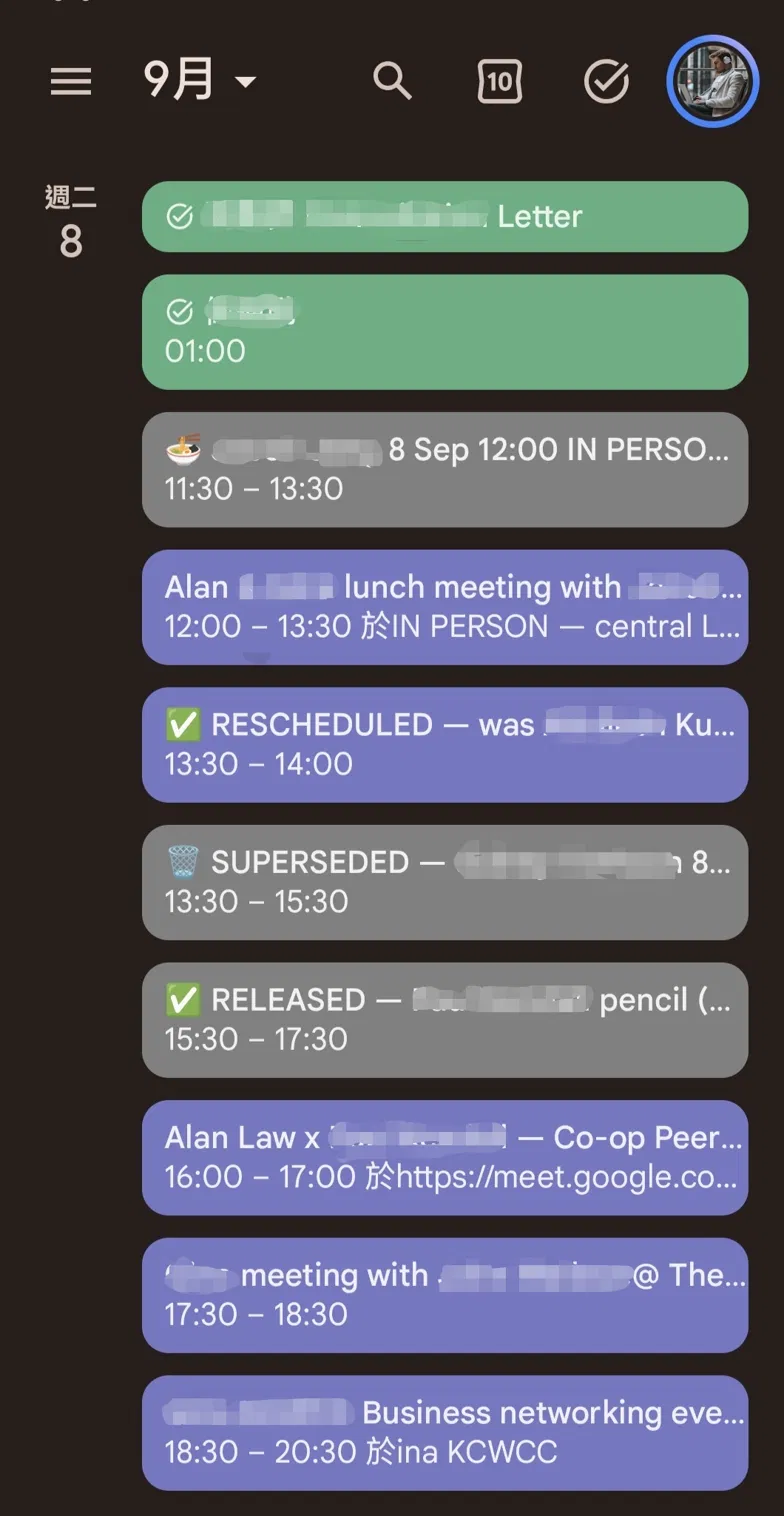
Look at the middle of that screenshot rather than the top. RESCHEDULED, SUPERSEDED, RELEASED. Booking a meeting is the easy part of scheduling. The hard part is what happens when a better slot appears, or a contact moves, or two holds overlap — and that is where most tools hand the mess back to you with a notification.
What was actually left for me
Three things, and only three.
- Turn up. Read the brief on the way, know who I am meeting and why they are worth the ninety minutes.
- Have the conversation. Nobody signs anything meaningful with a bot alone. Physical presence is still load-bearing and I do not expect that to change soon.
- Close. Or not close, and know why.
Everything on either side of that — the research, the first message, the follow-up, the calendar arithmetic, the write-up afterwards — happened without me. After the last meeting Axia summarised the day and set up what came next, which is why I had an hour to walk along the river instead of sitting in a café typing notes.

The questions that came up over lunch
Most of the day’s real content was one long conversation with a prospect. Four questions came up that are worth answering in public, and rather than repeat myself here, each of them now has a proper home on the site.
“For every feature you have, someone else does it too.” True, and the wrong comparison. A single-purpose tool will usually beat one component of a system at that component. What does not have an obvious competitor is the sequence — outreach, conversation, research and scheduling running as one thing, aimed at leaving a consultant with the meeting and the close. The Axia page makes that argument properly.
“What happens to our data?” The honest answer is that nobody can guarantee an AI system is completely safe, and you should be wary of anyone who says they can. What can be described is what it is built not to do — it answers from the sources you appoint rather than whatever it can infer, your deployment is not a shared surface, and it is tested against manipulation on a schedule rather than after something goes wrong. That is now an entry on the Axia FAQ, stated in those terms.
“Why did you build this rather than buy something?” Because I spent fifteen years selling the thing that was supposed to solve it. A CRM promises a visible pipeline and a perfect memory, and depends entirely on somebody typing everything in. Almost nobody does. I wrote the longer version of that — including the part where I became my own business partner’s secretary — on the about page.
“How much traffic can you drive?” Better question: how many conversations. I have paid a lot of attention to reach over the years and the accounts of mine that produce meetings are not the ones with the best numbers. They are the ones where the conversation was handled well and the material was credible. That one still needs its own post.
The problem this creates, which nobody warns you about
Here is the part I did not expect.
When a system runs mass engagement and research on your behalf, it produces more context than a person can hold. I now start most days reading summaries — who was approached, what came back, what the proposed agenda is for each meeting. That is a real task and it takes real attention.
It is a better problem than the one it replaced. But anyone telling you that agentic AI removes work rather than moving it is selling you something. What changes is which work: from data entry and calendar arithmetic, to reading and deciding. The second is the job I actually wanted.

If you want to see it rather than read about it
There is a pilot. A free month, configured around your business by hand — your inbox, your contacts, your voice, your pipeline rules. Billing starts when the system is doing work you would pay for, and not before.
I would rather you felt it than took my word for it. Send an enquiry and watch what comes back: Axia handles every inbound, and it will not push you toward a meeting you have not asked for. If something eventually arrives that I wrote by hand, I will tell you that is what happened.
Ready to take the next step?
Most AI is sold as a tool. Axia is built as the operating layer your business actually runs on.
Ask about an Axia pilot