You bought the automation. It works. The form submission triggers the email, the tag moves the contact, the missed call fires the follow-up. Everything you set up does exactly what you set it up to do.
And you are still losing deals to things nobody noticed.
That is not a failure of the tool. It is a gap in what the tool was ever built to do, and it stays invisible because the tool has no way of telling you about it.
The word “automation” is doing two jobs
When people say automation, they are usually collapsing two separate questions into one word:
- When does the system act?
- How does the system decide what to do?
These are independent. A system can be excellent at the first and have no answer at all to the second. Most of what gets sold as business automation is exactly that.
Worth separating them properly, because the money leaks out of the second one.
Question one: when does it act?
There are two answers.
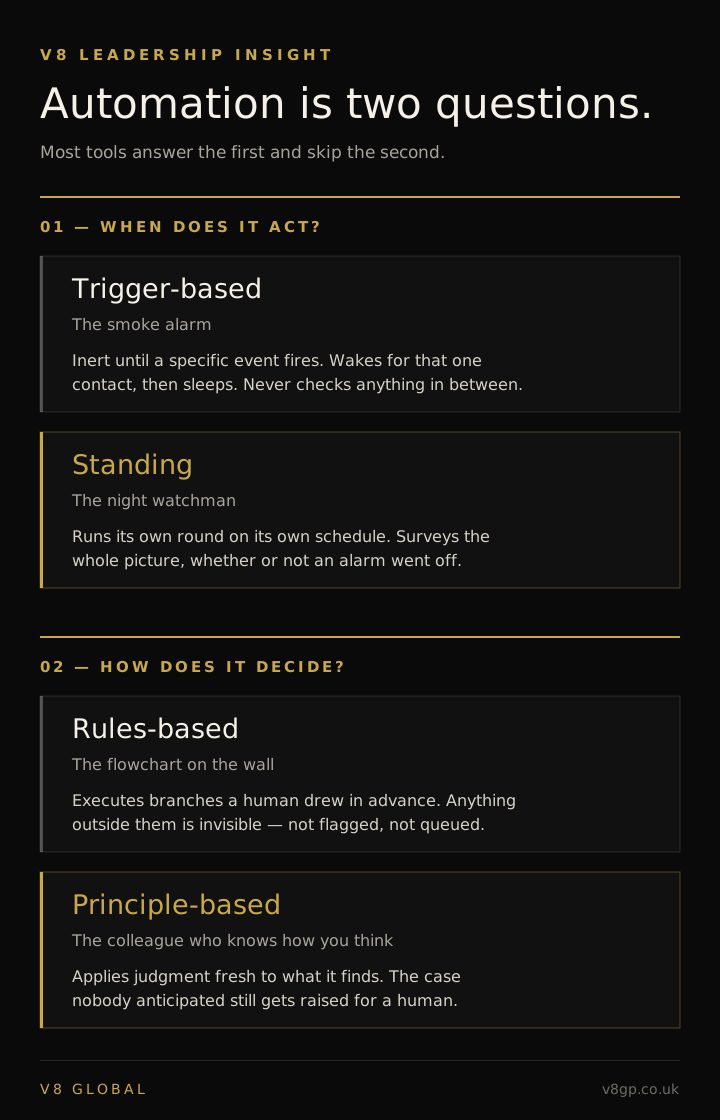
Trigger-based. The system sits inert until something specific happens. A form gets submitted. A tag gets added. A call gets missed. That single event wakes the system for that one contact, it runs, and it goes back to sleep. Nothing happens unless something happened first.
It is a smoke alarm. Silent until there is smoke, and it never checks anything in between.
Standing. The system runs its own round on its own schedule, whether or not anything fired. It surveys the whole picture, every inbox and every contact and every stage, and decides for itself what is worth raising.
It is a night watchman doing rounds. Walks the building whether or not an alarm went off, because the point is to catch the thing nobody wired an alarm for.
Most businesses have the smoke alarm. It is genuinely useful. But a smoke alarm only knows about fire.
Question two: how does it decide?
This is the one that gets skipped.
Rules-based. Someone sits down in advance and draws a decision tree. If this exact condition, then this exact action. The system’s entire job is to execute that tree faithfully. It has no judgment of its own. It is matching against branches a human already wrote.
It is a flowchart taped to the wall. Completely reliable for the situations someone thought of. Useless for the one they didn’t.
Principle-based. Instead of pre-drawn branches, the system holds a smaller set of general judgment principles and applies them fresh to whatever it is actually looking at. It reasons the case rather than matching it. A situation nobody anticipated still gets evaluated, and still gets raised for a human to look at.
It is a competent colleague who has internalised how you think, rather than one reading off a card. They handle the case you never briefed them on, because they are applying your judgment rather than your instructions.
Where the money actually leaks
A rules-based system fails silently. That is the whole problem.
When a situation falls outside every branch anyone drew, it is not flagged. It is not queued for review. It is invisible, because no rule matched, and a rule that does not match produces no output at all. Nothing appears in a report. Nothing lands in an inbox. The failure has no symptom.
Which means coverage is permanently a function of how much time someone spent anticipating scenarios up front. The system only improves when a human notices something is missing and goes back to add a branch.
Sit with what that requires. To close a gap, you first have to notice the gap. But the gap is defined by being the thing you did not think of. The one system positioned to tell you about it is the same system that cannot see it.
That is not a bug you fix with more branches. More branches makes the flowchart bigger. It does not change what happens at the edge of it.
A principle-based system does not carry that ceiling in the same shape. It is not matching against a list of anticipated cases, so a novel case does not fall through. It reasons the case against the principle, reaches a conclusion, and surfaces it. The gap that stays invisible in the first model is precisely what gets raised in the second.
The combination that is rare
Put the two questions together and there are four possibilities:
- Triggered and rules-based. Most marketing automation. An event fires, a pre-drawn tree routes the contact, fixed actions execute. Well built, widely deployed, and bounded by what someone anticipated.
- Standing and rules-based. A scheduled report or a nightly job. Runs on its own clock, but only ever checks the same fixed conditions. Broader coverage, identical rigidity underneath.
- Triggered and principle-based. Reasoning applied, but only once something wakes it. Judgment on demand rather than judgment on patrol.
- Standing and principle-based. The system runs its own round, and at each pass applies judgment fresh to whatever it finds. Nothing has to be anticipated for it to get noticed.
The fourth is rare because it is harder. It needs a process that runs without being summoned, a reasoning layer worth trusting, and a human approval gate on anything with commercial consequences. Three things, not one, and the third is what makes the first two safe to deploy.
What to ask when you are buying
Four questions, and the answers are usually quick:
- When does it act? If the honest answer is “when something triggers it,” you are buying coverage of the events someone already anticipated. That is worth having. It is not the same as coverage.
- How does it decide? If the answer is a workflow builder, the ceiling is however many branches you are willing to build and maintain.
- What happens to a situation nobody wrote a rule for? If the answer is nothing, that is your leak. Ask how you would ever find out.
- What approves the action? A system that reasons and then acts without a human gate is a different category of risk. Reasoning without approval is not an upgrade.
The honest version
Your current tool executes the rules you already thought of, and it does that well. What it cannot do is notice the thing you did not think to write a rule for. That is not a criticism of the tool. It is just not what the tool was built to do.
So the question worth asking is not whether your automation is working. It almost certainly is, on its own terms.
The question is what it has been quietly not seeing while it worked.