A contact flagged something to me yesterday that I’d been avoiding.
The V8 product pages were well-written. Clear, credible, professionally laid out. But they read like they were shipped once and left alone. They answered “what does this do?” — they didn’t answer “why is V8 the operator you’d trust to run it?”
Same week, a client forwarded me a competitor’s cold pitch. Not a threat — a signal. The pitch was from an IT managed services firm positioning AI for admin efficiency, and on the surface they sounded similar to V8. From a prospect’s point of view, every AI provider looks like the same category until something differentiates them clearly and fast.
Two signals in the same week. Same underlying problem.
The problem with a static website selling live operations
V8 sells AI systems that run continuously. Axia operates on a weekly cadence. Scaffold builds custom agents. Nexus runs as a live community. The entire proposition is we operate, we don’t just ship.
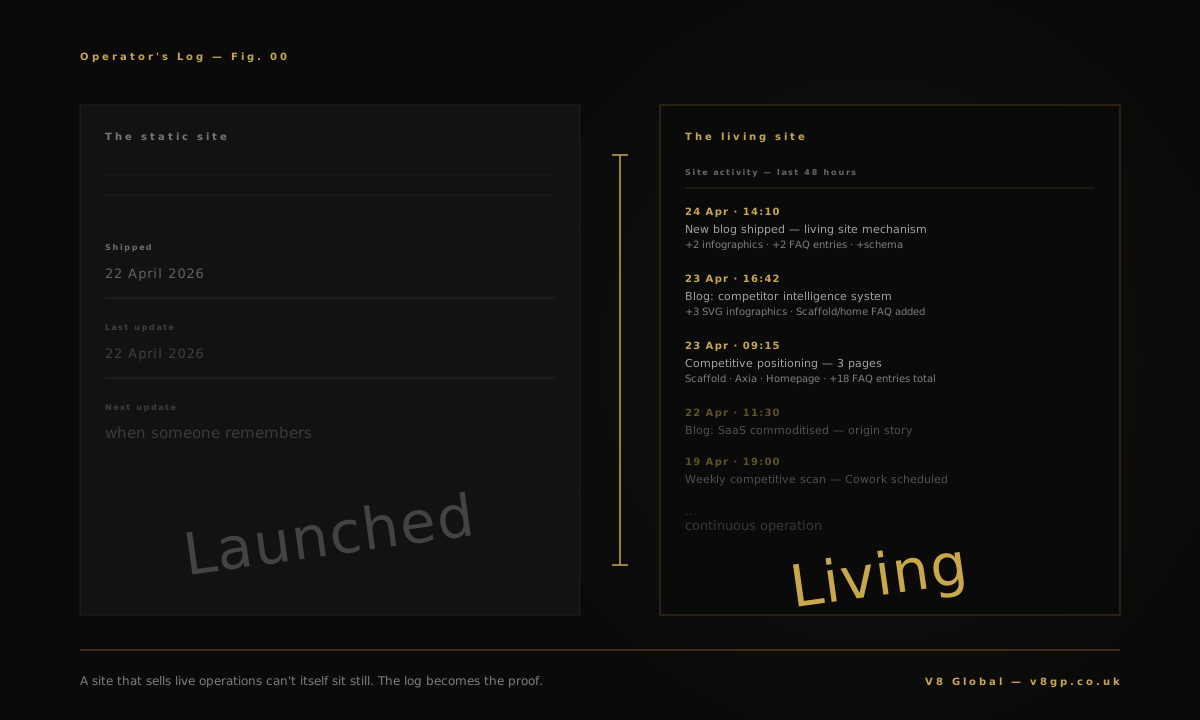
And our website — the surface that carries this proposition to everyone who hasn’t met me in person — was static. Shipped in March, untouched since. Every day it didn’t move, the pitch got weaker by a small amount that nobody could name but everyone could feel.
The instinct was to update it. Write new copy, rewrite the positioning, refresh the hero. And then in three months, do it again. And again. The cycle every consultancy website goes through — burst of effort, long silence, drift.
That cycle is the problem. Not the content. The cycle.
Removing the assumption that updating is expensive
Most B2B websites are built on an unspoken assumption: updating the site costs effort, so you only update when there’s a clear reason and a block of time. That assumption, quietly, is why most consultancy websites drift. The economics of updating are too heavy compared to the marginal benefit of any single update.
If the cost of updating drops close to zero, the economics flip. Every signal — a client question, a competitor move, a new insight — becomes a potential update. The site stops being a launch artifact and starts being the live surface of the operation.
That’s not a content strategy. It’s infrastructure.
What we built today
Three things, shipped across two commits yesterday and one today.
1. The content operation.
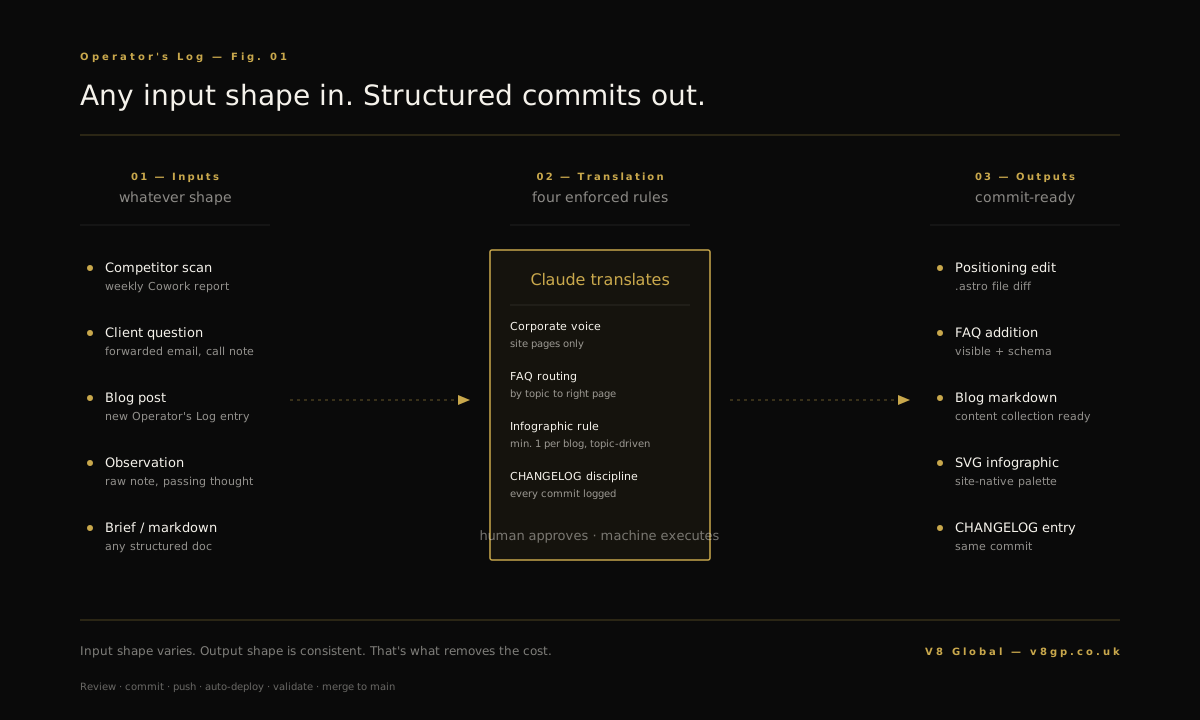
When I have something to update, I paste whatever shape of input I have — a brief, a client question, a competitor observation, a raw note — into Claude. Claude translates it into the site’s corporate voice, identifies which page needs the edit, produces the exact file diff, and writes the CHANGELOG entry. I review, commit, push. One loop, five minutes per update.
No schema I maintain. No form to fill. Whatever’s in my head, in whatever shape, becomes a commit.
2. The FAQ feedback loop.
Every blog post I ship now also ships with one or more FAQ entries added to the relevant product pages. Claude reads the blog, decides which product page’s FAQ should gain a question, writes both the question and the answer in the page’s voice, updates the JSON-LD schema to match. The FAQ on each page grows as the blog grows. LLMs and search engines eat structured Q-and-A; the FAQ layer becomes the GEO surface that lets AI crawlers cite the site accurately.
3. The competitive intelligence loop.
A Cowork scheduled task runs every Friday evening. It scans competitor categories — IT MSPs pivoting to AI, marketing SaaS updates, new agentic platforms launching — and generates a structured markdown report with threat levels and recommended site updates. Documented in last week’s post. The report drops into a folder, ready for the next build session.
What this looks like when it’s working
Yesterday morning the site gained a “Why Scaffold exists” section, a “Why Axia exists” section, a “Why V8” section on the homepage, and a six-question FAQ block on each of the three product pages with FAQPage JSON-LD schema. All shipped in one commit, preview-deployed, validated through Cowork, merged to main.
Yesterday afternoon I shipped a new blog post about competitive intelligence. The post included three custom SVG infographics, added one FAQ question to the Scaffold page and one to the homepage, and updated both pages’ JSON-LD schemas. One commit, one preview validation, merged to main.
Today, this post. Two infographics, two FAQ additions routed to the right pages, schema updates, CHANGELOG entry in the same commit. By the time you read this, the site has moved three times in 48 hours.
Not because anyone is heroically burning hours on content. Because the mechanism removed the cost.
Site record — 23 to 24 April 2026
The following is a record of what shipped, in the site’s own voice. Included here because transparency is part of the positioning. The CHANGELOG itself lives at github.com/alv8gp-lab/v8-global-site for those who want the full trail.
V8 Global has restructured its website around a content operation model. Three product pages — Scaffold, Axia, and the homepage — have been updated with competitive positioning sections and FAQ blocks. Every FAQ is mirrored in machine-readable JSON-LD structured data to support LLM and search engine indexing.
A new blog post has been published under the Operator’s Log series, documenting the competitive intelligence system V8 uses to maintain its own positioning. Site updates now follow a markdown-in, commit-out workflow that removes the traditional cost barrier to keeping a B2B website current.
The site operates under two standing rules. Every blog post ships with at least one FAQ addition routed to the relevant product page. Every blog post ships with at least one topic-driven infographic. These rules are enforced by the content operation, not by the author.
The point that matters for anyone else
This pattern is not specific to a martech consultancy. Any business whose proposition depends on being operational — not just being good — faces the same contradiction when its website sits static. Consultancies, agencies, AI companies, technical service providers, operational infrastructure vendors.
The content is not the bottleneck. The mechanism is.
If your website hasn’t materially changed in the last quarter, and your pitch is that you operate systems for clients on an ongoing basis, your site is quietly contradicting you. The fix is not a redesign. It is a content operation — input agnostic, output structured, cost near zero per update.
What V8 can build for you
The content operation described in this post took one session to design and is now operating as a standing capability. The same pattern builds for any SME running a professional services or operator-led business: a mechanism that turns any input into a structured site update, runs with human approval at every step, and removes the friction that causes most websites to drift.
If your own site has stopped moving, or if you want your content operation to match the sophistication of what you sell, start a conversation with us.
Alan Law is Co-Founder of V8 Global and architect of Axia and Scaffold. He writes Operator’s Log posts on how AI-native systems are built and operated in practice. For community and client-facing work, follow Gina Cheng.