You joined the network. You go to the meetings. You’ve had good conversations with people you genuinely like.
And your profile in the member directory is about forty percent filled in, because you meant to come back to it and then three months went past.
Sound familiar?
Here’s the thing nobody says out loud about that half-finished profile: it isn’t admin you’ve been putting off. It’s the first thing someone reads about you when they’re deciding whether you’re worth an introduction.
The profile is a two-way door
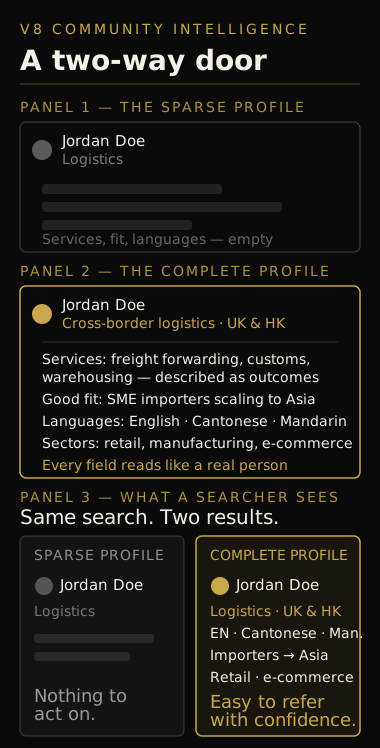
Alan mentioned something after a chapter visit that stuck with me. He’d heard about a logistics company whose member profile was properly built out — services described in detail, international capability spelled out, languages listed. A member in another country found them through the directory search and got in touch. That turned into work neither of them would have found otherwise.
Reported secondhand, so treat it as a story rather than a case study. But the mechanism in it is real and worth naming.
Most people think of their directory listing as somewhere they get found by vendors. It works in both directions:
- Someone searching for what you do can only find you if your profile says what you do
- A member deciding whether to refer you needs enough detail to describe you confidently to their client
- You can search the directory the same way — by industry, by location, by what someone actually offers
That last one is the part people underuse. You’re not limited to whoever happened to be standing near you at the last meeting.
What “complete” actually means
Not every field filled with something. Every field filled with something a real person would recognise as you.
The test is simple. Read your profile out loud. Does it sound like how you’d introduce yourself to someone at a table, or does it sound like a corporate directory entry written by someone who’s never met you?
Most half-finished profiles fail on the same things:
- Services listed as categories rather than described as outcomes
- No indication of who you’re actually a good fit for
- Nothing that helps someone else explain you to a third party
- Blank fields where the specifics live — languages, sectors, geography
Let AI do the writing, not the clicking
This is where most people stall, and it’s a solvable problem.
The content already exists. It’s on your website. Your services, your positioning, the language you use to describe what you do — you’ve written it once already. The obstacle isn’t creativity, it’s the hour of copying from one place to another.
So don’t write it again. Point an AI assistant at your own site and ask it to draft each profile field in your voice, using what’s already there. You get a set of drafts to review, edit, and paste in yourself. Twenty minutes instead of an evening.
A few things worth being deliberate about:
- Give it your site, not a blank prompt. The output is only as good as what you feed it
- Ask for your voice, not a professional tone. Otherwise you get the corporate directory version
- Edit before you paste. AI drafts well and overstates occasionally — you’re the last check
- Do the entry yourself. Most member platforms restrict automated access to their systems. Read the terms before pointing any tool at a directory that isn’t yours
That last point matters more than it sounds. The value here is in the drafting, and drafting is the part that was costing you the time anyway.
The same trick works on the conversation after
Once your profile is doing its job, the next bottleneck is what you say when you reach out to someone.
Same principle. You’ve found a member whose work genuinely overlaps with yours. Before you message them, read their profile properly and use AI to help you think it through — what they do, where the overlap sits, what would actually be useful to them rather than to you.
Then write something personal. One person, one message, written because you had a reason.
That’s the opposite of volume. It’s the thing volume can never buy, and it’s why a good introduction from a member who understands your business is worth more than a hundred connection requests.
What this actually asks of you
Three things, none of them heavy:
- A profile that reads like you. Complete, specific, and written the way you’d introduce yourself
- A clear sense of who you’re looking for. AI can help you draft and think, but you have to know what a good fit looks like
- Your eyes on everything before it goes. AI handles the research and the first draft. You decide what gets sent
The system does the tedious part. You keep the judgement.
Where this goes next
Everything above applies to whichever network you’re in — a chapter, an association, a professional body, a community like ours.
V8 Nexus members get the AI Toolkit Notebook on joining, which covers the setup behind this: how to configure an AI that knows your business well enough to draft in your voice rather than a generic one, and how to use it for research and follow-up without it sounding like a template.
Free with membership. No separate signup.