In almost every first meeting, someone asks about social media. Do you do Instagram? LinkedIn? And then the real question: so what’s the difference between you and a marketing agency?
The honest answer starts with yes. I can make a profile grow.
I’ve done the social side, and it works
With AI doing the heavy lifting on drafts and timing, Gina’s LinkedIn network went from zero to 2,000 in her first six months, with more than 6,000 profile views. Those numbers are old now; she passed them months ago. Someone in my family runs a YouTube channel, and every so often a video passes a million views.
So I’m not here to tell you social media doesn’t work. I’m here to tell you what bothered me when I looked at the numbers.
What bothered me in the data
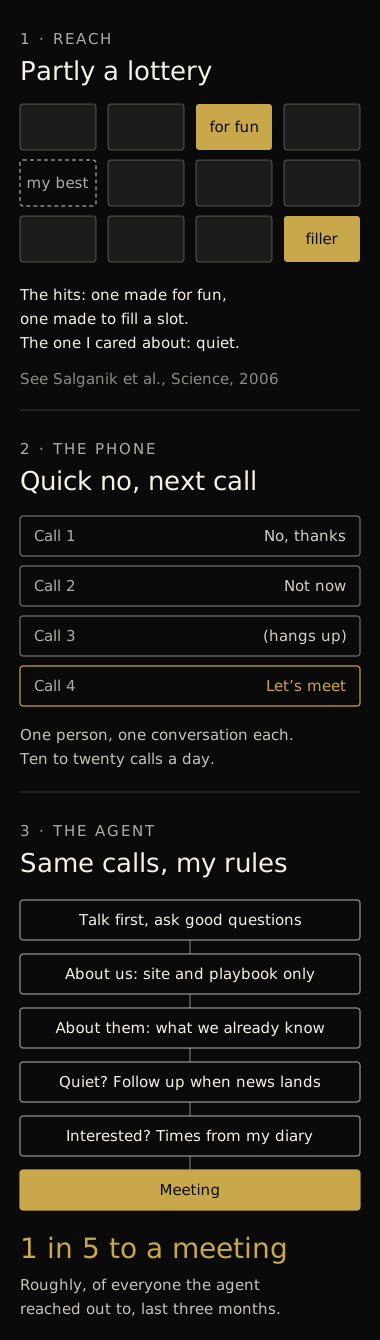
The pieces I thought were valuable, the ones with real thinking in them, didn’t land. The ones made for fun, or just to fill a slot in the schedule, became the hits.
That’s my own experience, not a study. But it isn’t only me. In a well-known experiment at Columbia, 14,341 people downloaded unknown songs, some of them able to see what others had picked. Quality mattered only partly: the best songs rarely did badly and the worst rarely did well, but anything in between could happen, and the more people could see each other’s choices, the less predictable success became (Salganik, Dodds and Watts, Science, 2006). A later study of Twitter by Microsoft Research found that even their best models could explain less than half of why some posts spread and others didn’t (Martin et al., 2016).
Reach is partly a lottery. You can buy more tickets. You can’t buy the draw.
And even when a post wins, the gap between views and real enquiries, in my experience, is huge. I can’t put a published number on that, so take it as one founder’s feeling. It’s the feeling that sent me back to something I learned fifteen years ago.
How I landed my first client
When I started my business in Hong Kong, I got my first web design client the plain way: I picked up the phone.
I wrote the cold-call script myself. I listened to every rejection, rewrote the script, and called again, until I had a version that could close. Ten to twenty calls a day. Hard? Yes. Rejection? Daily, and some of it in words I won’t put on this blog.
What that taught me:
- A quick no is the second-best answer. The worst answer is the one that wastes your time.
- A cold caller is not customer service. If it isn’t going anywhere, end the call politely and dial the next one.
- Every call is a real conversation with one person. They fit or they don’t, and you find out in minutes, not after a thousand impressions.
The problem with the phone was never the method. It was me: one person, a few hours a day, and here in the UK, calling in my second language.
So I asked myself: why not build an agent to do what I used to do?
The first version failed, and the failure was useful
The first agent went out and the rejection rate was almost funny. When I looked at what it was doing, the problem was obvious. It was using the same outreach playbook as everyone else, leading with a post about AI.
Why would a post about AI make anyone want a meeting about my service? And if it did, that meeting would probably be a waste of both our times.
What I changed
I stopped tuning the messages and wrote down my sales process instead, the way I’d run it myself:
- Talk first, pitch later. The agent chats and asks questions that get people thinking about their own business, and those questions keep the conversation on track to find out whether there’s real interest.
- No meeting is fine. If someone just enjoys the chat and never wants a meeting, nothing is lost. Nobody’s afternoon was wasted.
- Strict about my business. When the conversation turns to what V8 does, the agent can only say what’s on our website and in our internal playbook. Nothing invented.
- Informed about theirs. About the other person, it draws on what we already know from past conversations, plus what they’ve shared publicly.
- A reason to follow up. After a cooling-off period, relevant industry news coming in through our research can trigger a new follow-up. A reason to talk, not a “just checking in”.
If you’re wondering why you couldn’t do this with a general AI model and a lead data tool, this is the answer. Those tools will find people and write messages. They don’t come knowing what you’re allowed to say about your business, what this person told you three months ago, or when to stay quiet.
Why the agent books my meetings and a booking link doesn’t
When someone shows real interest, or asks for a meeting themselves, the agent checks my calendar and offers times for them to pick.
There’s nothing wrong with booking links. My calendar just doesn’t work like that. I drop things straight in: a networking event that came up, time off, a flight. And I have rules a booking link doesn’t know: no online meeting when I’m out unless I have time to prepare first. The agent follows those rules instead of just filling the next free slot.
On my own account, I let it do this automatically. That’s my choice: I trained it on my own rules, so I trust it with my own diary. For anyone else using Axia, the default is different. The agent prepares the conversation and the times, and you click send on the final message yourself.
What happened
Over the last three months, about 20% of the people the agent reached out to ended up in a meeting with me. That filled two to three meetings a day, and in one month brought in 20 pilot users for Axia.
A caveat: everyone wants more leads, so my business is an easy conversation to start. If you sell something else, I’d expect something nearer half that rate. That’s my estimate, not a measured number.
The real win wasn’t the rate. My pipeline finally stopped depending on me doing it by hand every day.
So, what’s the difference?
An agency sells reach. Reach is worth having, but it’s partly a lottery, and you can’t plan a quarter around the draw.
Axia works on the other end: the conversation, the follow-up, and getting to the meeting. Post if you enjoy it. Just don’t bet your pipeline on it.
That’s what you can expect from Axia, because before anyone else used her, I trained her on myself.
Try it on your own business first
Don’t take my word for it. Ask my agent to give your business an introduction: tell it who you’d like to meet, and the conversation carries on from there, the same way it does for me. Ask for an introduction.
Alan Law is founder of V8 Global and architect of Axia. Leadership Insight posts examine the structural decisions behind AI-native commercial systems.