Professional firms often make us a generous-sounding offer: “We pay referral fees, but only on successful engagements.”
For them, it’s a fair model. Accountants, solicitors and consultants have run on it for decades. For a matching service like ours, it doesn’t work, so we say no, politely, every time. Here’s why, and what you pay for instead.
The short answer
- We find the right person and ask them first. You hold the conversation and the deal.
- We take no share of anyone’s deals, and we don’t work on commission.
- Your first introduction is on us. After that, it’s £10 for each introduction you accept. That covers the work behind the introduction, including the computing power that searches our network, and it never depends on whether your deal closes.
Why can’t an introduction service work on commission?
1. We can’t see the deal
A commission needs someone to know the deal closed, when it closed and for how much. We don’t sit inside your business, so we’d have to chase every introduction months later, ask whether it turned into work, and then ask to be paid.
Even between honest people, “did that conversation lead to this project?” has more than one fair answer. A fee that hangs on the answer turns a good working relationship into an audit. We’d rather not build our business on that.
2. We control the match, not the sale
We find a relevant person and ask them first. That’s the part we control. What happens next is yours: how fast you reply, how you price, how strong your proposal is.
If our fee only existed when your deal closed, we’d be paid for work we didn’t do, and you’d be paying us for it.
3. We’re not an outsourced sales team
A success-only deal quietly asks the introducer to carry your cost of sales: learn your business, rehearse your objections, follow up, and take all the risk that nothing converts. If it converts, they get a percentage. If it doesn’t, they worked for free.
That’s a sales hire on commission only, not an introduction. We don’t pretend to be one.
Then why do you pay commission to partners?
We do, in one direction only. When a partner brings someone to use Axia, we pay them a share of what that customer spends with us.
That works because it’s our own sale. We can see it, so we can pay it fairly. It’s the same reason we can’t take a share of yours.
What does the charge actually pay for?
“Introduction” is the easy word for a bundle of work:
- setting up your ask: what you do, who you’d like to meet and how you’d like to be introduced;
- the search across our network, which is where the computing power goes;
- a person checking every match before anything moves;
- asking the other side first, without your name or details;
- recording both yeses, and checking back with you both afterwards.
You pay for that work when you accept the introduction it produced. The introduction is our output. Whether you win the business is the outcome, and that stays yours.
After the introduction: where Axia comes in
An introduction gets you to the first conversation. What happens next is still work: replies to keep moving, follow-ups to send on time, a meeting to fit into two diaries.
That’s what Axia is for, and it’s separate from the introduction charge:
- it keeps the conversation moving, and follows up when there’s a real reason to;
- it offers meeting times from your own diary, following your own rules about when you meet;
- it keeps one record of where every relationship stands, without anyone typing it in;
- you approve what matters, and by default you click send on the final message.
The meeting, the relationship and the close stay with you.
The junior salesperson test
Imagine hiring a junior to find the right people, open the conversations, handle the replies and book the meetings. You wouldn’t put them on commission only and expect them to learn your business in their own time. You’d pay for the work, because the work happens whether or not a deal closes.
The same logic applies to us. Our introductions cover the first part of that job: finding the right person and asking them first. Axia covers the rest: the follow-ups, the replies and the meeting times. Either way, you pay for the work done, never a share of the deal, and without a salary, training or management.
What you pay before your first right introduction
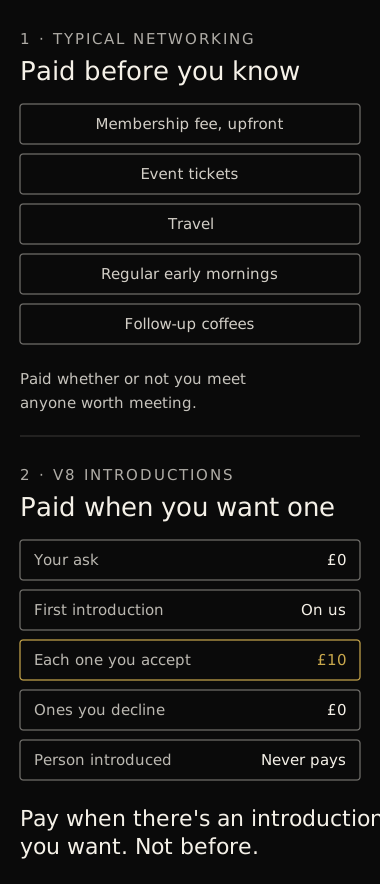
Most networking asks you to pay before anything useful happens. The membership is paid upfront. Then come the event tickets, the travel, the regular early mornings and the follow-up coffees. All of it is spent whether or not you ever meet someone worth meeting.
We work the other way round:
- telling us who you’d like to meet costs nothing;
- your first introduction is on us;
- after that, it’s £10 for each introduction you accept, and nothing for the ones you turn down;
- you see what they do and why we think it fits before you decide;
- the person you’re introduced to never pays.
Check the maths yourself
Don’t take our word for it. Work it out against what you spend now.
Your cost per useful conversation today: add up your membership fees, event tickets and travel, plus the hours you spend multiplied by your hourly cost. Divide by the number of conversations you had with someone you actually wanted to meet.
Your cost per useful conversation with us: add £10 for each introduction you accepted after the first, plus the hours you spent reviewing them multiplied by your hourly cost. Divide by the number of introductions you accepted.
An illustration, with made-up numbers you should replace with your own. Say you spend £600 a year on memberships and tickets, plus 40 hours at £75 an hour, and come away with six conversations you were glad to have. That’s (£600 + £3,000) ÷ 6 = £600 per useful conversation.
Six accepted introductions with us: the first is on us, the other five are £50 in total, plus 15 minutes reviewing each one (£112.50 of your time). That’s £162.50 ÷ 6, about £27 each. And an accepted introduction means both sides have already said yes, which is more than most event conversations can claim.
Include the hours. For most professionals, the time costs more than the ticket.
What this means in practice
- We introduce. You hold the conversation and the commercial terms.
- We never ask what you earned from an introduction, and we take no share of it.
- The person you’re introduced to never pays.
- If your model is “pay only when it closes”, we’re probably not the right fit, and that’s fine. If someone worth your time comes up in our own networking, we may still mention you, with nothing attached.
Next step
Tell us who you’d like to meet: Find me introductions. Your first introduction is on us.
Alan Law is the founder of V8 Global and builds Axia, the system behind V8 Nexus introductions.