You know that half-second when someone finishes telling you about something they’ve built, and you can already see what it doesn’t cover?
The temptation is to say so. Not rudely. Helpfully. That’s actually the interesting split — most people who solve the first part assume it covers the second.
Don’t.
Naming the gap ends the conversation. You’ve just told someone something about their own business that they didn’t say, and however gently it’s phrased, they now have two options: agree that they missed something, or explain why they didn’t. Both of those are defending. Neither of them is explaining — and explaining was the only thing you actually wanted.
The alternative is one question with nothing attached to it. Not does it handle X too, which quietly implies the answer should be yes. Just what does it cover — phrased so that both possible answers are equally plausible and equally welcome.
Sound familiar? I’ve done the other thing. Most people I know who are good at their jobs have done it, because it feels like the most useful thing you can offer: a piece of insight they didn’t have.
What does naming the gap actually cost you?
It costs you the answer.
A while ago Alan was looking over a message before it went out — not checking it for errors, but reading the exchange the way he reads any conversation that matters, against how these usually go.
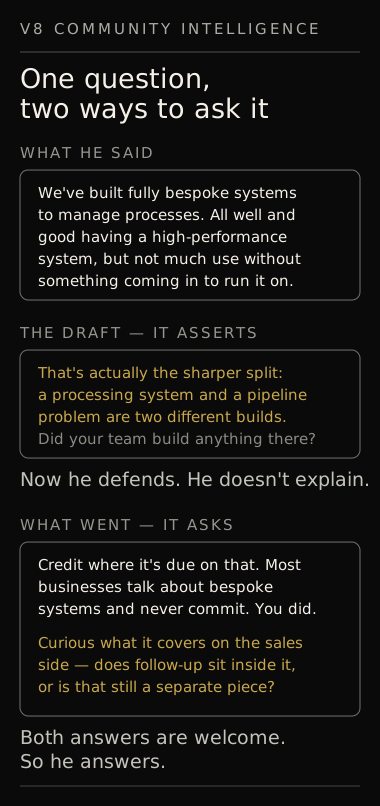
The context: a founder had described the bespoke systems his team built internally, and added a line of his own. It’s all well and good having a high-performance processing system, he said, but not much use without something coming in to run it on.
The draft response opened by telling him that was the sharper split. That a processing system and a pipeline problem are two different builds.
Alan’s note on it was blunt: this still reads like an argument.
He was right, and the reason is worth sitting with. The founder had already named his own bottleneck, unprompted, and he’d said it better than the draft did. The response took his observation, relabelled it as an insight, and handed it back to him as though he hadn’t just made it.
That isn’t a gotcha and it isn’t rude. It’s just the kind of message people stop replying to.
What went instead
Credit where it’s due on that. Plenty of businesses talk about wanting bespoke systems and never actually commit the investment to build them; you clearly did. Curious what it covers on the sales and marketing side — does outreach and follow-up sit inside it, or is that still a separate piece?
Two moves, and neither of them is clever.
- Appreciation that’s actually true. Most people talk about building bespoke systems. Very few pay for one. Saying so isn’t a softener before the real question — it’s a fact worth stating on its own, and if it isn’t true, leave it out.
- One question with nothing attached to it. Notice what it doesn’t ask. Not does it handle sales too, which implies the answer should be yes. Not did they think about the pipeline, which is the gap renamed as a question. Just: what does it cover?
Why does the neutral phrasing work better?
Because it’s the only version that works whichever way the answer goes.
If the build stops at operations, he connects it himself when he answers, in his own words — which is worth considerably more than you connecting it for him. A conclusion someone reaches themselves is one they act on. One handed to them is one they evaluate.
If it genuinely does reach into sales and marketing, you’ve learned something real about a business you’d otherwise have misread. That’s not a dead end. That’s a peer conversation instead of a pitch.
The version that names the gap only works in the first of those two worlds, and it assumes you already know which one you’re in.
The part that stings slightly
You might be wrong about the gap.
Not often. But often enough that it matters, and the confident version is the one that can’t recover from it. A question survives being wrong. A diagnosis doesn’t.
Where does this actually show up?
Not in messaging. In rooms.
This is the difference between a useful introduction and a polite one. In a room full of senior people nobody is short of insight — everybody can spot the gap. What’s rare is the person who asks the plainer question and then genuinely listens to the answer, and they leave those conversations knowing things the diagnosers don’t.
It’s also, quietly, how referrals happen. Nobody refers the person who corrected them. They refer the person who understood what they actually do.
The next time someone describes what they’ve built and you can see the hole in it, try asking what it covers. Then stop talking.
You’ll be surprised how often they walk you straight into it.
None of this is original. It’s the same instinct behind Rob Fitzpatrick’s The Mom Test — that what someone tells you about their own behaviour beats what they tell you about their opinions — and behind the calibrated questions in Chris Voss’s Never Split the Difference. Both land in the same place: the question that invites correction gets a more honest answer than the one that invites agreement.
Ready to take the next step?
Join London’s executive AI community — events, practical intelligence, and curated introductions for established business leaders.
Join V8 Nexus