First, a claim I had to retire
Until last week, V8’s internal competitor notes carried a line stating that every vendor in our category prices contacts, sends or seats, and that none of them prices an outcome.
It was load-bearing. Three separate internal documents rested on it, including the comparison we use in sales conversations.
It had been false since 14 April.
On that date HubSpot moved two Breeze agents to outcome-based billing. Customer Agent went from $1.00 per conversation to $0.50 per resolved conversation. Prospecting Agent went from a recurring monthly charge per enrolled contact to $1.00 per lead recommended for outreach.
Four months, and the claim sat in our own files describing a market that had already changed. I’d rather publish that than quietly delete it.
The correction turned out to be more useful than the claim. Once you stop asking does anyone price by outcome and start asking what kind of outcome, and when do they charge for it, two distinctions appear that the original line was too blunt to see.
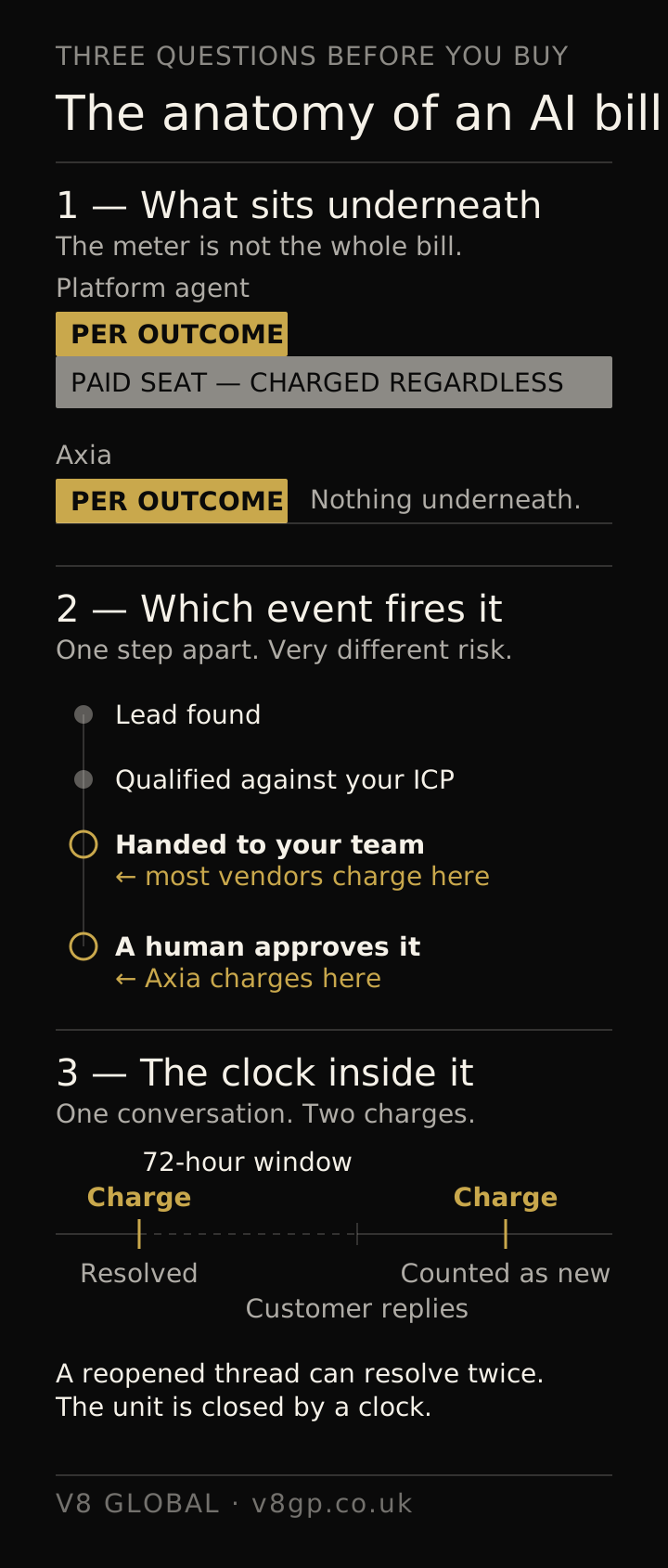
What sits underneath the meter
Both repriced agents require a paid seat before the meter starts. Prospecting Agent needs a Sales Hub subscription at Professional or above; both agents are available to Pro and Enterprise customers only.
So the per-outcome price is real, and it sits on a subscription that is charged whether or not any outcome occurs.
That isn’t a criticism of the pricing so much as a description of it. A platform sells you a platform. The agent is a meter bolted to something you were already paying for, and the meter is the part that got cheaper.
The question worth asking any vendor is therefore not do you charge by outcome. It’s what do I pay in a month where the outcome never happens.
If the answer is a number greater than zero, outcome pricing is describing part of the bill rather than the bill.
Which event fires the charge
This is the sharper of the two, and it’s where the word “outcome” does the most work while meaning the least.
HubSpot’s Prospecting Agent bills when a lead is recommended for outreach and handed to your team. That is a real event and it is genuinely measurable. It is also an event entirely within the vendor’s control.
A handover is the machine finishing its work. It says nothing about whether the work was any good.
The alternative is to bill on acceptance: the charge fires when a human looks at the output and approves it. Same action, one step later, and the difference is who absorbs the cost of poor work. Bill on handover and a bad lead is billable. Bill on approval and a bad lead is free, because nobody approved it.
That is the trigger Axia is built on, and I’d argue it’s the only version of outcome pricing that puts the vendor’s revenue at risk when quality slips. It’s also uncomfortable to run, which is presumably why it’s rare.
The clock inside the outcome
Here’s the detail that turned this from a positioning note into a post.
HubSpot defines a Customer Agent conversation as resolved when the agent shares a content source or performs an action, and there is no handoff to a human agent within 72 hours of the last message. Resolution status is evaluated and set 72 hours after the last visitor response.
So the unit being billed is closed by a timer rather than by the customer’s problem being over.
That has a consequence. In HubSpot’s own documentation: if a customer replies after more than 72 hours in an email thread, the conversation is treated as reopened and the 72-hour window resets, which “can result in multiple resolutions (and credit usage) if separate issues are resolved over time.”
A reply on its own doesn’t bill — multiple messages inside one open conversation don’t consume extra credits. But a customer who goes quiet for four days and comes back to the same thread has reopened it, and if the agent resolves it a second time, that is a second charge on what the customer experienced as one conversation.
This is defensible from an engineering standpoint. You need a boundary somewhere or a conversation never closes. But it’s worth being clear about what the boundary is: the thing being counted is defined by a clock, and the clock runs whether or not anything was resolved.
Once billing has a timer in it, “you pay when it works” needs reading alongside “and here is how often it can decide it worked.”
The same question, one tier down
There’s a version of this argument at the cheap end of the market that gets asked more often, usually as why not just use the twenty-quid tool.
Fair question, and it has the same answer.
The inexpensive tools are genuinely inexpensive because what they produce is cheap to produce. They generate a draft and stop. The draft goes into a library, and then a person reads it, decides whether it’s right, edits it, sends it, and remembers to follow up.
None of that was ever the expensive part in the sense that a licence is expensive. It’s expensive in the sense that it consumes the only afternoon you had.
So the axis isn’t cheap versus expensive. It’s draft versus decision. A tool that produces drafts has relocated the work rather than removed it, and the relocation is invisible on the invoice, which is exactly why it looks like such good value.
What to actually ask a vendor
Three questions, in order. They work on us as well as on anyone else.
- What do I pay in a month where nothing happens? This separates a meter from a subscription with a meter attached.
- Which event fires the charge — your system finishing, or a human accepting? This separates billing for output from billing for work someone wanted.
- Can the same piece of work be charged more than once? Time windows, re-openings, retries. If yes, ask what stops it.
HubSpot moving on this is a good thing for the market and I’d rather compete against it than against per-seat billing. The pressure it creates is real, and it should be applied to everyone, us included.
The details of how Axia’s actions are priced, and what each one includes, are on the pricing page rather than here. Prices move; arguments shouldn’t have to.