There is a contact in your CRM you met eighteen months ago. Good conversation. Clear fit. You said you would follow up properly once the quarter settled.
You didn’t. And if I showed you the name right now you would recognise it instantly, which means you never actually forgot them. You ran out of room.
That distinction matters more than it sounds, because one of those is a discipline problem and the other is a capacity problem, and they have completely different solutions.
The arithmetic nobody says out loud
Most people can hold twenty or thirty relationships actively in their head. Not remember they exist — actively hold. Know where the last conversation ended, what they were worried about, what would make now a sensible moment to get back in touch.
A working professional network is several hundred people.
So the gap is not a few contacts falling through. It is most of them, most of the time, structurally, forever. The relationships that stay warm are the ones that happen to surface — someone replies, someone posts something, someone is in town. Everything else goes quiet, and quiet is indistinguishable from over.
The uncomfortable part is where the revenue actually comes from. Not the strangers, and not the ten people you speak to weekly. It comes from that middle layer — real relationships, too many to hold in your head, too quiet to remind you they are there.
So why hasn’t software fixed this?
It has certainly tried. There is no shortage of tools promising to keep your pipeline warm.
Look at what they charge for.
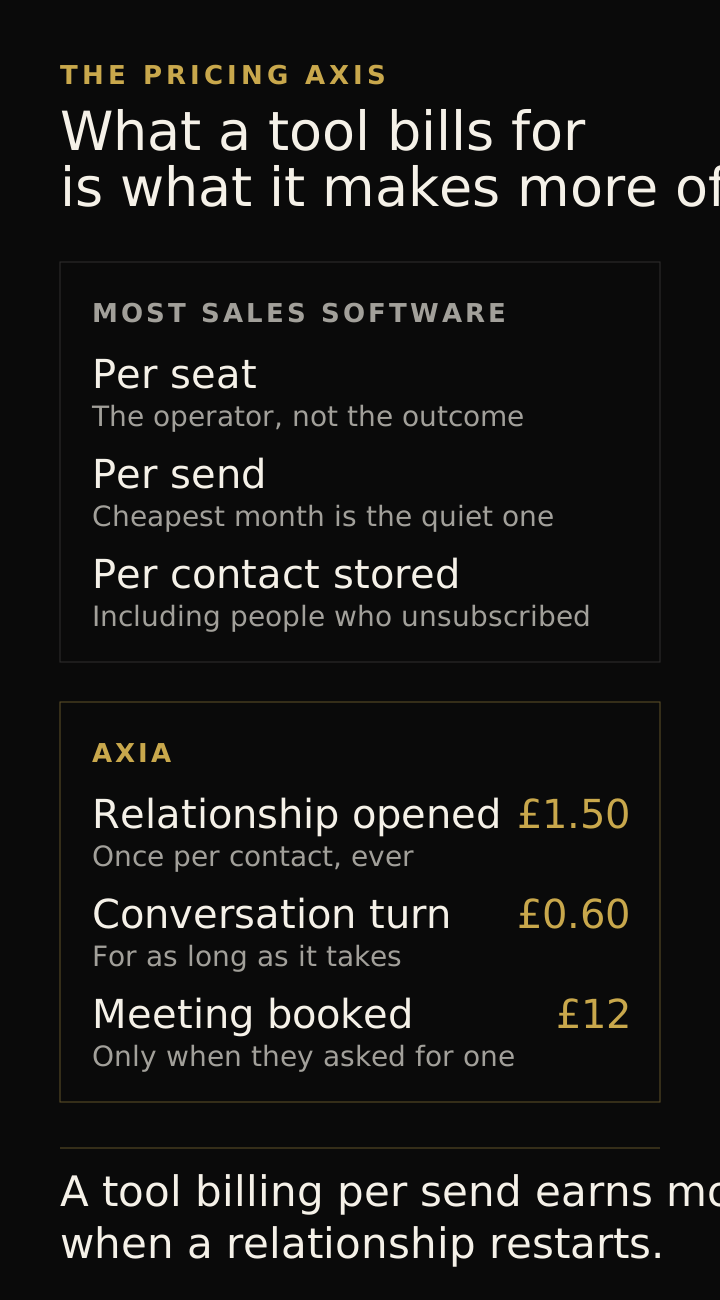
- Per seat. You pay for the person operating the tool, whether or not any relationship moves.
- Per send. You pay each time a message goes out, so the cheapest month is the one where nothing happens and the most expensive is the one where you blast everyone.
- Per contact stored. You pay to hold names in a database — including, on most platforms, the ones who unsubscribed and the ones nobody has spoken to since 2023.
Not one of those prices the thing you actually want, which is a relationship being alive.
And it is worse than merely neutral. A tool that bills per send has a commercial interest in you sending more. A platform that bills per contact stored has an interest in your list growing rather than your list being worked. Pricing is not decoration on top of a product — it is the strongest statement a company makes about what it wants you to do more of.
Which is why every one of these tools eventually produces the same behaviour: sequences, cadences, volume. Not because the people who built them are cynical, but because that is what the meter rewards.
We priced it the other way round
When we built the commercial model for Axia, we started from the failure rather than the feature list. The failure is a relationship going quiet and nobody noticing. So the meter had to be attached to relationships, not to messages.
Three prices, and each one maps to a moment that actually happens:
Opening a relationship. Finding the person, researching them, writing them into the record, making the first approach. This bills once per contact, ever.
A conversation turn. One message in a relationship that already exists, on whatever surface that relationship lives on.
A meeting booked and confirmed. Agreed in the thread, written to the calendar, confirmation sent.
Once at entry, repeatedly through the middle, once at conversion. That is the shape of an actual relationship, and now it is the shape of the invoice.
The current prices are on the pricing page, with a calculator.
The part that matters is what we cannot do
Read that first price again: once per contact, ever.
If a relationship goes quiet for two years and then comes back, that is conversation. Not a new relationship. There is no restart fee, because there is no restart.
Which means Axia has no commercial route to profiting from you losing touch with someone. A tool billing per send earns more when a relationship is restarted, so nothing in its economics objects to letting one lapse. Ours objects structurally. Not as a policy we might revise, not as a promise about our intentions — as arithmetic.
The same logic runs through the rest of it. Nothing in the model pays for volume, so nothing pushes for volume. Axia does not propose a meeting until the person has asked for one, said they want to buy, or raised a genuine partnership. Restraint is not a setting we turned on. It is what happens when nothing pays for the alternative.
And nothing bills until you have approved it. Axia proposes, shows you exactly what it would do, and waits. Your approval is the billing event. If it gets something wrong and you fix it before confirming, you pay once for the corrected action and nothing for the misunderstanding.
What this is not
This is not appointment setting. If what you want is a volume of meetings dialled up per month, that is a real service and we are not it. The meetings Axia books are ones the other person asked for.
It is also not a tool you learn. There is no dashboard, no daily driving. The point is not a better interface for doing the work yourself.
Where this is going
The full price list is public, with a calculator that will tell you when a smaller plan is the right one. We would rather you arrived at a conversation already knowing what this costs than spend the first ten minutes of a call finding out.
Axia’s first clients are not self-serve. We configure it around your business by hand — your inbox, your contacts, your voice, your pipeline rules — and it is free while we do that. Billing starts when the system is doing work you would pay for.
If the contact you thought about in the first paragraph is still sitting there, that is the problem this was built for.
Ready to take the next step?
Most AI is sold as a tool. Axia is built as the operating layer your business actually runs on.
See how Axia is priced