Every week someone sends me a video of a one-person business run by an AI team. A manager bot at the top, a supervisor for each business line, and a row of bots underneath that each do one job: orders, quotes, customer service, copy, publishing. The owner clears the queue before work and again in the evening. Then comes the question: if I can build this, why would I need Axia?
My first question back is always the same. Is your business orchestrating bots, or closing business?
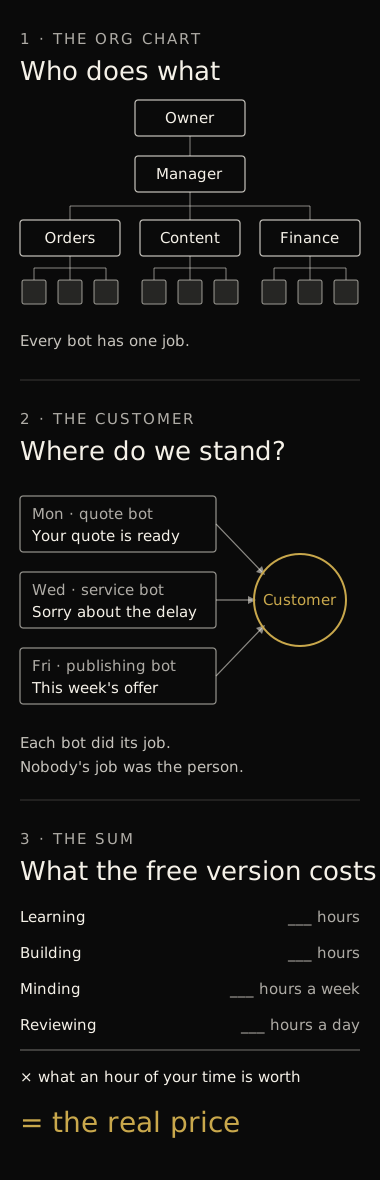
The cost nobody puts in the video
The bots are cheap. You are not. Before you build, write down four numbers:
- Learning: hours to learn the tools, and to relearn them every time one changes.
- Building: hours to set up each bot and connect it to the others.
- Minding: hours a week fixing what broke overnight.
- Reviewing: hours a day working through the queue.
Add them up and multiply by what an hour of your time is worth. Not your hourly rate on paper: the hour you would otherwise spend with a client, or closing one. That total is the real price of the free version.
For some businesses it’s worth paying. Most owners have never written it down.
If you build your own AI team, here’s what the good setups already do
The better DIY setups have learned the same lessons we did, and they deserve credit for it:
- Plan before work. Each job starts with a goal, what not to do, and who signs off.
- Nothing starts until the owner approves it.
- Nothing goes to an outside person without a draft and a yes.
- One bot, one job. Narrow scope means fewer mistakes.
The third rule is the one Axia is built around: human approval at every commercial decision. So approval is not the difference between building and buying. The difference is what the approval is attached to.
What the org chart leaves out
An org chart answers who does what. A business runs on a different question: where do we stand with this person?
Take one customer. On Monday they ask for a quote. On Wednesday they complain to customer service about a late order. On Friday the publishing bot sends them this week’s promotion. Every bot did its job well. Nobody looked at the whole person, because nobody’s job was the person.
Three questions expose that gap in any setup, built or bought:
- Where does a customer’s story live? A log of every task completed is not a record of the relationship. You need one place that says what stage this person is at, what they last said, and what they’re waiting for. Without it, the quote follow-up lands the day after the complaint.
- When someone says stop, which bots find out? A “please don’t email me” given to customer service has to reach the bot that sends newsletters. In the UK that’s not only good manners: under the ICO’s guidance, people must be able to withdraw consent easily, and once they do, you must stop sending them marketing by email (ICO guidance).
- What are you approving: a task or a decision? A queue of drafts from a dozen bots asks you to rebuild the context for each one before you can say yes. A draft written against where that relationship already stands asks you one thing: send it or not. The first kind of queue grows with every bot you add. The second grows with your customers, which is the growth you wanted.
If you have staff, ask who owns it
A bot army usually lives in one person’s head: the person who built it. That works until they’re on holiday, change roles or leave. Then nobody else knows why the quoting bot waits two days, or which rule stops it emailing a client who complained. A business that depends on one person to keep its customer machinery running has the same problem it had before the bots, just moved somewhere harder to see.
When building your own is the right call
For a side business, or a one-person business with few outside contacts, a DIY setup can be exactly right. The best advice in these videos is to start with the single most repetitive job and give it to one bot. That’s sound, and it costs very little to find out what you actually need.
It stops being the right call when the sum above gets large, when customers expect you to remember them, or when more than one person or bot talks to the same contact. If the build is going well and the minding is eating your weekends, we’ve written about that too: You Bought the Course and The Operator Gap.
What Axia does differently
Same approval gate, different unit of work. On the Axia page we put it in one line: every other tool automates a task; Axia manages a relationship portfolio. In practice:
- Relationships hold state: stage, last signal, what was said.
- Content is matched to where the relationship actually is, not produced on a separate track.
- A stop is a stop everywhere. When someone asks you to stop, it’s recorded once on the relationship and honoured on every channel.
- It re-engages when a signal appears, and runs on a schedule, not on your attention.
- V8 runs it. You approve, edit or override. You don’t learn it, build it or mind it.
Two tests before you decide
Do the sum from the second section. Then pick one customer and ask your setup to tell you everything that happened with them last month, and what goes out to them next.
If the sum is small and the answer is clear, build it yourself, and I’d rather you knew that. If not, see how Axia handles it.
Alan Law is founder of V8 Global and architect of Axia. Leadership Insight posts examine the structural decisions behind AI-native commercial systems.